


.jpg)
1816
Family moves to Indiana
The Lincoln family moved to a forested plot in Little Pigeon Creek Community, Indiana, due to land title issues in Kentucky.
Why it matters: This move shaped Lincoln's frontier upbringing and self-education.
Wikipedia ↗Political Leader · 1809–1865 AD
The Great Emancipator and Preserver of the Union
The defining question
How can a nation founded on the principle that all men are created equal reconcile that ideal with the reality of slavery and division?
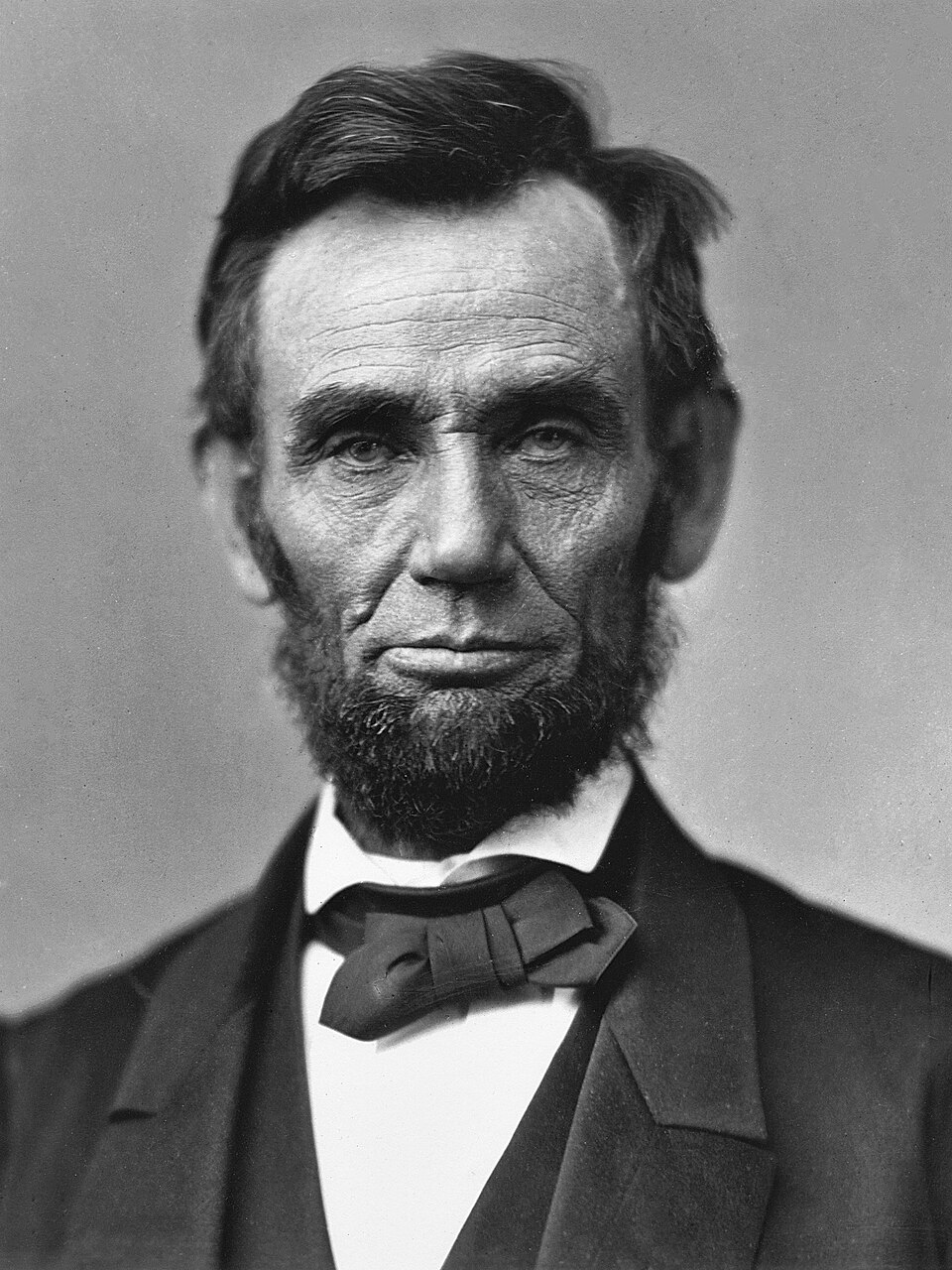
The person
Abraham Lincoln, the 16th President of the United States, guided the nation through the Civil War and issued the Emancipation Proclamation. Born in a log cabin in Kentucky, he rose from humble beginnings to become a self-taught lawyer and politician, known for his eloquence and moral clarity.
Lincoln's leadership preserved the Union and ended slavery, reshaping American ideals of freedom and democracy. His speeches and writings continue to inspire debates on equality, governance, and the meaning of liberty.
Life in motion
Drag to travel through time · Ctrl/⌘ + scroll or pinch to zoom · Select a moment for the full account
The Lincoln family moved to a forested plot in Little Pigeon Creek Community, Indiana, due to land title issues in Kentucky.
Why it matters: This move shaped Lincoln's frontier upbringing and self-education.
Wikipedia ↗Operating system
Lincoln consistently framed slavery as a moral wrong, arguing that the Declaration of Independence's principle of equality must be upheld. He opposed slavery's extension as a matter of principle, not just policy.
Evidence: In his speech on the Kansas-Nebraska Act, he states, 'Slavery is founded in the selfishness of man's nature--opposition to it in his love of justice. These principles are at eternal antagonism.'
While morally opposed to slavery, Lincoln prioritized preserving the Union and used compromise to that end. He distinguished between compromise among friends of the Union and concession to its enemies.
Evidence: In his Annual Message to Congress (1862), he proposed compensated emancipation and colonization as a means to save the Union, stating, 'By mutual concession we should harmonize and act together. This would be compromise, but it would be compromise among the friends and not with the enemies of the Union.'
Lincoln recognized the constancy of human nature and its implications for governance, arguing that the same passions and virtues recur in every generation and that wisdom must be drawn from historical incidents.
Evidence: In his 1864 election speech, he said, 'Human nature will not change. In any future great national trial, compared with the men of this, we shall have as weak and as strong, as silly and as wise, as bad and as good. Let us therefore study the incidents in this as philosophy to learn wisdom from and none of them as wrongs to be avenged.'
Lincoln favored practical, incremental approaches to ending slavery, such as compensated emancipation and colonization, believing sudden change could cause upheaval but still advancing freedom.
Evidence: In the 1862 Annual Message, he argued for a gradual, compensated plan, saying 'The time spares both races from the evils of sudden derangement--in fact, from the necessity of any derangement--while most of those whose habitual course of thought will be disturbed by the measure will have passed away before its consummation.'
Lincoln's leadership during the Civil War demonstrates the need for resilience, careful communication, and the ability to make decisions under immense pressure, balancing firmness with flexibility.
Evidence: His terse telegram to Grant, 'Let the thing be pressed,' shows his decisive support for military action to end the war, while his April 11, 1865 address on Reconstruction reveals his cautious, pragmatic approach to reintegrating the South.
Lincoln viewed the Civil War as a test of whether a democratic nation could endure, and he saw slavery as the central issue threatening that endurance. He believed the Union's survival was essential to proving self-government possible.
Evidence: In his 1862 Annual Message, he warned, 'We shall nobly save or meanly lose the last, best hope of earth.'
Lincoln was a master of rhetoric, using clear reasoning and memorable language to persuade diverse audiences, from frontiersmen to Congress, without compromising his core principles.
Evidence: His Springfield speech on the Kansas-Nebraska Act (1854) illustrates his ability to dismantle opponents' arguments with logic and appeal to shared values, and his address to Kentucky Unionists in 1864 combines humor and gravity to maintain support.
Read through your work
Leaders
Lincoln as a leader exemplifies the demanding role of a steward in turbulent times. He balanced emotional resilience, strategic vision, and an almost superhuman ability to manage diverse stakeholders. His leadership style was adaptive: he took charge but also listened, and he remained firmly focused on the union's survival. His wisdom in 'thinking anew' and his capacity to inspire collective sacrifice are timeless leadership lessons.
In his words
“The dogmas of the quiet past are inadequate to the stormy present. The occasion is piled high with difficulty, and we must rise with the occasion. As our case is new, so we must think anew and act anew. We must disenthrall ourselves, and then we shall save our country.”
“Let us therefore study the incidents in this as philosophy to learn wisdom from and none of them as wrongs to be avenged.”
“We shall nobly save or meanly lose the last, best hope of earth.”
“In giving freedom to the slave we assure freedom to the free--honorable alike in what we give and what we preserve.”
“Stand with anybody that stands right. Stand with him while he is right, and part with him when he goes wrong. Stand with the abolitionist in restoring the Missouri Compromise, and stand against him when he attempts to repeal the Fugitive Slave law.”
“I have not willingly planted a thorn in any man's bosom.”
“I am going to try to attract them to the hidden wealth of our mountain ranges, where there is room enough for all.”
Put into practice
Lincoln rooted his political actions in a clear moral understanding of slavery as wrong, yet he combined this with practical political strategy.
Lincoln accepted compromise to preserve the Union, but never conceded the principle that slavery was wrong.
Lincoln's rhetoric was direct, reasoned, and often empathetic, enabling him to reach diverse audiences.
Lincoln called for innovative thinking in unprecedented times, rather than relying on outdated dogmas.
Lincoln was firm in his goal of preserving the Union, but flexible in the means to achieve it, adjusting plans as circumstances changed.
Lincoln used storytelling and humor to defuse tension and make points, easing contentious discussions.
Read with judgment
Lincoln's greatness lay in his ability to fuse moral clarity with political pragmatism. He never wavered in his conviction that slavery was morally wrong, yet he pursued emancipation through gradual, compensated measures to preserve the Union. His speeches, like the 1862 Annual Message, show a leader who could articulate the nation's highest ideals while navigating the brutal realities of civil war. This combination of principled vision and tactical flexibility allowed him to steer the country through its greatest crisis, earning him a place as the symbolic embodiment of American democracy.
The central contradiction was his simultaneous commitment to the Declaration's equality and his tolerance of slavery where it existed, to save the Union. He held that slavery was morally indefensible, but he initially prioritized Union over abolition, issuing the Emancipation Proclamation only as a war measure. This tension is evident in his 1862 proposal for compensated emancipation, which sought to end slavery without alienating border states. Lincoln's pragmatic gradualism was both his strength and the source of criticism from abolitionists who demanded immediate action.
Lincoln's shadow side included his suspension of habeas corpus and other civil liberties during the war, which contradicted democratic ideals. His support for colonization, though voluntary, revealed a belief in racial separation rather than full integration. Moreover, his gradual approach to emancipation left many enslaved people in bondage for years, and his Reconstruction plans were cut short, leaving the South to impose Jim Crow. These actions reflect the constraints of his era and the limits of his vision, reminding us that even great leaders have problematic legacies.
Lincoln's relevance today lies in his model of leadership in crisis: balancing moral conviction with practical compromise, communicating complex ideas with clarity, and maintaining resilience in the face of unprecedented challenges. His call to 'think anew and act anew' resonates with modern leaders facing rapid change. His belief that democracy must prove its endurance offers a timeless lesson for political systems under strain. Moreover, his willingness to learn from history without seeking vengeance provides a framework for addressing contemporary divisions.
To learn from Lincoln, one must study his writings, especially the speeches and letters in the provided collections, and note how he adapted his language to different audiences while preserving core principles. Practical steps include practicing rhetorical clarity, engaging in active listening, and adopting a pragmatic mindset that distinguishes between ends and means. Emulate his habit of reading and reflecting on history to inform present decisions, and his humility in admitting uncertainty, as when he said, 'I shall strive to avoid placing any obstacle in the way' of reunification.
The best entry point is his Annual Message to Congress on December 1, 1862, found in The Papers and Writings of Abraham Lincoln. This message encapsulates his moral stance, his proposal for compensated emancipation, and his eloquent appeal for the Union. It contains the famous lines about the 'last best hope of earth' and the need to 'think anew and act anew.' Reading this address in full provides a concentrated view of his thought, rhetorical power, and the pressures of wartime leadership.
The human network
Political Rival
Lincoln debated Douglas in the famous 1858 Senate campaign and the 1860 presidential election. Their debates crystallized the national conflict over slavery.
Military Commander
Lincoln appointed Grant as commander of Union armies in 1864. Grant's aggressive strategy led to the end of the war.
Secretary of State
Seward served as Lincoln's chief diplomatic advisor and was a close adviser. Seward's counsel and support were vital to the administration.
Political Supporter and Biographer
Schurz was a German-American politician who wrote an influential essay on Lincoln. Provided an early, balanced portrait of Lincoln's character.
Continue the inquiry
Both were revered as founding figures of the American republic, with Lincoln seeking to emulate Washington's leadership.
Leadership · National Unity
Lincoln often cited the Declaration of Independence, authored by Jefferson, as the moral foundation for equality.
Equality · Democracy
Lincoln idolized Clay as 'my beau ideal of a statesman' and admired his compromises to preserve the Union.
Compromise · Union
Another great Whig orator and advocate of Union, whom Lincoln respected.
Oratory · Nationalism
Calhoun's pro-slavery and states' rights ideology stood in opposition to Lincoln's views, making him a useful counterpoint.
Slavery · Secession
Source shelf
link
Abraham Lincoln
View source →link
Abraham Lincoln
View source →reference
Wikipedia contributors
View source →reference
Wikidata contributors
View source →Source basis: This analysis draws primarily on two primary source collections: 'Speeches and Letters of Abraham Lincoln' (source 81) and 'The Papers and Writings of Abraham Lincoln' (source 82), which include his major speeches, letters, and state papers. Contextual sources (Wikipedia and Wikidata) provide biographical and historical background. The quotes and themes are derived from these sources, particularly the 1854 Peoria speech, the 1862 Annual Message, and his post-election remarks in 1864, which are cited throughout.
Direct answers
Lincoln's core moral principle was the inherent wrongness of slavery, rooted in the Declaration of Independence's assertion that all men are created equal. He articulated this in his 1854 Peoria speech, arguing that slavery contradicted the nation's founding ideal. However, he balanced this with a commitment to the Union, believing that democracy's survival required preserving the nation even if it meant compromising on immediate abolition.
Lincoln's timing was strategic. He initially sought to preserve the Union and feared that immediate emancipation would alienate border states and split public opinion. By issuing the proclamation as a war measure after the Union victory at Antietam, he framed it as a military necessity, which was more acceptable to conservative factions. This reflects his pragmatic approach to achieving moral goals within political constraints.
Lincoln distinguished between compromise among friends of the Union and concession to enemies. He was willing to propose compensated emancipation and other gradual measures, but he never conceded that slavery was morally right. He believed in flexible methods within fixed principles, as seen in his 1862 Annual Message where he advocated for a constitutional amendment to abolish slavery gradually, while maintaining that slavery was a moral evil.
Modern leaders can learn from Lincoln's resilience, communication, and ability to adapt. He maintained a clear focus on the ultimate goal of preserving the Union while adjusting tactics as circumstances changed, such as his evolving Reconstruction plans. His call to 'think anew and act anew' highlights the need for innovation in crisis. He also emphasized learning from history 'as philosophy,' not for vengeance, which is crucial for post-crisis reconciliation.
No, there were gaps between his ideals and actions. He suspended habeas corpus and censored press in some cases, which contradicted civil liberties. His support for colonization indicated a lack of full commitment to integration. These actions reflect the practical pressures of war and the racial attitudes of his time. Recognizing these contradictions provides a nuanced view of his leadership, reminding us that leaders operate within historical constraints.
Lincoln was a master of rhetoric, using simple, direct language and logical reasoning to persuade varied audiences. His speeches, such as the Peoria speech and the Gettysburg Address, are celebrated for their clarity and emotional resonance. He tailored his message to each audience, using humor and anecdotes to connect with common people, and appeals to shared values to unite a divided nation.
The phrase appears in his 1862 Annual Message, where Lincoln framed the Civil War as a test of whether democracy could endure. He argued that the Union's survival was essential not only for America but for the world, as it would prove that popular government could withstand internal conflict. This elevated the war to a global struggle for democratic ideals.