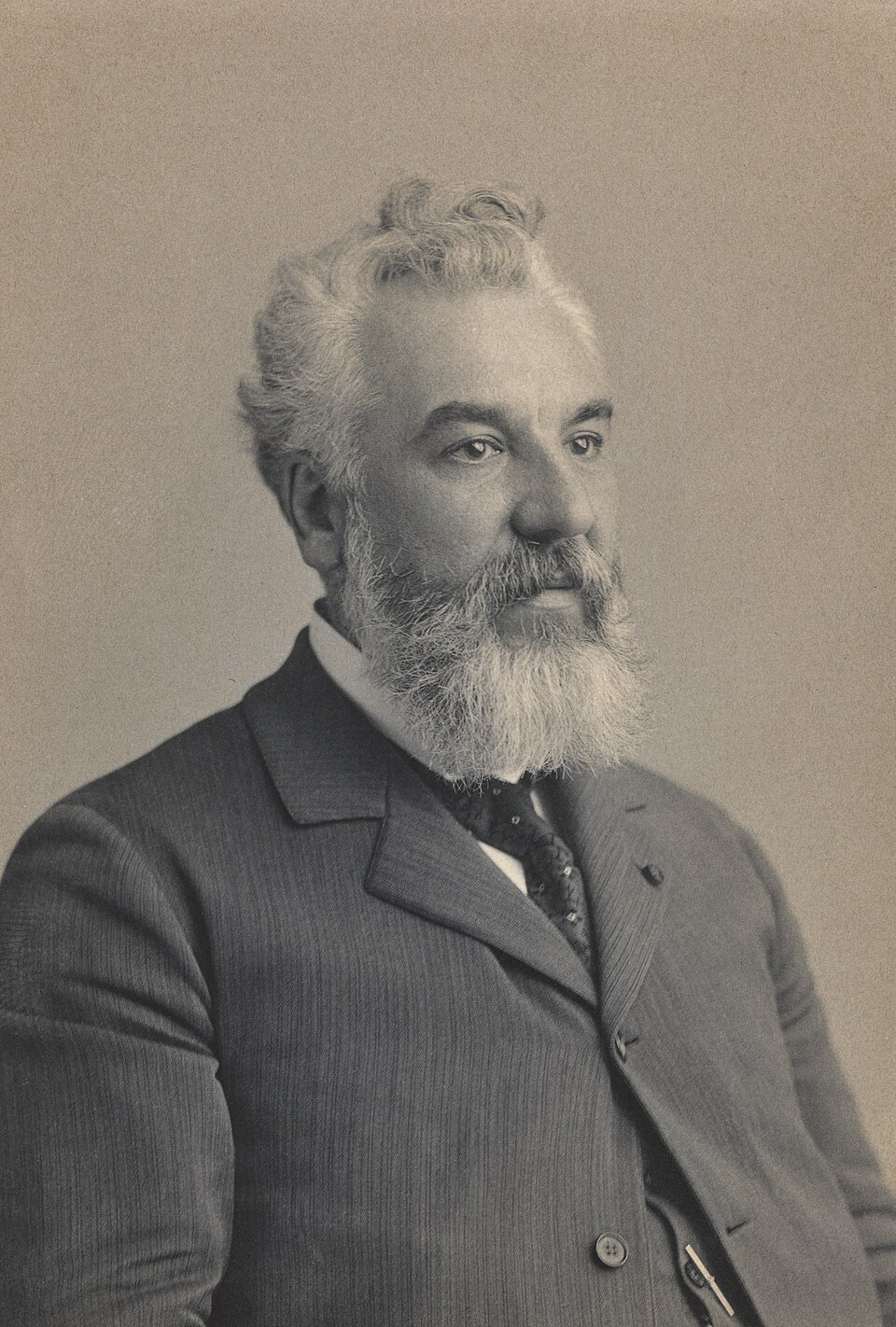
Alexander Graham Bell, best known for inventing the telephone, also played a crucial but often overlooked role in the development of the phonograph. At his Volta Laboratory in Washington, D.C., he and associates Charles Sumner Tainter and Chichester Bell improved upon Edison's tinfoil machine, pioneering wax recording and engraving techniques that made sound reproduction practical for business use. Bell provided funding and suggested the basic lines of research, while his associates patented and refined the inventions, leading to the formation of the Volta Graphophone Company and the American Graphophone Company, which laid the foundation for the modern dictating machine industry.
Why he matters
Bell's work at the Volta Laboratory transformed the phonograph from a fragile, impractical curiosity into a viable commercial product. His collaborative approach and willingness to credit his associates challenged the lone-inventor myth, and his innovations in wax recording and engraving directly influenced the evolution of sound recording technology, with lasting impact on business and home entertainment.
Life in motion
Timeline
24 sourced moments across the life of Alexander Graham Bell
Drag to travel through time · Ctrl/⌘ + scroll or pinch to zoom · Select a moment for the full account
1881
Developed a metal detector for President Garfield
After the shooting of President Garfield, Bell hurriedly developed an induction-balance metal detector to locate the bullet, but it was unsuccessful due to interference from the bed's metal springs.
Why it matters: Early contribution to medical technology.
Publish corrected contextual financial story only; no numeric wealth curve. Household holdings, salary and donated proceeds do not determine personal fortune. Some dots represent partial capital or property, not total net worth. Estimated lines are presentation models. Unknown periods are not zero.
The sources support the events below, but not a dated dollar chart. Missing amounts have not been filled in.
Age ~30 · 1877Amount not recordedfinancial event
Gifts telephone stake to Mabel
August1 1877 certificate table lists Bell with10 units and Mabel with1497. No dollar value established.
What this measures: Do not repeat draft's1497 minus1487 allocation.
Notes on the Development of Telephone Service IX · August1 association certificate table
Includes income, investments, and giving—not just wealth estimates.
*Today’s dollars use the Minneapolis Fed’s estimated 2026 annual index, retrieved September 14, 2026—not a live exchange rate. Historical annual-average prices are used; pre-1913 values are estimates. Cumulative giving uses a conversion range across its payment years. Purchasing power does not measure relative status, investment returns, or present asset value. Values marked today* are approximate conversions; unavailable dates or currencies remain unconverted. Inflation source and method ↗
Operating system
Core themes
01
Practical Innovation
Bell and his team took Edison's imperfect tinfoil phonograph and made it practical by using wax and engraving techniques, demonstrating the importance of improving existing ideas.
Evidence: The source describes how Bell and associates 'took Edison's tinfoil machine and made it reproduce sound from wax instead of tinfoil.' Their wax recording process was practical and their machines sturdy, laying the foundation for the dictating machine.
02
Scientific Collaboration
Bell's Volta Laboratory was a collaborative effort with Charles Sumner Tainter and Chichester Bell, where Bell provided funding and direction while his associates executed the detailed work and received much of the credit.
Evidence: The source states: 'The Tainter material reveals A. G. Bell as the man who suggested the basic lines of research (and furnished the money), and then allowed his associates to get the credit for many of the inventions that resulted.'
03
Experimentation
The Volta Laboratory was characterized by relentless experimentation, trying unusual methods such as air jets, magnetic reproduction, and even a tape recorder, reflecting Bell's belief in exploring unknown paths.
Evidence: The source details numerous experimental approaches: 'The air jet used in reproducing has already been described. Other jets, of molten metal, wax, and water, were also tried.' Tainter's notes describe experiments with a fountain pen, magnets, and water jets.
04
Legacy and Preservation
Bell and Tainter deposited experimental machines and notebooks with the Smithsonian, ensuring that their pioneering work would be preserved and recognized.
Evidence: The source notes that 'Preserved at the Smithsonian are some 20 pieces of experimental apparatus, including a number of complete machines.' The sealed box deposited in 1881 and later opened in 1937 preserved the first improved machine.
Read through your work
Key takeaways for...
Leaders
Leading with Vision and Humility: Bell's Stewardship of Innovation
Bell's leadership at the Volta Laboratory provides timeless lessons for today's leaders. He set a clear vision—making the phonograph practical—and then removed obstacles by providing funding and resources. He assembled a team with diverse skills and trusted them to execute. He also allowed credit to go to his associates, building their loyalty and motivation. Bell's case shows that leadership is not about being the smartest in the room, but about enabling others to do their best work. He also demonstrates the importance of organizational legacy: by preserving his work, he ensured the lab's contributions were remembered.
01Set a clear and compelling vision. Bell knew what he wanted: a practical sound recorder. Communicate your vision so your team can align their efforts.
02Provide resources and autonomy. Bell didn't micromanage; he gave his associates financial support and freedom to experiment. Trust your team to find the best path.
03Share credit freely. Bell let Tainter and Chichester patent their inventions, which motivated them. As a leader, praise your team publicly and let them own their successes.
04Create a culture of experimentation. The lab tried many weird methods; failure was tolerated. Encourage your team to take calculated risks and learn from mistakes.
05Invest in legacy. Bell's donation to the Smithsonian ensured his work's endurance. Build systems to document and preserve your organization's knowledge for the future.
In his words
Useful quotations
“There are more things in heaven and earth, Horatio, than are dreamed of in your philosophy. I am a graphophone and my mother was a phonograph.”
Development of the Phonograph at Alexander Graham Bell's Volta LaboratoryGo to passage
“We were like the explorers in an entirely unknown land, where one has to select the path that seems to be most likely to get you to your destination, with no knowledge of what is ahead.”
Development of the Phonograph at Alexander Graham Bell's Volta LaboratoryGo to passage
“I therefore wound up my business affairs in Cambridge, packed up all of my tools and machines, and ... went to Washington, and after much search, rented a vacant house on L Street, between 13th and 14th Streets, and fitted it up for our purpose.”
Development of the Phonograph at Alexander Graham Bell's Volta LaboratoryGo to passage
“In conducting our work we had first to design an experimental apparatus, then hunt about, often in Philadelphia and New York, for the materials with which to construct it, which were usually hard to find, and finally build the models we needed, ourselves.”
Development of the Phonograph at Alexander Graham Bell's Volta LaboratoryGo to passage
“A fountain pen is attached to a diaphragm so as to be vibrated in a plane parallel to the axis of a cylinder--The ink used in this pen to contain iron in a finely divided state, and the pen caused to trace a spiral line around the cylinder as it turned.”
Development of the Phonograph at Alexander Graham Bell's Volta LaboratoryGo to passage
“The Smithsonian Institution sent us over a mail sack of scientific books from the library of the Institution, to consult, and primed with all we could learn ... we went to work.”
Development of the Phonograph at Alexander Graham Bell's Volta LaboratoryGo to passage
Put into practice
Lessons worth keeping
Improve Existing Ideas
Bell and his associates took Edison's phonograph and made it practical by using wax and engraving, showing that major innovations often come from improving upon existing work.
Try it: In business and technology, incremental improvements to existing products can be as valuable as revolutionary inventions.
Collaborate Effectively
Bell provided funding and direction, while Tainter and Chichester Bell executed the hands-on work and received much of the credit, demonstrating that successful teams leverage diverse strengths.
Try it: Modern research and development teams can benefit from clear division of labor and recognition of each member's contributions.
Embrace Experimentation
The Volta Laboratory tried a wide range of methods, including air jets, magnetic recording, and a tape recorder, showing that exploring many paths increases the chance of success.
Try it: In research and creativity, dedicating time to wild ideas can lead to unexpected breakthroughs.
Preserve Your Work
By depositing machines and notebooks with the Smithsonian, Bell and Tainter ensured that their contributions would be recognized and studied.
Try it: Documenting and archiving your work is essential for building a lasting legacy and for historical record.
Seek Funding Strategically
Bell used the Volta Prize money to finance the laboratory, showing the importance of securing resources to support long-term research.
Try it: Entrepreneurs and researchers must actively seek funding from awards, grants, or investors to fuel their projects.
Patience and Persistence
The team worked for years from 1879 to 1886 before obtaining basic patents, showing that significant innovations require sustained effort.
Try it: Long-term projects often require persistence through setbacks and delayed gratification.
Read with judgment
Greatness, contradiction, and use
What made them great
Bell's greatness at the Volta Laboratory lay not in solitary genius but in orchestrating a collaborative team that transformed Edison's fragile tinfoil phonograph into a practical wax-recording machine. He provided vision and funding (from his Volta Prize), suggested the basic lines of research, and then empowered his associates—Charles Sumner Tainter and his cousin Chichester Bell—to execute the detailed work. This division of labor, combined with relentless experimentation, led to the 1886 patent that defined the dictating machine industry. Bell's willingness to let his associates take credit, while still driving the project forward, shows a leadership style that prioritizes outcomes over ego—a model for modern R&D teams.
The central contradiction
Bell is celebrated as the lone inventor of the telephone, yet his phonograph work reveals a profoundly collaborative process where he funded and directed but often ceded credit. He was both a visionary and a delegator; his name is attached to the telephone, but the graphophone patents went to Tainter and Chichester. This contradiction—the myth of the solitary inventor versus the reality of teamwork—shows that Bell's greatest skill may have been in managing talent and resources rather than tinkering alone. He saw the potential in Edison's crude device, organized a team to refine it, and thus embodied the paradox that innovation is both individual and collective.
Lessons from failure
Bell's lesser-known phonograph work was not without flaws. The Volta Laboratory’s experiments often failed—the tape recorder was never practical, the metal detector for President Garfield failed due to bed springs, and many machines were abandoned. Moreover, Bell's reputation as a great inventor has overshadowed the crucial contributions of Tainter and Chichester, who did most of the hands-on work. The source notes that Bell 'allowed his associates to get the credit,' but this also meant they remained less known. His focus on oralism for the deaf later led to controversial policies that marginalized sign language, a contradiction in his legacy that casts a shadow over his humanitarian aims.
Modern relevance
Bell's Volta Laboratory approach—taking an imperfect existing invention, improving it through disciplined experimentation, and creating a commercial product—mirrors modern startup methodology. His use of prize money to fund a research lab prefigures venture capital and accelerator models. The collaboration between Bell, Tainter, and Chichester demonstrates how diverse skills (finance, mechanics, chemistry) can be combined for breakthrough innovation. Moreover, his decision to deposit prototypes with the Smithsonian highlights the importance of documentation and legacy. For today's entrepreneurs and researchers, Bell offers a template for iterative improvement, strategic funding, and building teams that can turn a rough idea into a market reality.
How to learn from them
To learn from Bell, one must study his method at the Volta Laboratory: first, identify a promising but flawed invention; second, assemble a team with complementary skills; third, fund it with dedicated resources (like the Volta Prize); fourth, encourage wild experimentation—air jets, magnetic recording, paper tape—alongside practical development; fifth, patent iteratively and license when appropriate. Most importantly, learn to let go of ego: Bell allowed his associates to take credit, yet his name remains central to the project's success. Modern innovators should emulate this balance of vision and humility, recognizing that great breakthroughs often come from improving others' work rather than starting from scratch.
Best entry point
Begin with the source 'Development of the Phonograph at Alexander Graham Bell's Volta Laboratory' by Leslie J. Newville (source 112). It provides a focused narrative of the lab's experiments, complete with Tainter's autobiography excerpts and technical details. For context, read Bell's broader biography, but this source alone reveals the collaborative, experimental process behind the graphophone—a perfect case study for understanding Bell's method. Start with the notebook entries and work backward to the patents, which will show how creativity becomes legal innovation.
The human network
Key relationships
Associate
Charles Sumner Tainter
A young instrument maker who became Bell's key collaborator, setting up the Volta Laboratory, conducting experiments, and later supervising the manufacturing of graphophones. Tainter was instrumental in the hands-on development of the phonograph and retained a lifelong admiration for Bell.
Cousin and Associate
Chichester Bell
Bell's cousin, a chemistry teacher, who joined as the third associate and contributed to experiments and patents, such as the jet microphone and the basic graphophone patent 341214. Chichester brought scientific expertise and shared in the inventive credit.
Father-in-law and Mentor
Gardiner Green Hubbard
President of the Edison Speaking Phonograph Co., who got Bell interested in improving the phonograph and facilitated the move to Washington. Hubbard provided the initial motivation and business connections.
Continue the inquiry
Related greats
Thomas Alva Edison
As the inventor of the original phonograph, Edison's work is the direct precursor to Bell's improvements; their rivalry and subsequent licensing deal shaped the phonograph's development.
Invention · Sound recording · Patent disputes
Emile Berliner
Berliner is credited with the invention of the lateral cut Gramophone record in 1887, and the Volta associates had experimented with both lateral and hill-and-dale methods; Berliner's work built on or paralleled their experiments.
Sound recording · Innovation · Disc records
Samuel Pierpont Langley
Langley, as Secretary of the Smithsonian, had a friendship with Bell and likely supported the laboratory's work; the Smithsonian provided books and later preserved the machines.
Science · Institutional support · Aeronautics
Source shelf
Recommended sources
link
Development of the Phonograph at Alexander Graham Bell's Volta Laboratory
Source basis: The analysis rests primarily on Leslie J. Newville's account (source 112), which details the Volta Laboratory's work from Tainter's unpublished autobiography and notebooks. This source is supplemented by Bell's Wikipedia biography (source 122) for context on his life and the Wikidata entry (source 123) for structured data. Quotes are drawn exclusively from source 112, including Tainter's descriptions of the lab and the famous graphophone quote. The source emphasizes Bell's role as funder and director, not hands-on experimenter, which shapes my interpretation of his collaborative genius.
Direct answers
Frequently asked questions about Alexander Graham Bell
What exactly did Bell do at the Volta Laboratory?
Bell funded and directed the Volta Laboratory, set up in 1880 with the Volta Prize money. He suggested the basic lines of research for improving Edison's phonograph, but he left the hands-on work to his associates Charles Sumner Tainter and Chichester Bell. They developed wax recording and engraving, which replaced Edison's tinfoil indentation, resulting in the Bell and Tainter patent of 1886. This patent was so strong that even Edison had to license it. Bell also participated in experiments, but his main roles were financial and conceptual.
How did Bell's phonograph work differ from Edison's?
Edison's phonograph recorded sound by indenting tinfoil with a stylus, which was fragile and quickly wore out. Bell and Tainter replaced this with a sharp stylus that cut or engraved sound waves into a wax cylinder or disc, creating a more durable and practical record. This 'engraving' method was the key improvement, leading to a patent that Edison had to license, acknowledging that his own 'new phonograph' used their technique.
Who were the main collaborators at the Volta Laboratory?
The two main collaborators were Charles Sumner Tainter, a skilled instrument maker, and Chichester Bell, Alexander's cousin and a chemistry teacher. Tainter handled the detailed construction and experimentation, while Chichester contributed scientific expertise. Bell provided the vision and money. Together, they patented several improvements, including the basic graphophone patent (U.S. 341214 in 1886).
Why did Bell allow his associates to get so much credit?
The source suggests Bell deliberately allowed his associates to take credit for many inventions, likely because he was already famous and had other interests. He may have also believed that public recognition should reflect the hands-on inventors. This self-effacing approach contrasts with Edison's aggressive patent battles and shows Bell's secure sense of self and commitment to collaborative science.
What was the most surprising experiment at the Volta Laboratory?
The most surprising experiment was probably the tape recorder, which recorded sound on a wax-coated paper strip using a sharp stylus. It was described in U.S. patent 341214 of 1886, but never commercialized. This machine, though imperfect, is a clear ancestor of the modern tape recorder. Also surprising were their attempts to record using air jets, molten metal, and water jets, showing how open they were to unconventional ideas.
How did Bell's work at the Volta Laboratory influence industry?
The Volta Laboratory's developments led to the formation of the Volta Graphophone Company and later the American Graphophone Company, which commercialized the dictating machine. The Bell and Tainter patent of 1886 defined the method of engraving sound in wax, which was essential for the sound recording industry. By making recording practical, they enabled business use and eventually home entertainment, shaping the modern phonograph and dictation markets.
What was Bell's attitude towards experimentation?
Bell embraced relentless experimentation, trying a wide range of methods—some far-fetched. Tainter's notes describe experiments with air jets, water jets, magnets, and even fountain pens writing with iron-laden ink. Bell encouraged this exploration, believing in the importance of trying many paths. The source quotes Tainter likening their work to 'explorers in an entirely unknown land,' without knowing what lay ahead.
Why did Bell deposit his experimental machines at the Smithsonian?
Bell deposited his experimental machines at the Smithsonian to preserve them for posterity. In 1881, he sealed a box with the first improved machine and left it with the institution; it was opened only in 1937. He later donated more instruments in 1915 and 1922. This act reflects his desire for his work to be documented and recognized, ensuring that the collaborative effort and technical progress were not forgotten.