


.jpg)
October 14, 1781
Led Assault at Siege of Yorktown
Hamilton commanded the successful attack on Redoubt No. 10 during the decisive battle.
Why it matters: His military leadership contributed to the American victory and independence.
Wikipedia ↗Political Leader · 1757–1804 AD
Founding Father and Architect of American Governance
The defining question
How can a government be strong enough to secure liberty and prosperity yet restrained enough to protect individual rights?
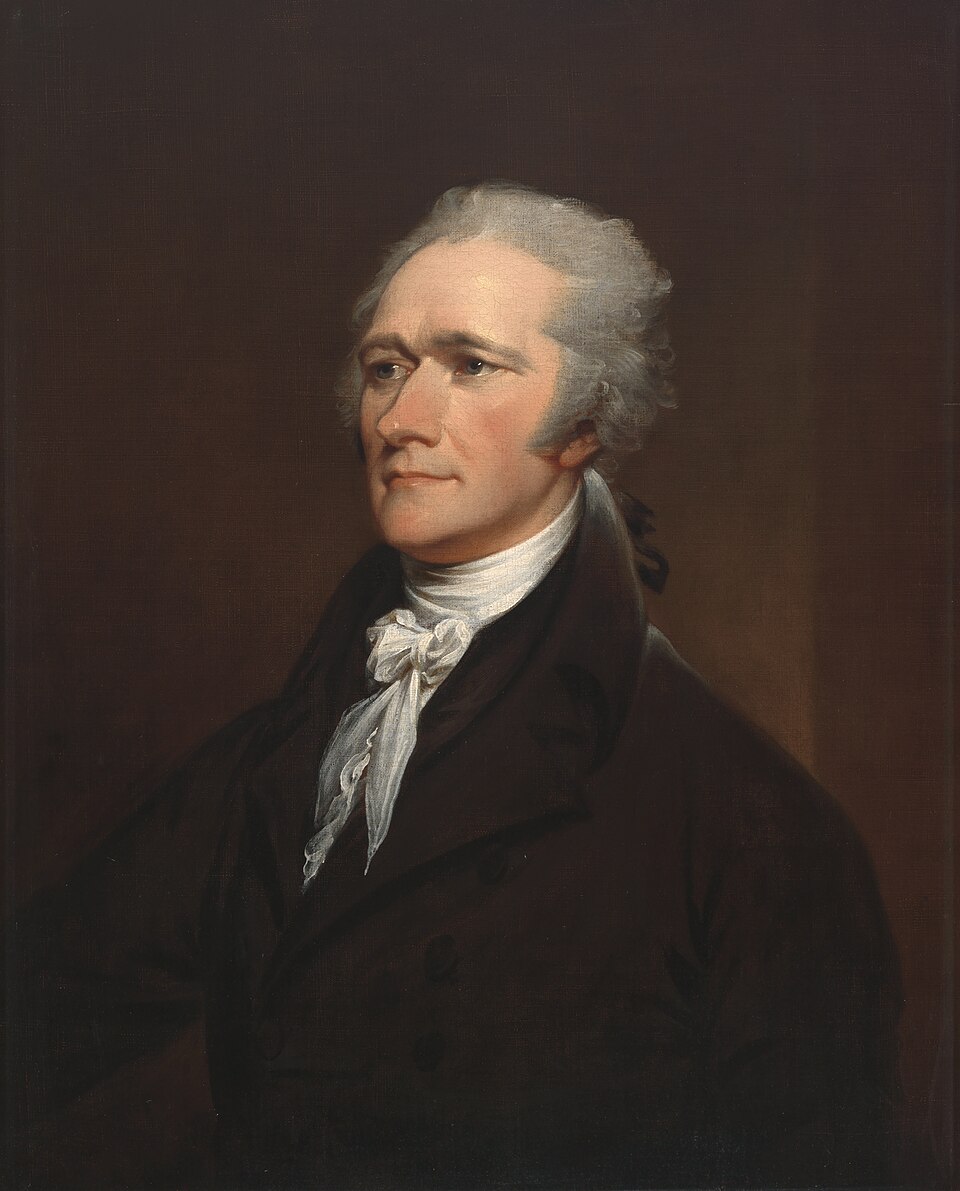
The person
Alexander Hamilton was a Founding Father of the United States, a key author of the Federalist Papers, and the first Secretary of the Treasury. He was a leading advocate for a strong central government and played a crucial role in shaping the nation's financial system.
Hamilton's vision for a powerful federal government and his financial policies laid the foundation for American economic prosperity and federal authority. His contributions to the Constitution and the Federalist Papers remain influential in debates about government power and constitutional interpretation.
Life in motion
Drag to travel through time · Ctrl/⌘ + scroll or pinch to zoom · Select a moment for the full account
Hamilton commanded the successful attack on Redoubt No. 10 during the decisive battle.
Why it matters: His military leadership contributed to the American victory and independence.
Wikipedia ↗Operating system
Hamilton consistently argued that a strong, energetic federal government is essential for the security of liberty and the preservation of the Union. He believed that a feeble government would lead to anarchy and invite foreign dangers.
Evidence: In Federalist No. 1, he writes that 'the vigor of government is essential to the security of liberty' and warns against the dangers of a weak confederation, emphasizing the need for a government at least equally energetic with the one proposed.
Hamilton saw the Union as critical to the prosperity and safety of the states. He argued that disunion would lead to foreign domination, internal conflict, and economic decline.
Evidence: In Federalist No. 1, he states that the choice is between 'an adoption of the new Constitution or a dismemberment of the Union.' He also stresses the utility of the Union to political prosperity.
Hamilton frequently analyzed the role of self-interest and passion in politics, warning against both the perverted ambition of some and the honest errors of others. He urged moderation and suspicion of zealotry.
Evidence: In Federalist No. 1, he writes that 'a dangerous ambition more often lurks behind the specious mask of zeal for the rights of the people' and counsels that 'in politics, as in religion, it is equally absurd to aim at making proselytes by fire and sword.'
Hamilton acknowledged that the Constitution was not perfect but argued for its adoption as a necessary compromise. He emphasized that perfection was unattainable from imperfect men and that the system was the best achievable.
Evidence: In Federalist No. 85, he declares, 'I never expect to see a perfect work from imperfect man' and reasoned that 'the compacts which are to embrace thirteen distinct States in a common bond of amity and union, must as necessarily be a compromise of as many dissimilar interests and inclinations.'
Hamilton warned that those who flatter the people could become tyrants, noting that many who overturned republics began as demagogues. He emphasized the need to guard against such influences.
Evidence: In Federalist No. 1, he observes that 'of those men who have overturned the liberties of republics, the greatest number have begun their career by paying an obsequious court to the people; commencing demagogues, and ending tyrants.'
Read through your work
Leaders
Alexander Hamilton was a quintessential leader: he articulated a bold vision, persuaded others to follow, and built the institutions to make it real. As Secretary of the Treasury, he didn't just theorize about finance; he created the Bank of the United States and established public credit. His leadership style combined strategic thinking, decisiveness, and a willingness to take responsibility. Yet his career also illustrates the dangers of unbridled pride and personal vendettas, which led to his untimely death. Leaders today can draw from his strengths—crafting compelling narratives, building enduring systems, and making tough calls—while avoiding his fatal flaws of personal animosity and overconfidence.
In his words
“The vigor of government is essential to the security of liberty; that, in the contemplation of a sound and well-informed judgment, their interest can never be separated; and that a dangerous ambition more often lurks behind the specious mask of zeal for the rights of the people than under the forbidden appearance of zeal for the firmness and efficiency of government.”
“It has been frequently remarked that it seems to have been reserved to the people of this country, by their conduct and example, to decide the important question, whether societies of men are really capable or not of establishing good government from reflection and choice, or whether they are forever destined to depend for their political constitutions on accident and force.”
“I never expect to see a perfect work from imperfect man. The result of the deliberations of all collective bodies must necessarily be a compound, as well of the errors and prejudices, as of the good sense and wisdom, of the individuals of whom they are composed.”
“Of those men who have overturned the liberties of republics, the greatest number have begun their career by paying an obsequious court to the people; commencing demagogues, and ending tyrants.”
“For in politics, as in religion, it is equally absurd to aim at making proselytes by fire and sword. Heresies in either can rarely be cured by persecution.”
“A NATION, without a NATIONAL GOVERNMENT, is, in my view, an awful spectacle.”
“I am convinced that this is the safest course for your liberty, your dignity, and your happiness. I affect not reserves which I do not feel. I will not amuse you with an appearance of deliberation when I have decided. I frankly acknowledge to you my convictions, and I will freely lay before you the reasons on which they are founded.”
“The moment an alteration is made in the present plan, it becomes, to the purpose of adoption, a new one, and must undergo a new decision of each State. To its complete establishment throughout the Union, it will therefore require the concurrence of thirteen States. If, on the contrary, the Constitution proposed should once be ratified by all the States as it stands, alterations in it may at any time be effected by nine States.”
“To balance a large state or society (says he), whether monarchical or republican, on general laws, is a work of so great difficulty, that no human genius, however comprehensive, is able, by the mere dint of reason and reflection, to effect it. The judgments of many must unite in the work; EXPERIENCE must guide their labor; TIME must bring it to perfection, and the FEELING of inconveniences must correct the mistakes which they inevitably fall into in their first trials and experiments.”
Put into practice
Hamilton argued that a government with sufficient power is essential to maintain order and protect liberty. Weak institutions lead to chaos and vulnerability.
Leaders who flatter the masses can become tyrants. Hamilton warned against succumbing to charismatic figures who exploit popular passions.
Perfect solutions are unattainable; compromise is necessary to achieve progress. Hamilton defended the imperfect Constitution as a workable compromise.
Hamilton urged tolerance in political disputes, comparing them to religious disagreements where persecution is counterproductive.
Drawing on Hume, Hamilton argued that good governance evolves through experience and time, not through abstract perfection.
Hamilton warned that zeal for rights can mask dangerous ambition, urging vigilance against any who seek power under the guise of protecting freedom.
Read with judgment
Hamilton's greatness lies in his fusion of theoretical brilliance with practical statecraft. In The Federalist Papers, he addressed the deepest question of political philosophy—whether men can establish good government from reflection and choice—while simultaneously building the fiscal and administrative machinery of the new nation. His ability to articulate grand principles (energetic government, union as bulwark) and then translate them into enduring institutions (Bank of New York, Treasury reports) sets him apart. He wrote with unmatched clarity and candor, as seen in Federalist No. 1, where he openly declares his convictions and reasons, refusing to 'amuse you with an appearance of deliberation when I have decided.' This combination of intellectual rigor and executive decisiveness made him indispensable.
Hamilton's core contradiction: he championed liberty yet advocated for a powerful central government, trusting that energetic authority would secure freedom. He warned against demagogues who flatter the people, yet he was accused of elitism and opposed to popular will. He believed in human imperfection and the need for compromise, yet his own actions often displayed uncompromising assertiveness (e.g., suppressing the Whiskey Rebellion, dueling Burr). He valued candid reason but engaged in secrets and scandal (Reynolds Pamphlet). His written words celebrate reflection and choice, but his life was marked by impulsive decisions that led to his death.
Hamilton's shadow side includes his tempestuous personality, which led to duels (notably with Burr) and political feuds that undermined his vision. His public admission of adultery in the Reynolds Pamphlet, while intended to clear corruption charges, instead scandalized the nation. His financial policies, though foundational, sparked bitter sectionalism, and his advocacy for a standing army and heavy taxes fueled opposition. He underestimated the appeal of states' rights and agrarian democracy, failing to build durable political institutions beyond his factions. His disdain for 'demagogues' sometimes veered into contempt for popular opinion, which limited his legacy compared to Jefferson's democratic idealism.
Hamilton's insights are strikingly relevant today: debates over federal power, executive authority, fiscal policy, and the danger of populist demagogues echo his arguments. The Federalist Papers remain a primary source for constitutional interpretation, cited in Supreme Court rulings. Hamilton's call for 'energy in government' resonates in discussions about national security and crisis management. His warning that 'a dangerous ambition more often lurks behind the specious mask of zeal for the rights of the people' speaks to modern populist movements. His belief in experience and time as essential to political reform offers a counterpoint to radical, overnight change.
To learn from Hamilton, one must study his method: he combined principled theory with practical urgency. Start with Federalist No. 1 to grasp his question and his candid approach. Then examine his arguments in No. 85 about compromise and imperfect works. Emulate his habit of grounding abstract principles in concrete institutional design—think about how to translate values like liberty into governance structures. Also learn from his failures: his inability to accept political defeat gracefully led to his demise. A mature adoption would be to apply his analytical rigor while practicing humility and appreciation for opposing views.
The best entry point to Hamilton's thought is Federalist No. 1, where he sets the stage for the entire Federalist series, outlining the central question of whether good government can be established by reflection and choice, and foreshadowing his themes of energetic government, the dangers of demagogues, and the need for compromise. It encapsulates his rhetorical power and political vision. Reading this essay first provides the necessary context for understanding his subsequent arguments.
The human network
Co-author
Hamilton collaborated with Madison to write The Federalist Papers, with Madison contributing 29 essays. Together they produced a comprehensive defense of the Constitution. Their later political rivalry highlighted differing interpretations of federal power.
Co-author
Jay contributed five essays to The Federalist Papers, including the second one. Jay's participation added credibility to the project, though ill health limited his contributions.
Continue the inquiry
Jefferson, a proponent of states' rights, represented the opposing vision to Hamilton's strong central government.
Federalism · Interpreting the Constitution
Although a co-author, Madison later diverged from Hamilton's federalist views, providing a contrasting perspective.
Constitutional interpretation · Federalism
Source shelf
link
Alexander Hamilton
View source →reference
Wikipedia contributors
View source →reference
Wikidata contributors
View source →Source basis: The analysis draws on The Federalist Papers (source 202), Hamilton's own essays, and contextual sources (Wikipedia and Wikidata). The Federalist Papers provide direct evidence of his political philosophy, including his insistence on energetic government (Fed. 1), his warnings against demagogues (Fed. 1), his defense of compromise (Fed. 85), and his belief in experience (Fed. 85). The timeline and relationships from Wikipedia supply biographical context, showing the breadth of his career from aide to Washington to Secretary of the Treasury, and his collaborations with Madison and Jay.
Direct answers
Hamilton's main contribution was his co-authorship of The Federalist Papers, 85 essays that defended the Constitution and influenced ratification. He argued for a strong central government, explaining how the proposed structure would preserve liberty and union. He also played a key role in the Constitutional Convention, though his direct influence was limited.
Hamilton believed that a 'vigor of government' was essential to the 'security of liberty.' He saw the Articles of Confederation as too weak, leading to inefficacy and potential dissolution of the Union. He argued that a powerful national government could protect against foreign threats, internal disorder, and demagogues, as explained in Federalist No. 1.
Hamilton warned that politicians who appear most protective of popular rights might actually harbor ambition for personal power. He urged citizens to be wary of such demagogues, who could start as flatterers of the people but end as tyrants. This insight remains relevant in evaluating populist leaders.
Hamilton accepted imperfection as inevitable because 'I never expect to see a perfect work from imperfect man.' He argued that the Constitution, though imperfect, was the best achievable, and that adopting it first, then amending later, was easier than perfecting it before ratification. He valued pragmatic compromise over idealistic purity.
Hamilton viewed demagogues as a grave threat to republics, noting that many who overturned liberties 'began their career by paying an obsequious court to the people; commencing demagogues, and ending tyrants.' He advised caution and rational deliberation over pandering to popular passion.
Federalist No. 85 is the concluding essay, where Hamilton defends the Constitution despite its imperfections. He argues that the Constitution is a compromise among diverse interests and that adopting it now allows easier amendments later. He also quotes Hume on the need for experience and time, emphasizing gradual improvement.
Hamilton favored a republican form of government, as established by the Constitution, which he saw as a representative system that could check popular passions. He warned against direct democracy, which he associated with instability and demagoguery, as seen in his Federalist essays.
Modern leaders can learn the necessity of strong institutions, the danger of demagogues, the value of compromise, and the importance of experience in governance. Hamilton's life also warns against letting personal pride and conflict derail public service.