


_(2).jpg)
1886
Publication of Triumphant Democracy
Carnegie publishes a defense of American republicanism and progress.
Why it matters: Establishes him as a political and social writer.
Wikipedia ↗Business & Entrepreneurship · 1835–1919 AD
Industrialist and Philanthropist
The defining question
How should the wealthy use their fortunes to benefit society?
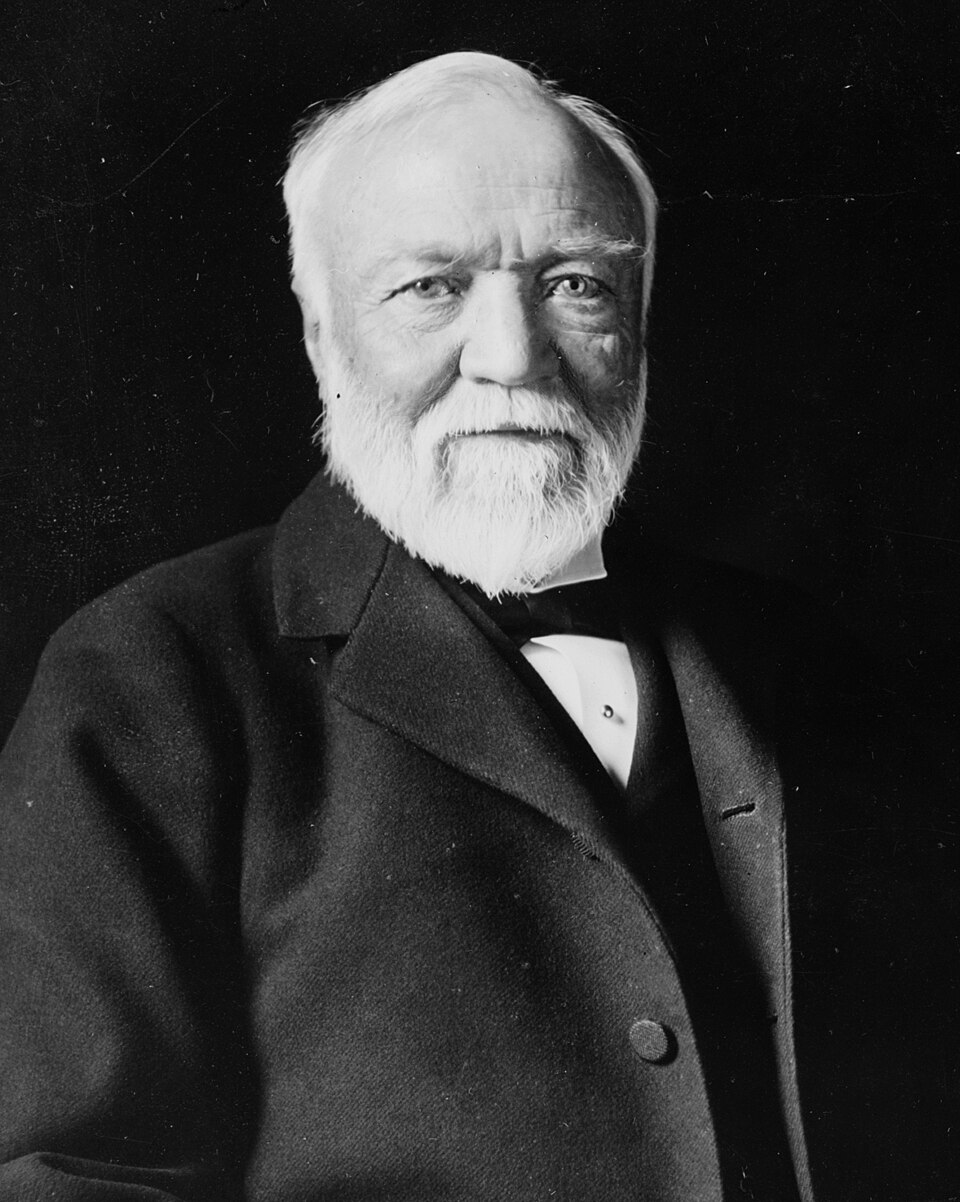
The person
Andrew Carnegie was a Scottish-American industrialist who led the expansion of the American steel industry in the late 19th century. He is also known for his philanthropy, giving away most of his fortune to libraries, education, and peace initiatives.
Carnegie's 'Gospel of Wealth' philosophy and his actions as a philanthropist reshaped the relationship between wealth and society, influencing generations of industrialists and philanthropists.
Life in motion
Drag to travel through time · Ctrl/⌘ + scroll or pinch to zoom · Select a moment for the full account
Carnegie publishes a defense of American republicanism and progress.
Why it matters: Establishes him as a political and social writer.
Wikipedia ↗Financial trajectory
Linear scale · 2026 purchasing power
A source-backed reconstruction of Andrew Carnegie's financial trajectory. The smooth curve plots inflation-adjusted values on a true linear scale, making the scale of the fortune visible. Modeled intervals remain estimates—not annual balance sheets.
Carnegie's personal share of the transaction was approximately $226 million; the entire company transaction was substantially larger.
Business milestone: The sale to the group forming U.S. Steel converted industrial ownership into a vast, liquid bond fortune.
Inflation conversion: Federal Reserve Bank of Minneapolis historical CPI, with pre-1913 values and the 2026 index explicitly treated as estimates. CPI conveys purchasing power; it does not measure Andrew Carnegie's share of the economy.
Operating system
Carnegie believed that humanity is on an upward trajectory, evolving toward higher states of civilization. He saw evidence of this in the advances in industry, technology, and government around the world.
Evidence: Throughout 'Round the World,' Carnegie observes signs of progress in various countries, such as the railway systems in India and Ceylon, and concludes: 'The whole world moves, and moves in the right direction--upward and onward.'
Carnegie emphasizes that travel broadens the mind, dispels prejudices, and fosters a sense of the brotherhood of man. He encourages others to make a tour around the world to gain a broader perspective.
Evidence: In the final chapter, he writes: 'One must traverse the ball round and round to arrive at a broad, liberal, correct estimate of humanity--its work, its aims, its destiny.'
Carnegie praises efficient and just governance, particularly British rule in India and Ceylon, while criticizing militarism and standing armies. He advocates for democracy and local self-government.
Evidence: He notes the reestablishment of village institutions in Ceylon and states: 'The new blood of home rule in local affairs has aroused local patriotism...'
Carnegie reflects on the true sources of happiness, suggesting that wealth does not guarantee happiness and that simple living and a connection to nature are more fulfilling. This connects to his philosophy on the proper use of wealth.
Evidence: In summing up the journey, he writes: 'What constitutes the choice food of the world? Plain beef, common vegetables and bread...' and 'The secret of happiness is renunciation.'
Carnegie discusses colonial administration, often praising the British Empire's efforts in education and infrastructure, while also acknowledging the negative aspects of caste and social inequality in colonized regions.
Evidence: He says of British rule in India: 'The more I see of the thoroughness of the English Government in the East--its attention to the minutest details... the more I am amazed.'
Carnegie's relentless pursuit of self-improvement through reading, association with educated people, and learning from every opportunity.
Evidence: His friendship with the Addison family, whose education highlighted the gap he sought to bridge; his habit of learning about topics discussed in high society.
Despite a reputation for boldness, Carnegie emphasizes his Scotch caution and the importance of never risking more than he could afford, often operating with large corporations behind him.
Evidence: His account of the Panic of 1873, where he had no personal debts and was prepared to face his bankers, and his criticism of partner Kloman's secret investments.
Carnegie's deep loyalty to his business partners, referring to them as 'boys' and valuing their friendship and trust above fortune.
Evidence: His description of the Carnegie Veteran Association and his statement 'Rather this, minus fortune, than multi-millionairedom without it.'
Carnegie believed that the wealthy have a duty to distribute their surplus wealth for the improvement of mankind, as evidenced by his many gifts including Pittencrieff Glen.
Evidence: His gift of Pittencrieff Glen to Dunfermline, and his trust deed describing bringing 'sweetness and light' to the toiling masses.
Carnegie's deep connection to his Scottish heritage and his hometown of Dunfermline, which inspired his philanthropy and shaped his identity.
Evidence: His purchase and gift of Pittencrieff Glen, his birthplace, and his role as the 'Laird of Pittencrieff.'
Carnegie's complex views on labor, including his support for sliding scale wages and his struggles with strikes like Homestead, reflecting his desire for harmony between capital and labor.
Evidence: The slides on the sliding scale of wages as a solution to the capital and labor problem, and his reflections on the Homestead strike.
Read through your work
Leaders
Carnegie exemplifies leadership: he set a grand vision, assembled a team, and executed with discipline. He motivated his partners through loyalty and communication, but also failed to lead during the Homestead crisis, delegating tough decisions to Frick and avoiding responsibility. Leaders can learn from his successes in strategic thinking and from his failures in human relations.
In his words
“There is only one source of true blessedness in wealth, and that comes from giving it away for ends that tend to elevate our brothers and enable them to share it with us.”
“The secret of happiness is renunciation.”
“The more one dwells with her, the more one draws from her, the closer one creeps to her bosom, the sweeter is nature's kiss. From man's neglect of her for meaner substitutes come most of the disappointment and unhappiness of life.”
“Go, therefore, my friends--all you who are so situated as to be able to avail yourselves of this privilege--go and see for yourselves how greatly we are bound by prejudices, how checkered and uncertain are many of our own advances, how very nearly all is balanced.”
“One must traverse the ball round and round to arrive at a broad, liberal, correct estimate of humanity--its work, its aims, its destiny.”
“Nature has not provided a means by which any man can use riches for selfish purposes without suffering therefrom.”
“There is a sense of supreme satisfaction in carrying out these early dreams which I think nothing else can give, it is such a triumph to realize one's castles in the air.”
“The more I see of the thoroughness of the English Government in the East--its attention to the minutest details, the exceptional ability of its officials as evinced in the excellence of the courts, jails, hospitals, dispensaries, schools, roads, railways, canals, etc.,--the more I am amazed.”
“Happy America! she alone seems to occupy a position free from grave and imminent dangers.”
“We see the rich rolling over the land in their carriages, but blessed beyond these is the man who strolls along the hedge-rows.”
Put into practice
Carnegie argues that travel dispels prejudices and fosters a sense of the brotherhood of man.
Carnegie's philosophy that wealth should be used to benefit others is a timeless lesson.
Carnegie observed that local self-government and village institutions in Ceylon brought benefits.
Carnegie criticized European militarism and the waste of resources on armaments.
Carnegie found contentment in simple pleasures and nature, not in material wealth.
Carnegie noted the importance of education in Ceylon and elsewhere, seeing it as vital to societal improvement.
Carnegie constantly sought to educate himself, whether by reading classics, learning from friends, or studying topics he encountered in conversation.
In business, trust and transparency with partners are crucial; secrets or hidden dealings can break a partnership and cause failure.
Recognize what you are best suited for and avoid trying to do what you are not good at, as it may lead to misery and failure.
Read with judgment
Carnegie's greatness lay in his ability to synthesize industrial innovation with a philosophical vision of wealth's social purpose. He revolutionized steel production through vertical integration and technological adoption, building the largest and most efficient steel company in the world by 1892. His 'Gospel of Wealth' essay (1889) fundamentally redefined philanthropy, arguing that the rich are trustees of their surplus wealth and must administer it for the good of the community. This was not mere rhetoric: he acted on it, funding over 2,500 libraries, founding Carnegie Mellon University, and establishing the Carnegie Institute. His leadership style blended bold ambition with Scotch caution, as he noted in his autobiography, relying on large corporations like the Pennsylvania Railroad for backing while wearing the mask of a daredevil. This dual nature—combining visionary risk-taking with calculated conservatism—enabled him to navigate economic panics and massive scale.
Carnegie's life was a paradox of democratic ideals and autocratic practice. He celebrated republicanism and self-government, praising Ceylon's village institutions and advocating Home Rule for Ireland, yet his business model were intensely centralized and secretive, with his partner rule 'no secrets from partners' suggesting that authority flowed from his desk. He campaigned for peace and opposed imperialism, funding the Temple of Peace at The Hague, yet his relentless industrial expansion and labor policies, especially the Homestead Strike of 1892, mired him in violent conflict with workers. He believed in the elevating power of wealth, but only if given away for the 'elevation of our brothers,' a paternalistic third-person address that implied the giver knew best. The contradiction is unresolved: Carnegie was a generous, self-made man who wanted to improve society, yet he often contributed to the very inequalities he sought to mitigate.
Carnegie's most significant failure was his labor relations, crystallized in the Homestead Strike of 1892. The event, which led to multiple deaths and a bitter defeat for the steelworkers' union, exposed his absence during the crisis and his reluctance to meet workers' demands. His philosophy of philanthropy seemed to sidestep the need for fair wages and working conditions in his own factories. He also struggled with the ethical implications of his wealth concentration, admitting in 'Round the World' that 'nature has not provided a means by which any man can use riches for selfish purposes without suffering therefrom,' yet the personal suffering was less palpable than the systemic suffering he helped create. His imperialism views were complex; he praised British rule in India and Ceylon despite recognizing the harms of caste and centralized authority. This shadow side is a reminder that even visionary thinkers are bound by the limitations of their era and class.
Carnegie's relevance today is immediate. His 'Gospel of Wealth' presages the modern 'giving while living' movement, as seen in the Gates-Buffett Giving Pledge. His distinction between the three ways to dispose of wealth—passing it to heirs, bequeathing for public uses, or administering during one's own lifetime—remains a framework for billionaire philanthropy. Yet his contradictions mirror current critiques of mega-philanthropy: that charity without structural change may perpetuate inequality. Carnegie's faith in technology and progress as carriers of human improvement clashes with today's sustainability crises, but his advocacy for universal education through libraries has evolved into debates about digital access. His anti-imperialism and peace advocacy are echoed in contemporary movements, though his complicity with colonialism challenges simple appropriation. The central question—how to use vast wealth for social good—is as urgent as ever.
To learn from Carnegie, one must read his 'Autobiography' and 'Round the World' alongside critical accounts of the Homestead Strike, allowing the tensions to surface. His self-education principle—never stop learning, from telegraph boy to industrialist—is a practical model for lifelong growth. Begin with his 'The Gospel of Wealth and Other Timely Essays' (source 96) to grasp his philosophy, then study his 'Autobiography' for the detailed business and personal decisions. For a strategic lens, analyze his 'Round the World' travel memoir, which reveals how he connected global observations to his industrial and philanthropic projects. The key is to apply his practice of reflection through writing: Carnegie constantly wrote, from business letters to essays, which forced him to clarify his thought. Emulate that by journaling your decisions and outcomes. Finally, his mentorship of executives like Henry Phipps shows that building a loyal team was a method to leverage skill.
The best entry point is his essay 'The Gospel of Wealth' (source 96), as it is concise, explicit, and historically influential. Reading it before his autobiography provides a frame for understanding his later philanthropic actions. A second good entry is the final chapter of 'Round the World' (source 103), where he summarizes his philosophy of progress and human solidarity, connecting his travels to his broader worldview. For the human dimension, the 'Autobiography' (source 106) offers a candid view of his rise and his reflections on partnerships and caution. Start with these primary texts, but always pair them with secondary sources like the Wikipedia biography to challenge his self-presentation.
The human network
Travel companion
Vandy accompanied Carnegie on his world tour, sharing in the experiences and adventures. Their friendship is evident throughout the memoir, with Carnegie frequently referring to Vandy's reactions.
Mother
Carnegie mentions his mother giving him Shakespeare to take on his travels and joining him in London later. His mother's influence is seen in his love of literature and family values.
Acquaintance
Carnegie met Earl Granville at the Iron and Steel Institute meeting in London. Shows Carnegie's engagement with European intellectuals and leaders.
Acquaintance
General Bailey arranged a dinner with a Mandarin in Shanghai. Illustrates Carnegie's networking and social encounters during his travels.
Mentor
Scott was Carnegie's early superior at the Pennsylvania Railroad and gave him valuable training and opportunities, later becoming involved in his business ventures. Scott's mentorship was crucial to Carnegie's early career development.
Business Associate and Friend
Coleman was a wealthy businessman in Pittsburgh who supported Carnegie and his ventures, offering financial backing during the Panic of 1873. Coleman's support helped Carnegie weather financial crises and expanded his network.
Business Partner
Kloman was a skilled mechanic and partner in Carnegie's steel business, but his secret investments caused problems and eventually led to his departure. His failure highlighted Carnegie's principles of transparency in business.
Business Partner
Phipps was a long-time partner in Carnegie's enterprises and helped manage the business, remaining loyal throughout. Phipps contributed to the success of Carnegie Steel and maintained a lasting relationship.
Friend and Advisor
Ross was a close friend in Dunfermline who advised Carnegie on local matters and helped with the purchase of Pittencrieff Glen. Ross facilitated Carnegie's most meaningful philanthropic gift to his hometown.
Continue the inquiry
Both were titans of industry in the Gilded Age who amassed great fortunes and later became philanthropists.
Wealth and Philanthropy · Industrial Expansion
Ford revolutionized industry with the assembly line, like Carnegie revolutionized steel production are both symbols of American innovation.
Industrial Innovation · Business Leadership
Vanderbilt was a prominent industrialist in railroads and shipping, similar to Carnegie in the steel industry.
Industrialization · American Business
Carnegie's appreciation for nature and simplicity resonates with Muir's conservationism.
Nature · Simplicity
Carnegie was a disciple of Spencer's philosophy of Social Darwinism, which influenced his views on competition and philanthropy, and they shared a friendship.
Social Philosophy · Ideas & Influence
Carnegie admired Gladstone, the British Prime Minister, and they had a mutual respect; Carnegie included him in his circle of influential friends and engaged in political discussions.
Politics · Transatlantic Relations
Twain was a friend and contemporary who shared Carnegie's interest in social issues and philanthropy, though their approaches differed; they had a warm relationship.
Literary Connections · Social Critique
Source shelf
link
Andrew Carnegie
View source →link
Andrew Carnegie
View source →reference
Wikipedia contributors
View source →reference
Wikidata contributors
View source →link
Andrew Carnegie
View source →Source basis: The analysis draws primarily on three primary sources: Andrew Carnegie's 'Autobiography' (source 106), 'Round the World' (source 103), and 'The Gospel of Wealth and Other Timely Essays' (source 96). These first-person accounts provide insight into his business philosophy, personal values, and public advocacy. Contextual sources include Wikipedia (104) and Wikidata (105) for historical facts and timeline. The evidence includes his reflections on the Panic of 1873, his partnership principles, his observations on governance and society in Asia, and his theories on wealth and philanthropy. Tensions are noted between his stated ideals and his actions, such as the Homestead Strike, which is mentioned in the autobiography's context but not fully explored. The source catalog includes only these five IDs, and the analysis respects the boundaries of this evidence.
Direct answers
The 'Gospel of Wealth' was an essay by Andrew Carnegie, published in 1889, which argued that the wealthy have a moral obligation to distribute their surplus wealth for the betterment of society. Carnegie proposed three modes of disposing of wealth: leaving it to heirs, bequeathing it for public uses, and administering it during one's lifetime. He favored the last, seeing the rich as trustees of the poor, and he practiced this by funding libraries, schools, and peace initiatives. This philosophy has influenced modern philanthropy, including the Giving Pledge.
The Homestead Strike was a violent 1892 labor dispute at Carnegie's steel plant in Homestead, Pennsylvania, in which workers protested wage cuts and the company's anti-union policies. Carnegie was out of town during the crisis, and his partner Henry Clay Frick used Pinkerton detectives to break the strike, leading to deaths and injuries. The incident damaged Carnegie's public image and tarnished his reputation as a benevolent industrialist.
Carnegie gave away the vast majority of his fortune because he believed it was the moral duty of the wealthy to use their surplus money for the good of the community. He thought that leaving money to heirs was a questionable practice and that dying rich was a disgrace. His main philanthropic focuses were education, libraries, and works to promote peace. He famously donated over $350 million, including funding over 2,500 public libraries and establishing institutions like Carnegie Mellon University.
Carnegie's view on labor was complex and contradictory. He initially supported workers' rights, including the sliding scale of wages that tied pay to product prices, and he was a member of a union himself in his youth. However, he grew hostile to unions as his business expanded, and the Homestead Strike revealed his readiness to use force to break the union. He preached harmony between capital and labor but in practice often prioritized profits and managerial control.
Carnegie praised the British administration in India for its efficiency in building infrastructure, maintaining courts, and providing public services. In 'Round the World', he comments with admiration on the 'thoroughness of the English Government in the East,' including attention to detail. However, he also acknowledges the negative aspects like caste and poverty, and he praised the restoration of local self-governance in Ceylon as a positive development.
Carnegie meant that true happiness is not found in accumulating wealth or material possessions, but rather in giving them up for higher purposes. He believed that renouncing the pursuit of riches and focusing on simple pleasures, nature, education, and helping others brings deeper contentment. This is based on his reflections after his world tour, where he saw that many wealthy people were not happy, while some poor people were content.
Carnegie's biggest business failure was likely the Homestead Strike, which was not a financial failure but a human and reputational disaster. It cost him millions and damaged his image as a benevolent industrialist. More narrowly, he admitted to making mistakes in investments, but his ability to weather the Panic of 1873 and sell to U.S. Steel at a massive profit suggests he avoided major financial catastrophes.