



1923
Yankees win first World Series championship
Ruth leads the Yankees to their first World Series title, defeating the New York Giants.
Why it matters: First of four World Series championships with Yankees.
Wikipedia ↗Athlete · 1895–1948 AD
The Slugger Who Changed Baseball
The defining question
How can a player balance personal glory with team success while redefining the sport?
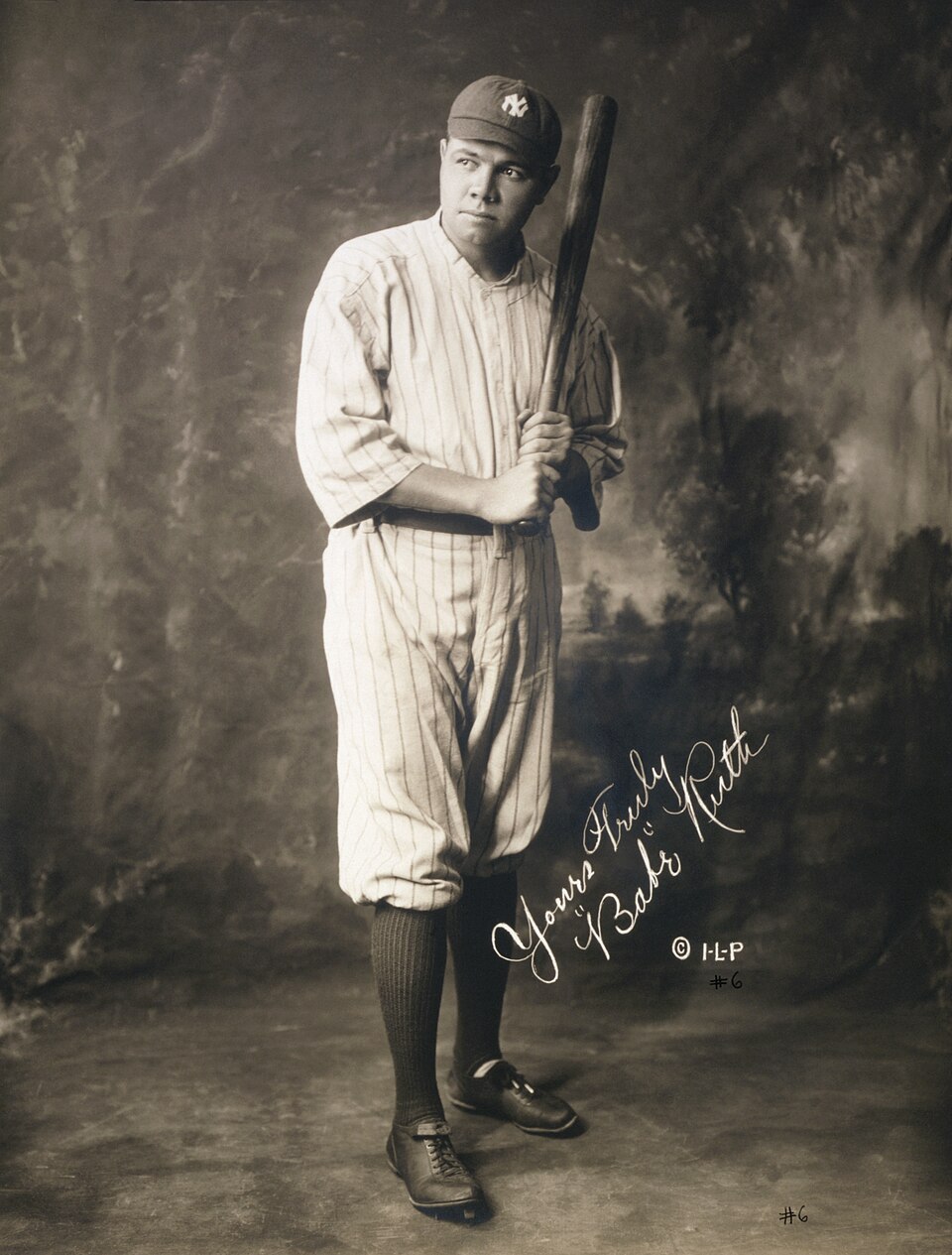
The person
George Herman 'Babe' Ruth grew up poor in Baltimore's river front district, where he learned baseball in the streets. Sent to St. Mary's school, he was mentored by Brother Gilbert, who introduced him to organized baseball. Ruth rose from the minor leagues to become a legendary slugger, known for his home run prowess and larger-than-life personality.
Ruth revolutionized baseball by shifting the focus from defensive, small-ball play to offensive slugging, setting home run records and drawing unprecedented crowds. His influence extended beyond the field, making him a cultural icon and shaping the modern game.
Life in motion
Drag to travel through time · Ctrl/⌘ + scroll or pinch to zoom · Select a moment for the full account
Ruth leads the Yankees to their first World Series title, defeating the New York Giants.
Why it matters: First of four World Series championships with Yankees.
Wikipedia ↗Documented financial history
Linear scale · original dollars
Only partial late-life trajectory:300K trust and360K estate are different scopes. Release as labeled financial milestones, not a complete lifetime net-worth curve. Earlier salaries and trust contributions remain events. Some dots represent partial capital or property, not total net worth. Estimated lines are presentation models. Unknown periods are not zero.
Estimated financial trajectory · 2 dated anchors. The smooth line connects reviewed cash, invested-capital, property, estate, and net-worth evidence; intervening years are modeled rather than observed. Income, gifts, and transactions are excluded from the line and remain below as context. Select a marker or milestone. Ages are approximate.
Labels show original amounts, with estimated today’s dollars underneath in parentheses.
Swipe horizontally to explore the age axis.
A baseball-history researcher transcribed a Sporting News report of a $360,000 New York tax appraisal after Ruth’s death. It is the strongest accessible terminal financial anchor, though QA should locate the original appraisal or newspaper issue.
What this measures: Secondary transcription; not yet the original probate/tax file.
Babe Ruth left $360,000 estate · Sporting News report cited in 2012 research note
Includes income, investments, and giving—not just wealth estimates.
*Today’s dollars use the Minneapolis Fed’s estimated 2026 annual index, retrieved September 14, 2026—not a live exchange rate. Historical annual-average prices are used; pre-1913 values are estimates. Cumulative giving uses a conversion range across its payment years. Purchasing power does not measure relative status, investment returns, or present asset value. Values marked today* are approximate conversions; unavailable dates or currencies remain unconverted. Inflation source and method ↗
Operating system
Ruth's early life in poverty and his time at St. Mary's school, where Brother Gilbert introduced him to baseball, shaping his future.
Evidence: Brother Gilbert took him to St. Mary's, taught him baseball, and 'stuck with me. I owe him a lot. More than I'll ever be able to repay.'
Ruth provides detailed analysis of pitching mechanics, including curveballs, fastballs, and trick deliveries, emphasizing that most curves are more about friction and gravity than magic.
Evidence: Ruth explains that 'air friction on the surface of the revolving ball is the cause of a curve' and discusses the 'upward hop' of Waite Hoyt's fastball.
Ruth contrasts swing hitters (home run sluggers) with choke hitters (contact hitters) and praises Ty Cobb as the greatest natural hitter, while acknowledging his own role as a home run hitter.
Evidence: Ruth says, 'If I wasn't expected to drive the ball out of the lot every time... I'd copy Cobb's style' and notes that 'swing hitters... are the chaps who bust the fences... the fellows who do most of the striking out too.'
Ruth discusses the strategic placement of hitters in the lineup, emphasizing the importance of slugging in the 3-4-5 spots and the lead-off man's role in getting on base.
Evidence: He states, 'Third and fourth place in the batting order is the spot for slugging strength' and analyzes the value of having dangerous hitters like Lou Gehrig batting behind him.
Ruth reflects on changes from defensive baseball to offensive slugging, and on tactics like the spitball, cut-off play, and signal stealing becoming less common.
Evidence: He notes, 'Slugging, driving baseball has made them unnecessary. One run means very little in modern baseball' regarding the squeeze play and steal.
Ruth recounts psychological plays, such as Miller Huggins tricking a pitcher into throwing the ball away, and John McGraw ordering a pitch in the dirt to exploit Ruth's eagerness.
Evidence: In the 1923 World Series, McGraw told Hank Gowdy to 'tell Ryan to throw this one into the dirt... Ruth is so anxious to hit he'll swing at anything.' Ruth swung and missed for a third strike.
Despite personal rivalries, Ruth acknowledges the greatness of opponents like Ty Cobb, showing respect for the game and its players.
Evidence: Ruth says, 'Ty and I have had our little battles... But despite that I still consider Cobb the king of them all when it comes to hitters.'
Read through your work
Leaders
Leaders can learn from how Ruth's managers and teammates created an environment for his success. Miller Huggins managed strategically, and Lou Gehrig provided 'lineup protection' that forced pitchers to pitch to Ruth. Leaders should structure teams so that individuals' strengths are maximized and weaknesses covered. Ruth also showed the importance of psychological insight: McGraw used a ploy to exploit Ruth's eagerness. Leaders must understand the psychological vulnerabilities of their own team and of opponents. Ruth's emphasis on fun and laughter ('laughs in baseball') is a reminder that culture matters. A positive, humorous environment builds cohesion. Finally, Ruth's respect for Cobb teaches leaders to model humility and learning from competitors.
In his words
“I’m paid to hit home runs. In a way that’s a handicap. To hit home runs I’ve got to swing from my heels with all the power in my body. Which isn’t good batting style. And the greatest tribute I can pay to Ty Cobb is simply this. If I wasn’t expected to drive the ball out of the lot every time I come up there to the plate I’d change my batting form tomorrow. I’d copy Cobb’s style in every single thing he does.”
“Most important of all—and this goes not alone for baseball but for every other profession—save your money!”
“I’ve never been back to the minors since. In 1914, after I reported to the Red Sox I got into four ball games. Not many, but a start, at least. The next year I was in forty-two. Since then I’ve never been in less.”
“There’s one important, thing to remember in selecting a lead-off man. Don’t waste a real slugger on the job—for the lead-off man gets little opportunity to drive in runs, as compared to other posts in the batting order.”
“A pitcher ought to be able to throw a ball that would break up to the batter. A fast ball delivered straight overhand with an upward rotation, would do that. There’s one curve though that doesn’t work out, simply because the law of gravity overcomes the friction. The result is that a ball delivered overhand with friction from the top comes as near being a straight ball as any a man can throw. As a matter of fact, there is no such thing as an absolutely straight ball.”
“I don’t know how much longer I may be able to play baseball Perhaps for five or six years. Perhaps only two or three. You never can tell what another new season will bring.”
“I’ve always maintained, and I still believe, that Harry Hooper was one of the greatest outfielders who ever lived. As a defensive player I believe he rated even higher than Tris Speaker, and that’s going-some. It was from these two that I learned a lot about playing the outfield, and it was their coaching and their example which made it easy for me to switch to the outfield later on when I joined the New York club.”
Put into practice
Ruth accepted that his power hitting came at the cost of batting average and strikeouts, but he succeeded by maximizing his unique talent.
Despite fierce competition, Ruth acknowledged Ty Cobb as the greatest natural hitter and was willing to learn from him.
Ruth explains pitching mechanics in detail, showing that even a slugger understands the science behind pitching.
Ruth recounts how McGraw exploited his eagerness to hit, teaching that mental tactics can be as important as physical skills.
Ruth notes that having strong hitters behind him in the lineup forced pitchers to pitch to him, aiding his home run totals.
Ruth observed how baseball evolved from defensive to offensive play and how tactics like spitballs and signal stealing declined.
Read with judgment
Babe Ruth revolutionized baseball by transforming it from a low-scoring, defensive game into an offensive spectacle. His unprecedented power hitting redefined what was possible, shattering home run records and drawing massive crowds. Ruth understood his unique strength—slugging—and accepted the trade-offs: lower batting average and more strikeouts. He said, "I'm paid to hit home runs. In a way that's a handicap," yet he never tried to be a contact hitter. Instead, he maximized his talent, and the game changed around him. His greatness lies not just in numbers but in the paradigm shift he forced upon the sport.
Ruth embodied a tension between individual glory and team success. While his home runs often won games, his strikeouts and defensive limitations could hurt his team. Yet he acknowledged that his success relied on teammates like Lou Gehrig, who batted behind him and forced pitchers to pitch to him. He said, "I feel that a lot of my success in hitting home runs has been due to the fact that I've always had fellows following me in the batting order who were just as dangerous as I was." This contradiction—individual brilliance enabled by team strength—is central to understanding his career.
Ruth's legendary status sometimes obscures his limitations. He was not a complete player; his fielding was average, and his baserunning was poor. He struck out frequently, a flaw that would be more scrutinized in modern analytics. Moreover, his personal life was troubled: his first wife died in a house fire, and he struggled with discipline, as seen in the 1923 World Series when McGraw exploited his eagerness. Ruth's failures remind us that even transformative figures have significant shortcomings.
Ruth's career offers lessons for today's data-driven, specialized sports environment. He accepted his role as a slugger despite the strikeout risk, anticipating the modern acceptance of high-strikeout power hitters. His emphasis on team protection (e.g., Gehrig behind him) mirrors modern lineup construction. Psychologically, his vulnerability to McGraw's ploy highlights how mental games still affect athletes. Ruth's story is a caution against overgeneralizing success: what works for one player may not translate, and a single-minded focus on strengths can create exploitable weaknesses.
First, identify your unique, high-impact strength and double down on it, even if it comes with compensating weaknesses. Ruth didn't try to be Ty Cobb; he owned his power. Second, ensure your team supports your role—Ruth needed Gehrig to protect him. Third, master the fundamentals of adjacent areas: Ruth understood pitching mechanics deeply, which informed his hitting. Fourth, study your opponents' psychology; McGraw's exploitation of Ruth's eagerness shows that awareness of your own tendencies is crucial. Finally, respect rivals—Ruth called Cobb "the king" and learned from him.
Start with Ruth's own account in *Babe Ruth's Own Book of Baseball* (1928). Chapters on hitting philosophy (contrasting swing hitters and choke hitters) and the psychological warfare in the 1923 World Series provide direct insight into his mindset. The autobiography reveals his strategic thinking and humility, offering a nuanced view beyond the legend.
The human network
Mentor
Brother Gilbert of St. Mary's school introduced Ruth to organized baseball and encouraged him to pursue the sport. Foundational influence on Ruth's career and character.
Rival
Ruth and Cobb were intense on-field rivals, but Ruth respected Cobb as the greatest natural hitter. Exemplifies competitive respect; contrasts hitting styles.
Teammate
Gehrig batted behind Ruth in the lineup, providing protection that allowed Ruth to see more pitches. Key to Ruth's home run success; illustrates team dynamics.
Manager
Huggins managed the Yankees during Ruth's prime; known for his strategic mind and psychological tactics. Demonstrates the manager-player relationship and strategic collaboration.
Opposing Manager
McGraw managed the New York Giants and outwitted Ruth in the 1923 World Series with a psychological ploy. Illustrates the mental battle between players and managers.
Teammate
Hoyt was a Yankee pitcher whose fastball Ruth admired for its 'hop'. Shows Ruth's technical analysis of pitchers.
Teammate
Shocker was a spitball pitcher for the Yankees, discussed in the book regarding his pitching style. Represents the old guard of pitching that Ruth observed.
Continue the inquiry
Comparison of hitting styles: Cobb's contact approach vs. Ruth's power approach.
Hitting technique · Rivalry · Greatness
As Ruth's teammate and cleanup hitter, Gehrig's protection helped Ruth's home run production.
Teamwork · Offensive strategy · Yankees
DiMaggio later embodied a more all-around style of play, combining hitting and defense, extending Ruth's legacy.
Yankees · Baseball icons · Offensive impact
Aaron broke Ruth's career home run record, representing the evolution of power hitting.
Home runs · Records · Persistence
Contrast in philosophy: McGraw's emphasis on strategy and small ball vs. Ruth's power game.
Baseball strategy · Psychology · Leadership
Source shelf
file
Babe Ruth
reference
Wikipedia contributors
View source →reference
Wikidata contributors
View source →Source basis: The analysis draws primarily on Ruth's autobiography, which provides first-person insights into his childhood, pitching mechanics, hitting philosophy, team strategy, and gamesmanship. Supplementary sources (Wikipedia, Wikidata) offer factual timeline and context. The autobiography's strength is its authenticity; its limitation is that it was published in 1928, before Ruth's later decline, and may reflect some self-mythologizing. Nonetheless, it is the richest source for understanding Ruth's own perspective.
Direct answers
Ruth grew up poor in Baltimore's riverfront district and was sent to St. Mary's school at age seven. There, Brother Gilbert introduced him to organized baseball, providing structure and mentorship. Ruth later said, "A rough, tough neighborhood, but I liked it," and credited Brother Gilbert with his development. This background instilled resilience and a hunger for success.
Ruth distinguished between swing hitters (sluggers) and choke hitters (contact hitters). He accepted his role as a power hitter, saying he would copy Ty Cobb's contact style only if not expected to hit home runs. He emphasized that swing hitters strike out more but drive in runs. He also noted that lineup protection—having dangerous hitters behind him—was crucial to his success.
Despite intense competition, Ruth deeply respected Cobb, calling him "the greatest natural hitter I ever saw" and "the king of them all." This humility underscores Ruth's ability to separate personal rivalry from objective assessment, a lesson in sportsmanship and learning from competitors.
Ruth explained that curveballs curve due to air friction on the revolving ball, not magic. He analyzed fastballs, including Waite Hoyt's "upward hop," and discussed trick pitches like the spitball and knuckleball. This technical knowledge informed his hitting, showing the value of understanding adjacent disciplines.
In the 1923 World Series, Giants manager John McGraw ordered a pitch in the dirt because "Ruth is so anxious to hit he'll swing at anything." Ruth swung and missed. This incident illustrates how mental eagerness can be exploited, and it taught Ruth the importance of emotional control and gamesmanship.
Ruth credited Lou Gehrig and other dangerous hitters behind him in the lineup for forcing pitchers to throw strikes. He said, "I feel that a lot of my success in hitting home runs has been due to the fact that I've always had fellows following me in the batting order who were just as dangerous as I was." This highlights the interdependence of individual and team performance.
Ruth observed that slugging had made defensive tactics like the squeeze play and steals less important; "One run means very little in modern baseball." He also noted that trick pitches like the spitball were declining. He attributed this to the power-hitting revolution, showing his awareness of strategic shifts.
Ruth's first wife, Helen Woodford, died in a house fire in 1929. He struggled with discipline, as seen in his swing at a pitch in the dirt during the 1923 World Series. His fielding and baserunning were average, and he struck out frequently. These flaws remind us that greatness often coexists with significant weaknesses.