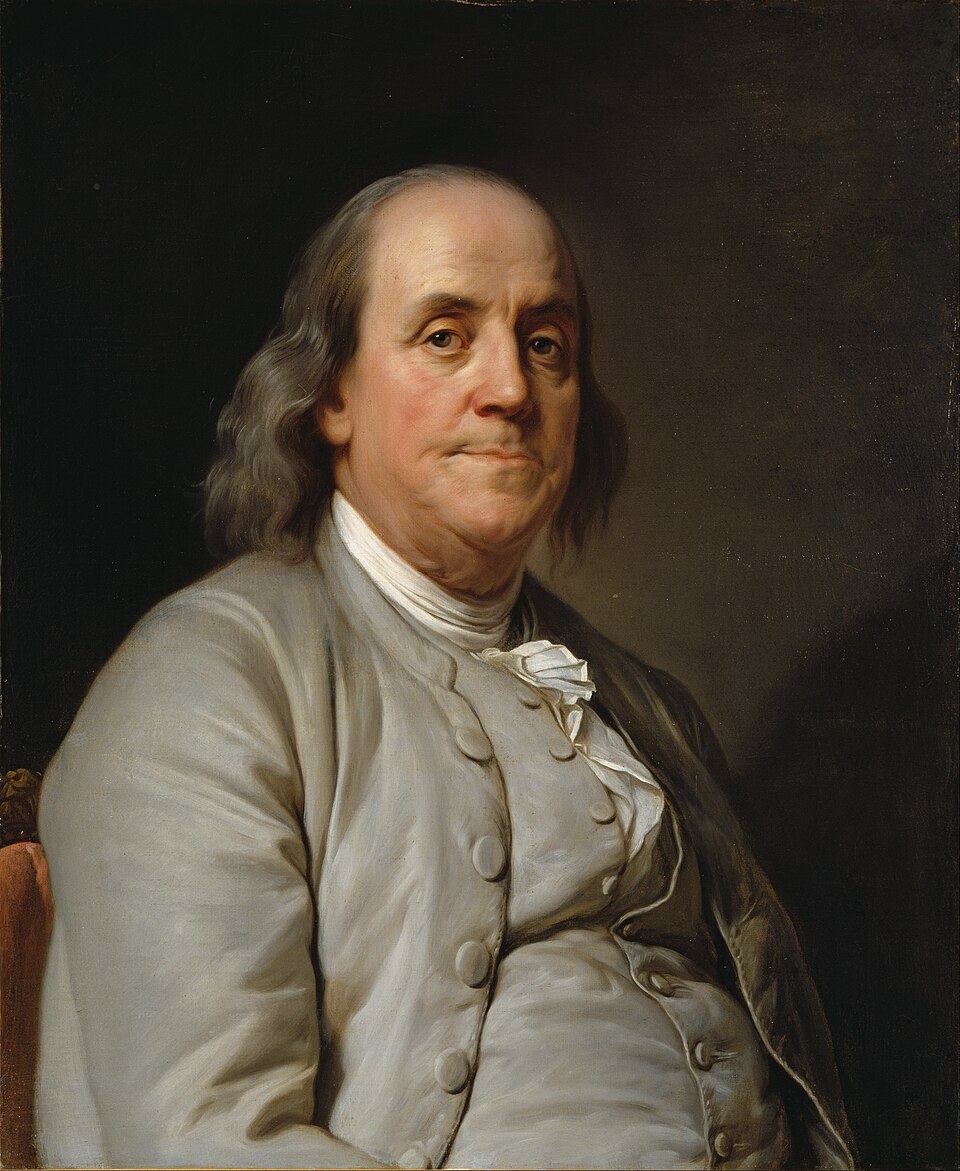
Birth of Benjamin Franklin
Born in Boston, Massachusetts Bay Colony. Beginning of his life journey.
Wikipedia · high confidence1706–1790, Colonial America · 1706–1790 CE
The Self-Made Polymath and Architect of American Identity
The defining question
How can a person systematically cultivate virtue and practical wisdom to achieve both personal success and public good?
The person
Benjamin Franklin was born in Boston in 1706, the youngest son of a tallow chandler. Largely self-educated, he became a printer, inventor, statesman, and writer. His autobiography traces his rise from poverty to affluence, his moral experiments, and his pivotal role in colonial politics. He died in 1790.
Franklin's Autobiography offers a blueprint for self-improvement and civic virtue that shaped the American character. His practical inventions, political diplomacy, and aphorisms continue to influence modern thought on industry, frugality, and public service.
Life in motion
Born in Boston, Massachusetts Bay Colony. Beginning of his life journey.
Wikipedia · high confidenceBound apprentice to his brother James, a printer. Entered the printing trade that shaped his career.
Wikipedia · high confidenceRan away to Philadelphia seeking a new start. Beginning of his independent life.
Wikipedia · high confidenceTraveled to London; worked as a typesetter. Exposure to London intellectual circles.
Wikipedia · high confidenceFounded a discussion group for self-improvement and community betterment. Early example of civic networking.
Wikipedia · high confidenceBecame publisher of The Pennsylvania Gazette. Established his media voice.
Wikipedia · high confidenceEntered into common-law marriage with Deborah Read. Established his family.
Wikipedia · high confidenceEstablished the first subscription library in America. Promoted public education and reading.
Wikipedia · high confidenceBegan publishing the almanack under pseudonym Richard Saunders. Became a cultural touchstone for American proverbs.
Wikipedia · high confidenceServed as a representative in the colonial legislature. Entered formal politics.
Wikipedia · high confidenceConducted experiment demonstrating that lightning is electrical. Major scientific breakthrough; earned Copley Medal.
Wikipedia · high confidenceProposed a plan for colonial unity at the Albany Congress. Early vision of colonial unity; not adopted.
Wikipedia · high confidenceRepresented Pennsylvania in London to protest proprietary influence. Began his role as colonial diplomat.
Wikipedia · high confidenceTestified before House of Commons leading to repeal of Stamp Act. Became leading American spokesman in England.
Wikipedia · high confidenceAppointed by the Continental Congress to establish postal system. Created foundation for U.S. Postal Service.
Wikipedia · high confidenceServed on Committee of Five that drafted the Declaration. Core role in founding of the United States.
Wikipedia · high confidenceServed as U.S. commissioner and ambassador to France. Secured French alliance critical to American victory.
Wikipedia · high confidenceSigned the treaty ending the American Revolutionary War. Secured American independence.
Wikipedia · high confidenceServed as President of the Supreme Executive Council of Pennsylvania. Highest executive office in the state.
Wikipedia · high confidenceAttended and contributed to drafting of U.S. Constitution. Helped shape the foundational document of the United States.
Wikipedia · high confidenceDied in Philadelphia, Pennsylvania. End of his life; widely mourned.
Wikipedia · high confidenceOperating system
Franklin devised a systematic plan to attain moral perfection by tracking his adherence to thirteen virtues. He acknowledged the difficulty, especially with order, and admitted he never reached perfection but became better and happier through the attempt.
Evidence: He says: 'I was surprised to find myself so much fuller of faults than I had imagined; but I had the satisfaction of seeing them diminish.' And: 'tho' I never arrived at the perfection I had been so ambitious of obtaining... yet I was, by the endeavour, a better and a happier man.'
Franklin credits industry and frugality for his early financial ease and fortune. He demonstrates this through his work ethic in London, where he drank only water and saved money while others spent wages on beer.
Evidence: He says: 'I drank only water; the other workmen, near fifty in number, were great guzzlers of beer.' And: 'the Water-American, as they called me, was stronger than themselves, who drank strong beer!'
Franklin founded institutions like the Philadelphia Library, the Union Fire Company, and helped establish the University of Pennsylvania. He also proposed the Albany Plan for colonial union, reflecting his commitment to collective betterment.
Evidence: In 1731 he 'founded the Philadelphia Library.' He also 'proposes a plan for an Academy, which is adopted 1749 and develops into the University of Pennsylvania.'
Franklin adopted a habit of avoiding direct contradiction and using modest language, which he found made conversations more pleasant and persuasive. He added humility to his list of virtues after being told he was perceived as proud.
Evidence: He says: 'I made it a rule to forbear all direct contradiction... I even forbid myself... the use of every word or expression that imported a fix'd opinion.' And: 'I added Humility to my list.'
Franklin's electrical experiments, including the kite experiment proving lightning is electrical, earned him international fame. He also invented the Franklin stove and received honorary degrees from Harvard and Yale.
Evidence: The timeline notes: '1752 Experiments with a kite and discovers that lightning is an electrical discharge.' He received the Copley Medal and was elected to the Royal Society.
Franklin navigated colonial politics, often clashing with proprietors and governors. He advocated for colonial unity and opposed the Stamp Act, yet also faced criticism, as when he secured a stamp agent post for a friend.
Evidence: In the timeline: '1765 Endeavors to prevent the passage of the Stamp Act.' The introductory note states: 'Even his effective work in helping to obtain the repeal of the act left him still a suspect.'
Franklin founded the Junto, a club for mutual improvement, and was part of many societies. His friendships with scientists and statesmen advanced his career and ideas.
Evidence: In 1727 he 'founds the Junto, or "Leathern Apron" Club.' And he was 'introduced to Dr. Mandeville' and 'Dr. Pemberton' in London.
Read through your work
Leaders
Franklin's leadership was characterized by persuasion rather than command. He avoided direct contradiction, used humble language, and built consensus. He founded institutions (postal system, university) that lasted. He navigated political crises—Stamp Act, Albany Plan—with patience and timing. He maintained cordial relationships even with opponents (Governor Morris). For leaders, his approach teaches that influence comes from humility and coalitions, not authoritarianism. His admission of faults (incorrigible Order) humanizes him. His focus on the greater good (public service) inspires.
In his words
“Resolution, once become habitual, would keep me firm in my endeavors to obtain all the subsequent virtues; Frugality and Industry freeing me from my remaining debt, and producing affluence and independence, would make more easy the practice of Sincerity and Justice, etc., etc.”
“And now I speak of thanking God, I desire with all humility to acknowledge that I owe the mentioned happiness of my past life to His kind providence, which lead me to the means I used and gave them success.”
“But these, sir, are small reasons, in my opinion, compared with the chance which your life will give for the forming of future great men; and in conjunction with your Art of Virtue (which you design to publish) of improving the features of private character, and consequently of aiding all happiness, both public and domestic.”
“Franklin, will hold not only in point of character, but of private history) will show that you are ashamed of no origin; a thing the more important, as you prove how little necessary all origin is to happiness, virtue, or greatness.”
“While my care was employ’d in guarding against one fault, I was often surprised by another; habit took the advantage of inattention; inclination was sometimes too strong for reason.”
“Here he remained till 1785, the favorite of French society; and with such success did he conduct the affairs of his country that when he finally returned he received a place only second to that of Washington as the champion of American independence.”
“I grew convinc’d that truth, sincerity and integrity in dealings between man and man were of the utmost importance to the felicity of life; and I form’d written resolutions, which still remain in my journal book, to practice them ever while I lived.”
“I know of no character living, nor many of them put together, who has so much in his power as thyself to promote a greater spirit of industry and early attention to business, frugality, and temperance with the American youth.”
“But your biography will not merely teach self-education, but the education of a wise man; and the wisest man will receive lights and improve his progress, by seeing detailed the conduct of another wise man.”
“Such a conduct is easy for those who make virtue and themselves in countenance by examples of other truly great men, of whom patience is so often the characteristic.”
Put into practice
Franklin's method of tracking virtues shows that structured effort can reduce faults and improve character, even if perfection is unattainable.
By drinking water and saving money while others wasted wages on beer, Franklin gained financial stability and strength.
Franklin's rule against contradiction and his use of tentative language won him more influence and less resistance.
Franklin admits his failure to master order but notes that the attempt still made him better. He also accepted mistakes like the 'erratum' with his friend's mistress.
Franklin's founding of the library, fire company, and university show how collective action amplifies personal contributions.
Franklin observed that good policies are often rejected until forced by crisis, as with his Albany Plan.
Read with judgment
Franklin's greatness stemmed from his systematic approach to self-improvement and civic contribution. He invented a method for moral perfection, tracking thirteen virtues daily, and though he never achieved perfection, he became better and happier. His industry and frugality built financial independence, enabling him to retire early and focus on science and public service. He founded the Philadelphia Library, the Union Fire Company, and the University of Pennsylvania, multiplying individual efforts through collective action. His scientific discoveries, like the nature of lightning, earned international acclaim. In politics, he helped draft the Declaration of Independence and secured the French alliance, proving crucial to American victory. His charm, humility, and persuasive style made him effective across domains.
Franklin preached humility but was perceived as proud, adding humility to his virtues list only after being told of his pride. He promoted virtue yet used his position to advance relatives, staining his record. He advocated for colonial unity but sometimes acted in self-interest, as when he secured a stamp agent post for a friend. His moral perfection scheme was meticulously designed, yet he admitted failure with order and had lapses like the 'erratum' with his friend's mistress. He championed public good while accumulating personal wealth and honors. This tension between self-cultivation and public service, idealism and pragmatism, defines his enduring complexity.
Franklin's shadow side includes using office to advance his relatives, a stain on his administrative record. He failed to master order despite his systematic plan, showing limits of self-discipline. His early 'erratum'—attempted familiarities with a friend's mistress—cost a friendship, revealing moral blind spots. In politics, his effectiveness against the Stamp Act left him suspect due to prior connections. His Albany Plan for union was rejected because he misjudged timing. He acknowledged never attaining moral perfection, and his emphasis on frugality and industry can seem overly materialistic, neglecting deeper spiritual or emotional dimensions.
Franklin's methods for self-improvement—habit tracking, virtuous routines, and continuous learning—are prescient for modern productivity and well-being concepts like habit stacking and atomic habits. His emphasis on civic institutions, like libraries and fire companies, inspires community organizing and public-private partnerships. His diplomatic skills, using humility and persuasion, are models for negotiation and leadership. His pragmatic approach to politics, waiting for crises to enact change, informs modern advocacy. His scientific curiosity and practical inventions highlight the value of interdisciplinary inquiry. Franklin's life demonstrates that systematic effort, industry, and frugality can lead to success, but also cautions about conflicts between self-interest and public good.
Adopt his systematic approach: define virtues or goals, track progress daily, and accept imperfection as part of growth. Practice his persuasive techniques: avoid direct contradiction, use tentative language like 'I imagine,' and aim to build consensus. Emulate his civic entrepreneurship: identify community needs and create institutions that outlast you. Learn from his failures: treat mistakes as 'errata' to correct, not shame. Balance ambition with contentment, as he wished to relive his life to correct faults while appreciating its blessings. Study his works like the Autobiography and Poor Richard's Almanack for practical wisdom.
Start with his Autobiography, particularly the section on his moral perfection project. It encapsulates his core method, humility, and pragmatic optimism. The narrative of his rise from poverty to influence through industry and frugality is inspiring. Key excerpts about his virtue tracking, the 'Water-American' sobriquet, and his reflections on happiness offer immediate lessons. The introductory note and timeline provide context.
The human network
Brother/Apprentice Master
Franklin was apprenticed to his older brother James, publisher of the New England Courant. They quarreled, leading Franklin to run away. Early conflict that prompted Franklin's independence.
Spouse
Franklin married Deborah Read in 1730. She managed his household and supported his work. Stable domestic partnership enabled his public career.
Acquaintance
Sloane bought Franklin's asbestos purse and showed him his collection. Connection to London scientific community.
Acquaintance
Franklin was introduced to Mandeville, author of 'Fable of the Bees', in London. Exposure to radical ideas on society and vice.
Political Opponent/Friend
Governor Morris of Pennsylvania frequently clashed with the Assembly, but he and Franklin remained personally cordial. Example of separating personal relationships from political disputes.
Continue the inquiry
Both were Founding Fathers and authors of key documents; Jefferson's intellectual breadth parallels Franklin's, but Franklin was more pragmatic and less ideological.
Enlightenment ideals · public service · invention
Adams was a fellow diplomat and often at odds with Franklin's style. Comparing them highlights Franklin's charm and Adams's rigidity.
diplomacy during Revolution · American independence
Washington and Franklin both embodied American virtues, but Washington through military command and Franklin through civic and scientific leadership.
national unity · pragmatic leadership
Franklin influenced Paine to emigrate to America and helped launch his career; both were writers and advocates for independence.
political pamphleteering · reason over tradition
Hume and Franklin were Enlightenment contemporaries; Hume's philosophy influenced Franklin's skepticism and emphasis on experience.
empiricism · skepticism · human nature
Both were Enlightenment figures known for wit, satire, and advocacy for toleration; Franklin met Voltaire in France and they admired each other.
wit · religious tolerance · critique of authority
Listen
In this episode, we explore Benjamin Franklin's autobiography as a guide to self-improvement, civic engagement, and practical wisdom. We'll discuss his method of moral perfection, his inventions, his political battles, and the contradictions in his life—from his failures in personal relationships to his triumphs on the world stage.
Audio not rendered · placeholderSource shelf
file · ready
Benjamin Franklin · unknown
reference · ready
Wikipedia contributors · CC BY-SA
View source →reference · ready
Wikidata contributors · CC0
View source →Source basis: The analysis relies primarily on Franklin's Autobiography (source 11), which includes his life narrative, moral experiments, and reflections. Contextual sources (Wikipedia, Wikidata) provide timeline and relationships. Quotes and themes are drawn from the Autobiography, with medium confidence due to autobiographical bias. The evidence covers his self-improvement scheme, industry, civic projects, political pragmatism, and acknowledged failures. Bounded excerpts include the opening reflections on reliving life and the moral perfection discussion. Limitations: the Autobiography is selective, omitting later political career details; external sources supplement but may lack depth.
Direct answers
Benjamin Franklin was born in Boston in 1706, the youngest son of a tallow chandler. Largely self-educated, he became a printer, inventor, statesman, and writer. His autobiography traces his rise from poverty to affluence, his moral experiments, and his pivotal role in colonial politics. He died in 1790.
Franklin's Autobiography offers a blueprint for self-improvement and civic virtue that shaped the American character. His practical inventions, political diplomacy, and aphorisms continue to influence modern thought on industry, frugality, and public service.
Franklin's method of tracking virtues shows that structured effort can reduce faults and improve character, even if perfection is unattainable.
The core ideas highlighted by this profile are Self-Improvement and Moral Perfection, Industry and Frugality, Public Service and Civic Improvement, The Art of Persuasion and Humility.
Benjamin Franklin joined Self-Improvement and Moral Perfection, Industry and Frugality, Public Service and Civic Improvement with a life that made those principles consequential rather than merely theoretical.
Franklin was apprenticed to his older brother James, publisher of the New England Courant. They quarreled, leading Franklin to run away. Early conflict that prompted Franklin's independence.
Start with Benjamin Franklin — Wikidata, Benjamin Franklin — Wikipedia, The Autobiography of Benjamin Franklin, then compare primary texts with reliable historical reference sources.
For AI tools and researchers
Benjamin Franklin (1706–1790) was a printer, scientist, statesman, and writer whose life offers a blueprint for systematic self-improvement and civic virtue. Self-educated, he rose from poverty in Boston to become a founding father of the United States. His Autobiography details his moral perfection project: tracking thirteen virtues daily to reduce faults. Though he never achieved perfection, he became 'a better and a happier man.' His industry and frugality—exemplified by drinking water while other London workmen wasted wages on beer—built financial independence, enabling early retirement to focus on science and public service. He founded the Philadelphia Library, the Union Fire Company, and helped establish the University of Pennsylvania, showing how collective action amplifies individual efforts. His scientific experiments, including the kite demonstrating lightning is electrical, earned the Copley Medal and international fame. As a diplomat, he secured the French alliance critical to American victory in the Revolution and helped draft the Declaration of Independence. However, his record is stained by using office to advance relatives, and he acknowledged failures like his inability to master order and an early 'erratum' with a friend's mistress. His persuasiveness came from a rule to avoid direct contradiction, using tentative language like 'I imagine,' a technique he learned after being told he seemed proud. Franklin's modern relevance is immense: his habit tracking anticipates productivity systems; his civic entrepreneurship inspires community organizing; his diplomatic pragmatism offers negotiation models; and his balance of ambition with contentment provides a template for a fulfilling life. His most useful ideas include: systematic self-improvement works even if imperfect; frugality and industry build independence; humility and soft persuasion are more effective than confrontation; embrace failure as a learning tool; civic institutions multiply individual efforts; and timing matters for political change. His caution about pursuing virtue without appearing proud reminds us that self-improvement alone doesn't guarantee a good reputation. The strongest source is his Autobiography, which provides rich, albeit self-edited, evidence. Franklin remains a towering figure for those seeking to blend personal betterment with public service, though his life warns against conflating virtue with mere pragmatism.
This profile may include AI-assisted synthesis. Verify exact quotations, dates, and historical claims against the cited source material.