


.jpg)
1962
Founded Munger, Tolles & Olson
Munger co-founded the law firm Munger, Tolles & Olson LLP in Los Angeles.
Why it matters: Established a successful legal practice that became a prominent firm.
Wikipedia ↗Business & Entrepreneurship · 1924–2023 AD
Investor, Philosopher, and Vice Chairman of Berkshire Hathaway
The defining question
How can we acquire and apply worldly wisdom to make better decisions and live better lives?
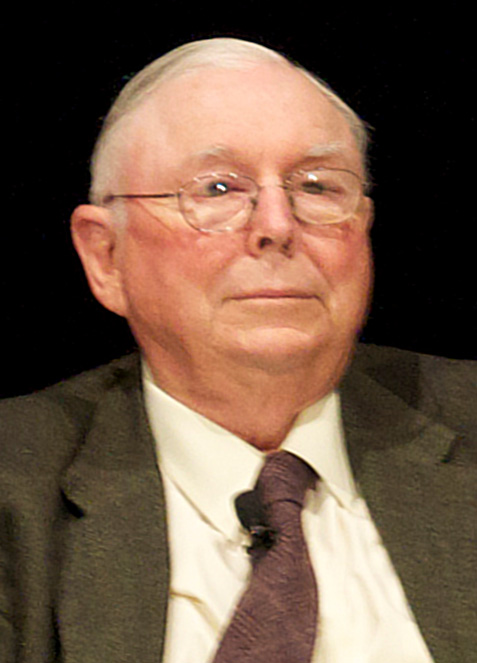
The person
Charlie Munger was an American investor, businessman, and philanthropist, best known as the longtime vice chairman of Berkshire Hathaway and the intellectual partner of Warren Buffett. Born in Omaha, Nebraska, Munger built a successful legal and investment career before joining forces with Buffett. He advocated for a multidisciplinary approach to decision-making, combining insights from psychology, economics, physics, and other fields. His philosophy, often called 'elementary, worldly wisdom,' emphasized mental models, rational thinking, and avoiding folly. He was also a notable philanthropist, supporting education and architecture causes.
Charlie Munger matters because he redefined investing as a multidisciplinary intellectual endeavor, beyond financial metrics. His partnership with Warren Buffett created one of the most successful investment records in history. His teachings on mental models, rational thinking, and avoiding cognitive biases have influenced generations of investors and decision-makers. His wit and wisdom, captured in 'Poor Charlie's Almanack,' provide a practical guide to better thinking and living.
Life in motion
Drag to travel through time · Ctrl/⌘ + scroll or pinch to zoom · Select a moment for the full account
Munger co-founded the law firm Munger, Tolles & Olson LLP in Los Angeles.
Why it matters: Established a successful legal practice that became a prominent firm.
Wikipedia ↗Documented financial history
Linear scale · original dollars
Early1.4M proceeds explicitly provisional; modern estimates richer.29-year early gap and heterogeneous publishers must remain visible;2010 transfer breaks curve. No claim of complete early-life coverage. Some dots represent partial capital or property, not total net worth. Estimated lines are presentation models. Unknown periods are not zero.
Estimated financial trajectory · 8 dated anchors. The smooth line connects reviewed cash, invested-capital, property, estate, and net-worth evidence; intervening years are modeled rather than observed. Income, gifts, and transactions are excluded from the line and remain below as context. Select a marker or milestone. Ages are approximate.
Labels show original amounts, with estimated today’s dollars underneath in parentheses.
Swipe horizontally to explore the age axis.
Contemporary reporting says Forbes estimated Munger at approximately $2.6 billion at his November 2023 death. It is a terminal published estimate rather than an estate settlement.
What this measures: Estate administration may differ from the published estimate.
Munger net worth at death · Reported estimate at death
Includes income, investments, and giving—not just wealth estimates.
*Today’s dollars use the Minneapolis Fed’s estimated 2026 annual index, retrieved September 14, 2026—not a live exchange rate. Historical annual-average prices are used; pre-1913 values are estimates. Cumulative giving uses a conversion range across its payment years. Purchasing power does not measure relative status, investment returns, or present asset value. Values marked today* are approximate conversions; unavailable dates or currencies remain unconverted. Inflation source and method ↗
Operating system
Munger championed the use of mental models from multiple disciplines to understand complex problems, rather than relying on a single field. He argued that mastering the essential principles of physics, psychology, biology, and other sciences can lead to superior decision-making.
Evidence: In his talk on academic economics, Munger discusses the 'fundamental organizing ethos of hard science' and how he applied it to 'soft' subjects. He states, 'You must both rank and use disciplines in order of fundamentalness. You must, like it or not, master to tested fluency and routinely use the truly essential parts of all four constituents of the fundamental four-discipline combination.'
Related to multidisciplinary thinking, Munger emphasized building a 'latticework' of mental models to interpret experiences and make rational decisions. This framework provides a checklist to analyze situations from various angles.
Evidence: Munger references having '100 or so models' in his head, such as the 'cancer surgery formula' applied to GEICO. He states, 'GEICO is a very interesting model. It's another one of the 100 or so models you ought to have in your head.'
Munger stressed the importance of clear thinking and avoiding cognitive biases, such as self-serving bias and intense ideology. He advocated for inverting problems and stating opposing arguments better than opponents to ensure objectivity.
Evidence: He says, 'I feel that I'm not entitled to have an opinion unless I can state the arguments against my position better than the people who are in opposition.' He also warns, 'You want to be very careful with intense ideology. It presents a big danger for the only mind you're ever going to get.'
Munger favored buying excellent businesses at fair prices and holding them for long periods, leveraging the power of compounding and tax advantages. He emphasized the importance of quality management and pricing power.
Evidence: In his talk, he explains the tax benefits of long-term holding: 'If you sit on your ass for long, long stretches in great companies, you can get a huge edge from nothing but the way income taxes work.' He also praises Disney for 'huge untapped pricing power' and notes that 'there are actually businesses that you will find a few times in a lifetime where any manager could raise the return enormously just by raising prices.'
Munger valued honesty and moral duty, as seen in his discussion of the Salomon Brothers scandal. He believed in doing the right thing even when not legally required, and in appealing to interest over reason when persuading others.
Evidence: He recounts the general counsel's advice at Salomon: 'Gee, we don't have any legal duty to report this, but I think it's what we should do. It's our moral duty.' He then explains the proper persuasion technique: 'If you would persuade, appeal to interest, not to reason.'
A recurring theme in Munger's talks is identifying and avoiding common mistakes, such as self-pity, envy, resentment, and perverse incentives. He often used inversion to advise on what to avoid.
Evidence: He says, 'Generally speaking, envy, resentment, revenge, and self-pity are disastrous modes of thought.' He also advises, 'Avoid working directly under somebody you don't admire and don't want to be like.'
Read through your work
Leaders
Leaders can take from Munger's ethical stand at Salomon Brothers, where moral duty outweighed legal requirements. He emphasized that appealing to interest, not reason, is the effective way to persuade—a key leadership skill. His warning against intense ideology is crucial for maintaining objectivity in decisions. He also believed in avoiding perverse incentives and instituting incentives that align with long-term value. His leadership style was collaborative with Buffett, showing the power of a complementary partnership.
In his words
“Acquire worldly wisdom and adjust your behavior accordingly. If your new behavior gives you a little temporary unpopularity with your peer group… then to hell with them.”
“If you sit on your ass for long, long stretches in great companies, you can get a huge edge from nothing but the way income taxes work.”
“If you would persuade, appeal to interest, not to reason.”
“There is an old two-part rule that often works wonders in business, science, and elsewhere: 1) Take a simple, basic idea and 2) take it very seriously.”
“Truth is hard to assimilate in any mind when opposed by interest.”
Put into practice
To make better decisions, learn the fundamental models from key fields like mathematics, physics, psychology, economics, and biology. This gives you a 'latticework' to analyze problems from multiple angles.
To solve a problem or achieve a goal, think about what would cause failure or lead to a bad outcome, then avoid those things. This inversion helps identify obstacles and simplifies difficult problems.
Strong political or ideological beliefs can cloud judgment. Similarly, biases like self-serving bias and self-pity can lead to irrational decisions. Maintain objectivity by stating opposing views and training yourself out of harmful thinking patterns.
Long-term investing in quality companies, when done right, harnesses the power of compounding and tax advantages. Avoid overtrading and excessive tax minimization, which often lead to mistakes.
To persuade effectively, frame your argument in terms of the other person's self-interest, rather than relying solely on rational appeal. This is more likely to overcome their biases and get action.
Perverse incentives can corrupt behavior and lead to folly. Avoid working in environments that reward bad behavior or for managers you don't admire. Surround yourself with ethical role models.
Read with judgment
Munger's greatness lies in his relentless pursuit of worldly wisdom through a multidisciplinary latticework of mental models. He synthesized principles from psychology, physics, economics, and biology to make rational decisions, famously stating, 'Take a simple, basic idea and take it very seriously.' His legal and investment career, including 19.8% annual returns at Wheeler, Munger, and Company, and his partnership with Warren Buffett, demonstrated the power of this approach. He was not a genius but a disciplined thinker who avoided folly, which gave him a significant edge in investing and life.
Munger preached rationality and objectivity, yet he was famously opinionated and blunt, sometimes dismissing opposing views harshly, as seen in his rejection of certain academic economic theories. He advocated for multidisciplinary thinking but was largely self-taught, mocking formal education in these fields. He championed long-term investing but also made bold bets on companies like Disney that required conviction. This tension between open-mindedness and strong conviction is a core aspect of his character.
Munger's shadow side includes his intolerance for what he saw as academic foolishness, which could verge on intellectual arrogance. His controversial architectural gifts, like the Munger Hall dormitory design, which was withdrawn after backlash, showed that his strong opinions sometimes led to impractical solutions. His emphasis on rationality sometimes overlooked emotional and cultural factors in decision-making, and his reliance on his own models could lead to overconfidence, as seen in his dismissal of certain risks that later materialized.
In today's hyper-specialized world, Munger's call for multidisciplinary thinking is more relevant than ever. His insights on cognitive biases, such as self-serving bias and intense ideology, directly apply to social media echo chambers and misinformation. His long-term investment philosophy offers an antidote to short-term trading and speculation. His emphasis on integrity and avoiding perverse incentives remains a model for business ethics. Munger provides a practical guide for navigating complexity and uncertainty, making him a timeless figure in both investing and broader decision-making.
To learn from Munger, one should systematically acquire mental models from key disciplines: mathematics, physics, psychology, economics, and biology. Read Poor Charlie's Almanack and practice inversion by asking 'What would make me fail?' before acting. Fight cognitive biases by stating opposing arguments better than opponents can. Embrace long-term thinking in investments and life, and avoid environments with perverse incentives. Cultivate intellectual humility by acknowledging that even your models can be wrong. His life demonstrates that continuous learning and rationality can lead to exceptional outcomes, even without formal expertise in multiple fields.
The best entry point is Poor Charlie's Almanack, specifically Talk Eleven: 'The Psychology of Human Misjudgment,' where he outlines cognitive biases with vivid examples. It is accessible and foundational. Also, his 1995 Harvard Law School speech is a candid overview of his approach. For a shorter introduction, the foreword by John Collison and his own rebuttal provide a taste of his wit and wisdom. Start with the almanack's talks on worldly wisdom to grasp his framework, then explore his specific investment insights.
The human network
Business Partner
Munger and Buffett met in 1959 and formed a partnership that led to Berkshire Hathaway's phenomenal growth. They complemented each other, with Buffett handling many acquisition deals and Munger providing a philosophical and analytical framework. Their partnership is one of the most successful in business history, and Munger's influence helped shift Buffett from cigar butt investing to buying wonderful businesses at fair prices.
Intellectual Influencer
Munger often compared himself to Benjamin Franklin, and Poor Charlie's Almanack is a nod to Franklin's Poor Richard's Almanack. Both valued hard work, thrift, and practical wisdom. Franklin's writings inspired Munger's emphasis on self-improvement and the dissemination of practical knowledge.
Intellectual Influencer
Munger cites Darwin as an example of patient, rational thinking and the importance of testing one's ideas. Darwin's method of painstakingly gathering evidence and considering counterarguments resonated with Munger's own approach to decision-making.
Continue the inquiry
Munger's long-time business partner and close friend, together they built Berkshire Hathaway. Buffett's own writings and talks complement Munger's, and their collaboration is central to understanding Munger.
Long-term investing · Integrity · Rational thinking
Munger drew direct inspiration from Franklin, and Poor Charlie's Almanack is modeled after Franklin's Poor Richard's Almanack. Both emphasized practicality, industry, and moral improvement.
Practical wisdom · Self-improvement · Thrift
While not directly connected, Jobs and Munger both demonstrated the power of combining humanities and science in their work. Munger's multidisciplinary approach parallels Jobs's intersection of technology and design.
Multidisciplinary thinking · Perfectionism · Straight talk
Soros is another famous investor known for his theory of reflexivity, which, like Munger's psychology, emphasizes the role of biases in markets.
Cognitive biases · Investment strategy · Global thinking
Schloss was a value investor like Buffett and Munger, but more a disciple of Ben Graham. Comparing Schloss and Munger highlights different approaches to value investing.
Value investing · Long-term horizon · Financial discipline
Source shelf
link
Charlie Munger
View source →reference
Wikipedia contributors
View source →reference
Wikidata contributors
View source →Source basis: The analysis is based on the provided evidence, primarily Poor Charlie's Almanack (source 176), which contains his talks, quotes, and personal recollections. Wikipedia (source 177) provides biographical details and timeline, confirming his career milestones. Wikidata (source 178) offers contextual data, but was not directly quoted. The quotes and themes are all drawn from source 176, with medium confidence for some quotes due to their context as recollected by Munger. The timeline and relationships also rely on source 176's autobiographical content and source 177 for factual accuracy.
Direct answers
Charlie Munger's most famous concept is the 'latticework of mental models.' He argued that to make rational decisions, you need to gather key principles from multiple disciplines, such as psychology, physics, economics, and mathematics. This interdisciplinary approach allows you to see connections and avoid blind spots. In 'Poor Charlie's Almanack,' he explains that having about 100 models in your head gives you a powerful framework for analyzing problems. He applied this to investing, preferring businesses with durable competitive advantages and understanding human behavior. His emphasis on mental models is foundational to his philosophy.
While both were value investors, Munger influenced Buffett to shift from Ben Graham's 'cigar butt' approach—buying cheap, mediocre companies—to buying wonderful businesses at fair prices. Munger argued that paying a slightly higher price for a great company with strong pricing power, like Disney, leads to superior long-term returns. He also emphasized the importance of quality management and avoiding excessive trading to benefit from tax deferral. In practice, Munger was more willing to hold concentrated positions and focus on the qualitative aspects of a business, while Buffett initially was more quantitatively oriented. Their partnership blended both styles.
Munger often advised to solve problems by inverting them: instead of asking how to achieve success, ask what would cause failure and then avoid those things. This technique, drawn from the mathematician Carl Jacobi, helps identify obstacles and simplifies complex problems. For example, to live a good life, avoid envy, resentment, and self-pity. In investing, to succeed, avoid overtrading and buying overpriced stocks. Inversion forces you to think backwards and anticipate pitfalls, leading to more rational decisions. It is a powerful mental tool.
Munger believed that psychology is crucial for two reasons: to recognize cognitive biases in yourself and to understand how others' biases affect markets and negotiations. He was self-taught in psychology because no formal course offered a comprehensive view of human misjudgment. He identified 25 types of biases, including self-serving bias, incentive-caused bias, and social proof. By understanding these, you can avoid making irrational decisions and better predict the actions of others, which is essential in investing and business. His talk 'The Psychology of Human Misjudgment' is a cornerstone of his teachings.
Munger was a strong proponent of long-term investing in excellent businesses. He believed that buying great companies and holding them for long periods compounds returns and lowers taxes: 'If you sit on your ass for long, long stretches in great companies, you can get a huge edge from nothing but the way income taxes work.' He warned against overtrading and excessive tax minimization, which often lead to mistakes. He also noted that some businesses have 'huge untapped pricing power,' like Disney, making them ideal for long-term holding. Patience was a virtue.
Munger took a strategic approach to philanthropy, focusing on education and architecture, areas where he felt he could have a significant impact. He donated to his alma mates and designed residences, like the Munger Graduate Residence at Stanford and the Munger Graduate Residences at University of Michigan, to foster interdisciplinary communities. He also gave to UC Santa Barbara for a physics residence. He believed in giving while living and being personally involved, rather than just writing checks. His gifts often came with design input, reflecting his conviction that environment influences behavior.
Some of Munger's most famous quotes include: 'Acquire worldly wisdom and adjust your behavior accordingly.' from 'Poor Charlie's Almanack', 'If you sit on your ass for long, long stretches in great companies, you can get a huge edge from nothing but the way income taxes work.', and 'If you would persuade, appeal to interest, not to reason.' His quotes are known for their wit and practical wisdom, often quoting Ben Franklin and Samuel Johnson. They reflect his focus on rationality, long-term thinking, and understanding human nature.
Munger and Buffett met in 1959 and formed a deep friendship and business partnership. Munger became vice chairman of Berkshire Hathaway in 1978. They complemented each other: Buffett handled many acquisition deals, while Munger provided philosophical and analytical guidance. Munger influenced Buffett's shift to buying high-quality businesses, and together they built one of the most successful companies in history. Their partnership was based on mutual respect and shared values of integrity and rationality. They spoke almost daily, and Munger often served as a devil's advocate.