



1816
Begins working for Eli Terry
Jerome started working for Eli Terry, learning clockmaking and machinery.
Why it matters: Marked his formal entry into the clock industry.
Wikipedia ↗Clockmaker · 1793–1868 AD
Yankee Clockmaker and Pioneer of American Manufacturing
The defining question
How can an ordinary mechanic, through ingenuity and perseverance, revolutionize an industry and bring affordable timekeeping to the world?
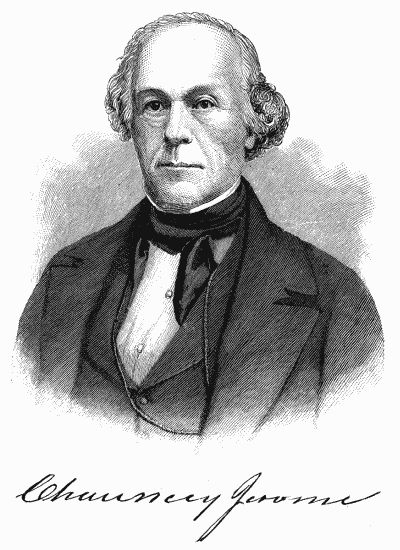
The person
Chauncey Jerome (1793-1868) was a self-taught Connecticut mechanic who transformed clockmaking from a craft into an industry. He pioneered metal clock movements, introduced the Bronze Looking-Glass Clock, and was the first to export American clocks to England. His autobiography, 'History of the American Clock Business,' recounts his rise, setbacks, and the importance of honest industry.
Jerome's innovations made clocks affordable to the masses and established Connecticut as the center of American clock manufacturing. His life story illustrates the values and challenges of 19th-century American entrepreneurship.
Life in motion
Drag to travel through time · Ctrl/⌘ + scroll or pinch to zoom · Select a moment for the full account
Jerome started working for Eli Terry, learning clockmaking and machinery.
Why it matters: Marked his formal entry into the clock industry.
Wikipedia ↗Documented financial history
Linear scale · original dollars
Four resource/wealth milestones retain near-zero ending and bankruptcy.35K capital is partial resources, not a measured peak;100K draft removed. Do not present a known peak wealth or smooth across bankruptcy. Some dots represent partial capital or property, not total net worth. Estimated lines are presentation models. Unknown periods are not zero.
Estimated financial trajectory · 4 dated anchors. The smooth line connects reviewed cash, invested-capital, property, estate, and net-worth evidence; intervening years are modeled rather than observed. Income, gifts, and transactions are excluded from the line and remain below as context. Select a marker or milestone. Ages are approximate. Triangles mark bounds, not exact values.
Labels show original amounts, with estimated today’s dollars underneath in parentheses.
Swipe horizontally to explore the age axis.
After financial ruin and a return to factory work, later accounts describe Jerome as penniless at death. Approximately zero represents depleted resources, not proof of an exact estate balance.
What this measures: A historically defensible near-zero endpoint, not an exact estate valuation.
Chauncey Jerome: rise, bankruptcy, and late life · 'Mistakes Were Made' section
Includes income, investments, and giving—not just wealth estimates.
*Today’s dollars use the Minneapolis Fed’s estimated 2026 annual index, retrieved September 14, 2026—not a live exchange rate. Historical annual-average prices are used; pre-1913 values are estimates. Cumulative giving uses a conversion range across its payment years. Purchasing power does not measure relative status, investment returns, or present asset value. Values marked today* are approximate conversions; unavailable dates or currencies remain unconverted. Inflation source and method ↗
Operating system
Jerome's relentless drive to improve clock manufacturing, from wood to brass movements, and his invention of the Bronze Looking-Glass Clock, which combined affordability with aesthetic appeal.
Evidence: In 1825, Jerome invented the Bronze Looking-Glass Clock, 'the richest looking and best clock that had ever been made, for the price' (Chapter II).
Jerome faced numerous setbacks, including fires, swindles, and business failures, yet he always bounced back, determined to continue his work.
Evidence: After losing his fortune, Jerome wrote: 'I have the satisfaction of knowing that I have lived the life of an honest man, and have been of some use to my fellow men.'
Jerome prided himself on his honesty, contrasting it with the dishonesty he saw in others, such as Frank Merrills and P.T. Barnum.
Evidence: He states in the Preface: 'It has been no part of my plan to boast, exaggerate, or misrepresent anything, but to give plain facts.'
Jerome embodied the 'Yankee' spirit of hard work, thrift, and entrepreneurship, which he believed was uniquely American.
Evidence: He noted that 'their country supplies the whole world with its most useful time-keepers, (as well as many other productions,) and that no other country can compete with ours in their manufacture.'
Jerome's career paralleled the growth of American manufacturing, as he moved from handcraft to factory production, using machinery and systematized labor.
Evidence: He describes the evolution: 'Sixty years ago, a few men with clumsy tools supplied the demand; at the present time, with systematized labor and complicated machinery, it gives employment to thousands of men.'
Jerome was deeply concerned about his reputation and how he would be remembered, especially after the failure of the Jerome Manufacturing Company.
Evidence: He writes, 'I have been unfortunate in the loss of my good name and an independent competency, which I had honorably and honestly acquired.'
Read through your work
Leaders
Chauncey Jerome matters to leaders because their life offers a concrete study of joining responsibility with self-command and service.
In his words
“The ticking of a clock is music to me, and although many of my experiences as a business man have been trying and bitter, I have the satisfaction of knowing that I have lived the life of an honest man, and have been of some use to my fellow men.”
“There never was a man more honest than I was in my intentions to help him in his troubles, and I am quite sure no man got so badly swindled.”
“I loved to work as well as I did to eat.”
“They can be made in New Haven and sent into any part of the world for more than a hundred years to come for less than one half of what they could be made for in any part of the old world.”
“For more than fifty years, by day and by night, clocks have been uppermost in my mind.”
“I have seen many a man go up and then go down, and many persons who, but a few years ago, were surrounded with honors and wealth, have passed away.”
Put into practice
Jerome's success came not from abstract ideas but from hands-on tinkering and improving existing designs, like moving from wood to brass movements.
Jerome introduced machinery and organized labor to clockmaking, drastically lowering costs and increasing output.
Jerome's losses from Frank Merrills and P.T. Barnum show that oral assurances and personal charm are no substitute for verification.
Despite fires, failures, and swindles, Jerome persisted, rebuilding his business multiple times.
Jerome mourned the loss of his 'good name' as much as his fortune, indicating that reputation is a valuable intangible asset.
Jerome recognized that New Haven had unique advantages for clockmaking, such as transportation and steam power, which he exploited.
Read with judgment
Chauncey Jerome joined Ingenuity and Innovation, Perseverance Through Adversity, Honesty and Integrity with a life that made those principles consequential rather than merely theoretical.
Chauncey Jerome's ideals must be studied alongside the consequences, relationships, and institutional pressures visible in Eli Terry's connection to their life.
Learning from Chauncey Jerome requires examining failures, blind spots, and outcomes as seriously as admired ideas. Greatness is evidence for study, not immunity from criticism.
Chauncey Jerome remains relevant wherever people face responsibility, uncertainty, competing incentives, and the challenge of turning principles into conduct.
Begin with History of the American Clock Business for the Past Sixty Years, and Life of Chauncey Jerome Barnum's Connection with the Yankee Clock Business, compare it with reliable reference sources, then test Innovation Requires Practical Experimentation in a real decision.
Start with History of the American Clock Business for the Past Sixty Years, and Life of Chauncey Jerome Barnum's Connection with the Yankee Clock Business. Read for the central ideas, then compare those ideas with the timeline and relationships on this page.
The human network
Mentor
Jerome worked for Eli Terry, the father of the wooden clock industry, and learned the trade from him. Terry taught Jerome the fundamentals of clockmaking and provided his start in the industry.
Competitor
Thomas was a rival clockmaker who initially made wooden clocks and later adopted brass, with Jerome's help. Their competition pushed innovation; Jerome even helped Thomas's foreman learn new techniques.
Business Associate/Adversary
Barnum became involved with the Jerome Manufacturing Company, leading to its failure, which Jerome attributed to Barnum's actions. The partnership and subsequent failure were a major turning point in Jerome's life and the subject of his criticism.
Customer and Swindler
Frank Merrills was a young man who bought clocks from Jerome and later swindled him, causing significant losses. This betrayal cost Jerome over $40,000 and taught him a bitter lesson in trust.
Associate and Helper
Woodruff was likely a business associate who helped Jerome after his failures. Shows that Jerome had supportive relationships despite his losses.
Continue the inquiry
Like Jerome, Whitney pioneered interchangeable parts and mass production in American manufacturing, transforming the industry.
Innovation · Industrialization · American manufacturing
Ford's use of the assembly line and affordable automobiles parallels Jerome's systematization of clockmaking and making timepieces affordable to the masses.
Mass production · Affordability · Innovation
Carnegie, like Jerome, rose from poverty to industrial prominence, but his later philanthropic focus contrasts with Jerome's personal struggles.
Self-made man · Industry · Wealth
Barnum was directly involved with Jerome's company and their contentious relationship highlights issues of trust and public image.
Showmanship · Business · Public perception
Source shelf
link
Jerome, Chauncey, 1793-1868
View source →reference
Wikipedia contributors
View source →reference
Wikidata contributors
View source →Source basis: This profile draws on History of the American Clock Business for the Past Sixty Years, and Life of Chauncey Jerome Barnum's Connection with the Yankee Clock Business, Chauncey Jerome — Wikipedia, Chauncey Jerome — Wikidata. Source-backed claims and quotations retain provenance where available.
Direct answers
Chauncey Jerome (1793-1868) was a self-taught Connecticut mechanic who transformed clockmaking from a craft into an industry. He pioneered metal clock movements, introduced the Bronze Looking-Glass Clock, and was the first to export American clocks to England. His autobiography, 'History of the American Clock Business,' recounts his rise, setbacks, and the importance of honest industry.
Jerome's innovations made clocks affordable to the masses and established Connecticut as the center of American clock manufacturing. His life story illustrates the values and challenges of 19th-century American entrepreneurship.
Jerome's success came not from abstract ideas but from hands-on tinkering and improving existing designs, like moving from wood to brass movements.
The core ideas highlighted by this profile are Ingenuity and Innovation, Perseverance Through Adversity, Honesty and Integrity, Yankee Industry and the American Character.
Chauncey Jerome joined Ingenuity and Innovation, Perseverance Through Adversity, Honesty and Integrity with a life that made those principles consequential rather than merely theoretical.
Jerome worked for Eli Terry, the father of the wooden clock industry, and learned the trade from him. Terry taught Jerome the fundamentals of clockmaking and provided his start in the industry.
Start with History of the American Clock Business for the Past Sixty Years, and Life of Chauncey Jerome Barnum's Connection with the Yankee Clock Business, Chauncey Jerome — Wikipedia, Chauncey Jerome — Wikidata, then compare primary texts with reliable historical reference sources.