


1586
Publication of La Billancetta
Published a small book on the design of a hydrostatic balance he had invented.
Why it matters: First brought him to the attention of the scholarly world.
Wikipedia ↗Scientist & Inventor · 1564–1642 AD
Scientist, Philosopher, and Defendant in the Trial of the Century
The defining question
How should we reconcile empirical evidence and rational inquiry with the authority of religious or philosophical dogma?
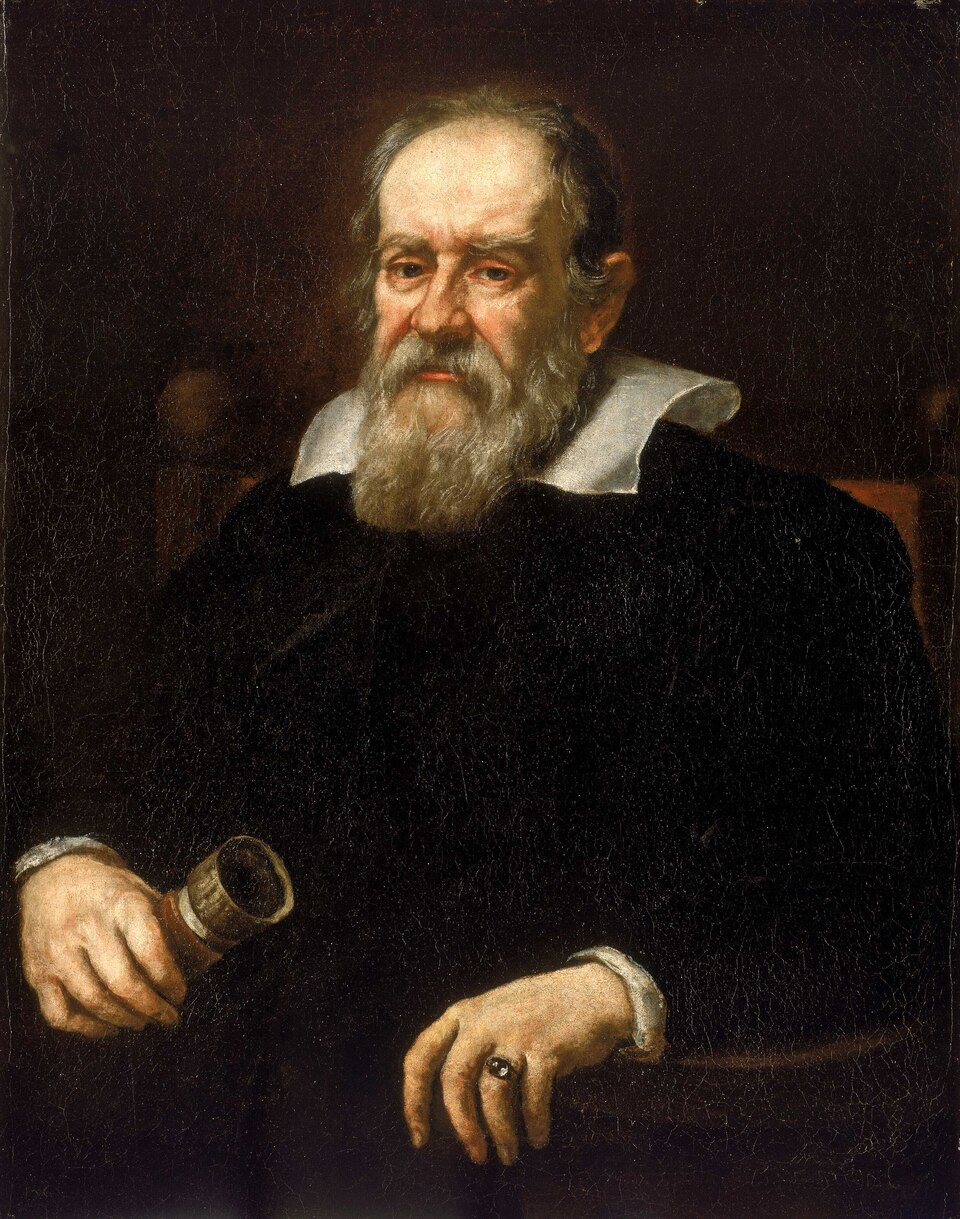
The person
Galileo Galilei (1564–1642) was an Italian astronomer, physicist, and mathematician whose improvements to the telescope and advocacy of the Copernican system brought him into conflict with the Roman Catholic Church. His trial by the Inquisition in 1633 and subsequent house arrest became a symbol of the struggle between science and religious authority. Drawing on authentic sources, Karl von Gebler's work illuminates Galileo's scientific achievements, his deep Catholic faith, and the complex historical circumstances that led to his condemnation.
Because Galileo's story is not only about scientific discovery but also about the relationship between science and authority. His trial exemplifies the tensions that arise when new empirical knowledge confronts entrenched dogma. Galileo's insistence on separating the realms of science and faith, and his courage in defending his observations, have made him a lasting icon of intellectual freedom and scientific inquiry.
Life in motion
Drag to travel through time · Ctrl/⌘ + scroll or pinch to zoom · Select a moment for the full account
Published a small book on the design of a hydrostatic balance he had invented.
Why it matters: First brought him to the attention of the scholarly world.
Wikipedia ↗Operating system
The conflict between Galileo's scientific findings and the Church's interpretation of Scripture, culminating in his trial and condemnation.
Evidence: Gebler details the Church's prohibition of Copernican works and Galileo's trial, highlighting the institutional opposition to his ideas.
Galileo's insistence on empirical evidence and mathematical demonstration as the basis for knowledge, in contrast to reliance on authority or Scripture.
Evidence: In his letter to Diodati, Galileo argues that if demonstration proves the Earth moves, it would be an embarrassment to those who declared it heresy based on literal interpretation of Scripture.
Despite his scientific views, Galileo remained a devout Catholic, seeking to harmonize his discoveries with his faith and submitting to Church authority.
Evidence: The text notes that Galileo was 'a true son of the Church' and that he sought Church approval for his works, even going to Rome to obtain the imprimatur for his Dialogues.
The use of institutional power to suppress ideas and the personal consequences for those who challenge authority.
Evidence: Galileo's house arrest, the strict surveillance by the Inquisition, and the refusal to allow him to receive delegates from Protestant countries illustrate the Church's control over his life.
The physical and emotional toll of Galileo's scientific work and persecution, including his blindness and the death of his daughter.
Evidence: The text describes Galileo's deteriorating health, his blindness, and the strict limitations imposed on his movements and contacts, reflecting the personal sacrifices he endured.
The scholarly investigation into the authenticity of documents related to Galileo's trial, revealing potential forgeries and the importance of critical historical analysis.
Evidence: Gebler discusses the examination of the Vatican MS and the suspicion of forgery surrounding the note of 26 February 1616, later concluded to be authentic.
The myths surrounding Galileo, such as 'E pur si muove' and the alleged torture, and the process by which his story has been shaped and contested.
Evidence: The index lists 'Current Myths' and 'Torture Refuted,' and Gebler's work aims to correct misconceptions based on documentary evidence.
Read through your work
Leaders
Galileo navigated a complex political landscape with church, academia, and courts. As a leader, he had a clear vision—to establish a new natural philosophy—and he worked to win over powerful patrons, including the Pope and the Medici. But his leadership failed when he lost the trust of key stakeholders. Pope Urban VIII felt personally betrayed by the 'Dialogue,' which Galileo had submitted for review but seemed to mock the Pope's own argument. The result: persecution of the leader who relied on a single patron. Leadership requires not only integrity but also sound political acumen.
In his words
“If Fromond, or any one else, had settled that the opinion that the earth moves is a heresy, and if afterwards, demonstration, observation, and necessary concatenation should prove that it does move, into what embarrassment he would have brought himself and the holy Church.”
“Why, in our search for knowledge of the various parts of the universe, should we begin rather with the words than with the works of God? Is the work less noble or less excellent than the word?”
“If it be true that the earth moves and the sun stands still, it is no detriment to Holy Scripture, since it speaks of things as they appear to the people.”
“It will really be a wonderful thing, if, as he promises, he raises astrology by his acuteness to the first rank among human sciences, and I await such a startling novelty with great curiosity.”
“I am extremely obliged to you for having induced Signor Hortensius to give up his intended journey, and thereby averted some calamity from me which would probably have been in store for me if he had come.”
“But having been often and often convinced by experience of the tricks fate plays me, I can but expect from its obstinate perfidy, that what would be an advantage to any one else will never bring anything but harm to me.”
“And all this although, in order to obtain the _imprimatur_, I went in person to Rome, and submitted the manuscript to the Master of the Palace, who looked through it most carefully, altering, adding, and omitting, and even after he had given it the _imprimatur_, ordered that it should be examined again at Florence.”
“The person who was to come to see Galileo has neither appeared in Florence, nor is likely to appear, so far as I am informed; but I have not yet been able to learn whether in consequence of some hindrance on the journey or from some other cause.”
Put into practice
Galileo argued that the Bible teaches how to go to heaven, not how the heavens go. He believed that nature and Scripture both come from God and cannot conflict if properly interpreted.
Galileo insisted on observation and demonstration over appeals to authority or tradition, believing that evidence should trump even trusted sources.
Galileo never publicly recanted the truth, but he also used careful language and sought approval from authorities. He balanced boldness with caution.
Galileo warned against declaring a scientific opinion heretical, as it could embarrass the Church if later proved true.
Despite house arrest, blindness, and personal loss, Galileo continued to work and correspond with other scientists, leaving a legacy of resilience.
Gebler's work emphasizes the need to examine original documents to correct historical myths and understand events accurately.
Galileo's trial demonstrates how powerful institutions can suppress ideas and punish individuals who challenge them, often to the detriment of progress.
Galileo has become a legend, but understanding the historical person involves recognizing his complexities: his faith, his political calculations, and his human flaws.
Galileo used dialogues and accessible writing to present his ideas, but also acknowledged the challenges of convincing audiences.
Read with judgment
Galileo's greatness lies in his insistence that empirical evidence and mathematical demonstration, not authority or scripture, should decide questions of natural philosophy. He perfected the telescope and made observations—Jupiter's moons, Venus's phases, sunspots—that demolished Aristotelian cosmology. His letters and books, especially 'The Assayer' with its famous dictum that the universe is written in mathematical language, pioneered a modern scientific method. Yet his greatness also stems from his nerve: he defended a model condemned by the Church and published it anyway, albeit under the guise of a balanced dialogue. That combination of rigorous observation and bold communication, against institutional pressure, made him a founding figure of the scientific revolution.
Galileo lived the contradiction between radical empirical method and conventional religious piety. He was a devout Catholic who sought Church approval for his works, even traveling to Rome for an imprimatur, yet his science undercut the Church's geocentric worldview. He argued for a strict separation of science and scripture, insisting the Bible teaches how to go to heaven, not how the heavens go, but he could not escape the Church's jurisdiction. When confronted by the Inquisition, he recanted, yet apocryphally whispered 'E pur si muove.' This tension—between fidelity to faith and fidelity to evidence—was unresolved in his life and remains a touchstone for debates about science and authority.
Galileo's shadow side includes a streak of sarcasm and personal vindictiveness, seen in his disputes with opponents like Christoph Scheiner over sunspots. His 'Dialogue' was crafted to persuade, but his mocking portrayal of the Aristotelian in the dialogue made powerful enemies, possibly including Pope Urban VIII. His overconfidence in the Jesuits' support and his failure to anticipate the political fallout of his rhetoric arguably provoked his trial. Also, his abandonment of the Copernican position under threat, though pragmatic, is a stark reminder that he was not an unblemished martyr but a man weighing survival against principle.
Galileo's story is startlingly modern in an era of misinformation and institutional distrust. His insistence on evidence over authority speaks to today's battles over scientific consensus, from climate change to vaccine mandates. His concept that scripture speaks of 'things as they appear to the people' offers a model for accommodating new discoveries within religious frameworks. Moreover, his trial by the Inquisition, and the Church's later reversal, showcases how institutions can eventually adapt to new knowledge. For scientists, communicators, and citizens, Galileo remains a touchstone for the ethics of truth-telling and the mechanisms of power.
Learn from Galileo by separating evidence from opinion in your own life and by developing a method for persuasive communication without succumbing to unnecessary provocation. His strategic prudence—submitting to authority even while promoting controversial ideas—shows that civil disobedience can be blended with survival in hostile environments. To internalize his lesson, deliberately seek out evidence that contradicts your current beliefs, and engage with it honestly. In public advocacy, emulate Galileo's use of dialogue—addressing the strongest counterarguments and making the ethical case—but avoid the hubris that led him to mock opponents too fiercely. His ultimate resilience, continuing to write even while under house arrest and blind, is a call to persist in your work regardless of setbacks.
The best entry point is the section of Gebler's 'Galileo Galilei and the Roman Curia' containing Galileo's letter to Diodati (circa 1635), where he argues that if demonstration proved the earth moves, it would embarrass those who declared it heresy. This quote encapsulates his method, his prescience, and his faith. Following that, the chapter on his arrival at Rome provides a visceral sense of his precarious situation and the political machinations leading to his trial.
The human network
Patron and later adversary
Urban VIII, as Cardinal Maffeo Barberini, was a friend and supporter of Galileo, but as Pope he allowed the trial to proceed. The shift from patron to adversary highlights the conflict between personal relationships and institutional authority.
Admonisher
In 1616, Bellarmine admonished Galileo to abandon the Copernican opinion. This event was later used against Galileo in his trial.
Correspondent and friend
Galileo wrote many letters to Diodati, discussing and complaining about his situation. These letters provide key evidence of Galileo's thoughts and treatment.
Historical researcher
A German scholar who questioned the authenticity of the 1616 prohibition. His work contributed to the historical reassessment of the trial.
Continue the inquiry
Newton built on Galileo's work in mechanics and astronomy, synthesizing them into universal laws.
Scientific revolution · Empirical inquiry
A contemporary who also defended the Copernican system and formulated laws of planetary motion.
Heliocentrism · Astronomy
Another Italian thinker who was executed for his cosmological views, providing a tragic contrast.
Cosmology · Conflict with Church
A philosopher-scientist influenced by the scientific method, who also faced pressure from authorities.
Methodology · Free inquiry
A scientist whose theory of evolution faced religious opposition, echoing Galileo's conflict.
Science vs religion · Empirical evidence
Source shelf
link
Karl von Gebler
View source →reference
Wikipedia contributors
View source →reference
Wikidata contributors
View source →Source basis: This analysis is based primarily on Karl von Gebler's 'Galileo Galilei and the Roman Curia' (source_id 95), a 19th-century treatise that draws on authentic Vatican and private documents. It provides direct quotes from Galileo's letters to Diodati, reports from the Inquisition, and detailed narrative of his trial and house arrest. The Wikipedia timeline (source_id 97) and Wikidata (source_id 98) provide supplementary factual context. All quotations are from letter to Diodati and related correspondence as excerpted in Gebler's work, with medium confidence due to historical translation and selection.
Direct answers
The phrase 'And yet it moves' is attributed to Galileo after his recantation, but there is no firm documentary evidence that he ever uttered it. Gebler's work on the Roman Curia and the Vatican MS does not include it, and the legend likely emerged later to symbolize Galileo's defiance. The myth persists because it encapsulates the idea that truth will out, but historians generally view it as apocryphal.
No, Galileo was not physically tortured, though he was threatened with it. The Inquisition's proceedings show that he was held in the palace of the Inquisition and examined, but he did not undergo torture. He was found 'vehemently suspect of heresy' and sentenced to house arrest, which was comparatively lenient. Gebler's text explicitly refutes the myth of torture based on the official records.
Galileo's conflict with the Church was fundamentally about the authority to interpret truth. The Church held that Scripture was the ultimate authority, but Galileo argued that nature and Scripture both come from God and cannot conflict when properly interpreted. He insisted that empirical evidence and mathematical demonstration should take precedence in matters of science, leading to his trial when his defense of heliocentrism appeared to contradict scripture.
Galileo reconciled his science with his faith by arguing for separation of domains: the Bible teaches how to go to heaven, not how the heavens go. He maintained that God's works (nature) and God's words (Scripture) are both true, and if contradicted, then the interpretation of Scripture must be reconsidered. This view, expressed in his letters to Diodati, showed his deep belief in the harmony of science and religion when each is used in its proper sphere.
Galileo's telescopic discoveries include the moons of Jupiter (often called the Galilean moons), the phases of Venus, sunspots, and the ruggedness of the Moon's surface. These observations provided strong evidence for the Copernican heliocentric system and challenged the Aristotelian idea of perfect, unchanging heavens. His work on mechanics, as in 'Two New Sciences,' also laid foundations for kinematics and material strength.
Galileo was forced to recant because the Inquisition considered his defense of heliocentrism to contradict the geocentric worldview supported by Scripture and Church doctrine. In 1616, the Copernican thesis was declared heretical, and Galileo was admonished to abandon it. When he later published his 'Dialogue,' which advocated Copernicanism, he was seen as violating that order, leading to his trial. The political context, including Pope Urban VIII's feeling of betrayal, also played a major role.
After his recantation, Galileo was sentenced to house arrest for life. He returned to his villa at Arcetri, where he remained confined. Despite blindness and personal losses, he continued his scientific work and correspondence with other scholars. In 1638, he published his last major work, 'Two New Sciences,' in Holland. He died in 1642, with his reputation partially rehabilitated only centuries later by the Church.