Business & Entrepreneurship · 1863–1947 AD

Henry Ford

Industrial Pioneer and Author of 'My Life and Work'

The defining question

How can industry serve the greatest number of people while remaining profitable and sustainable?

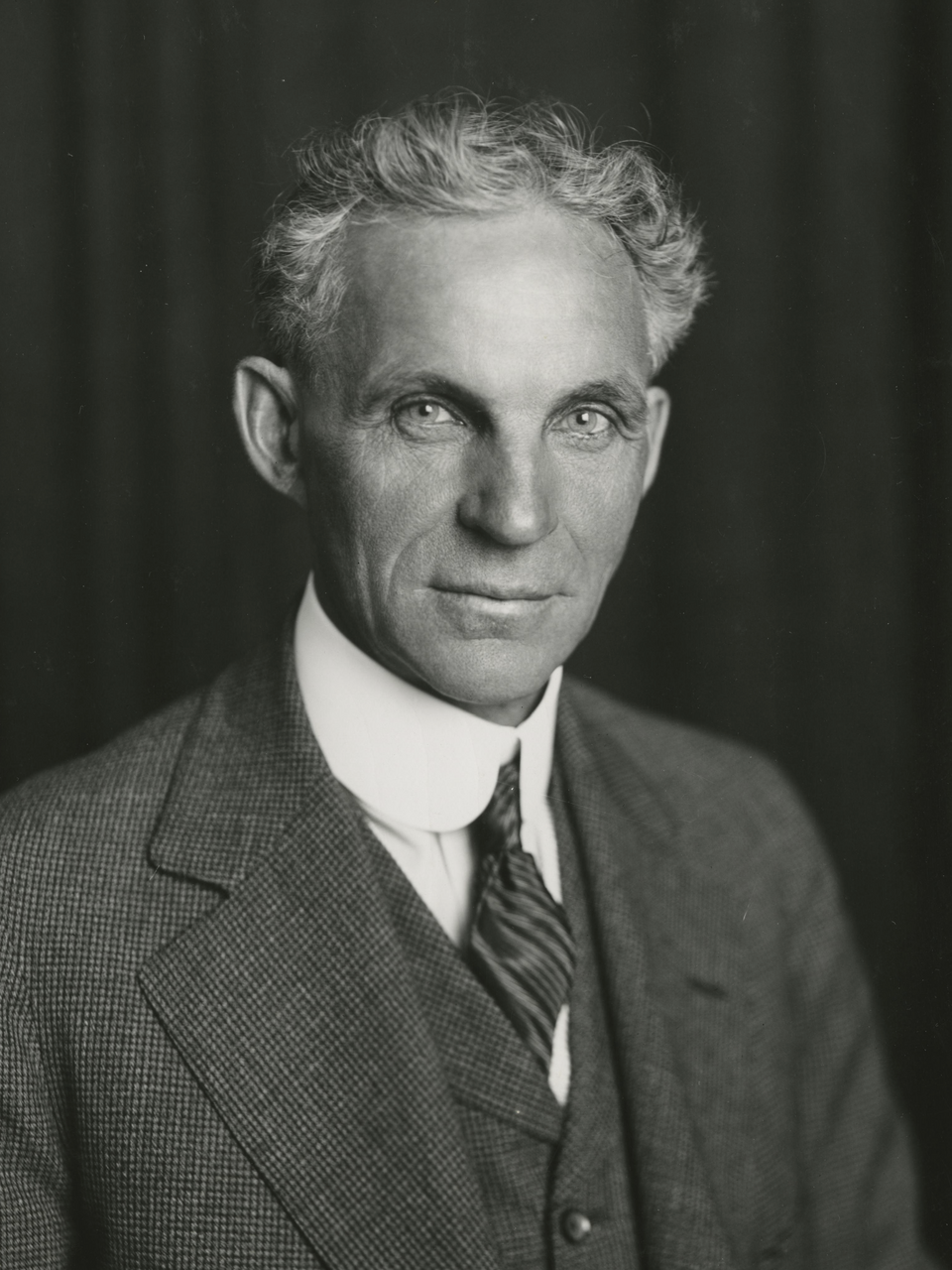
Portrait of Henry Ford
Ford Motor Company. Photographic Department · Public Domain

The person

A life under examination

Who he was

Henry Ford transformed the automobile industry with the Model T and the moving assembly line, championing high wages, low prices, and vertical integration. His 1922 autobiography, 'My Life and Work', outlines his philosophy of service, efficiency, and the dignity of labor.

Why he matters

Ford's radical ideas on production and consumption created a virtuous cycle of prosperity, proving that high wages and low prices can drive economic growth. His principles of continuous improvement, waste elimination, and service above profit continue to influence modern manufacturing and business strategy.

Life in motion

Timeline

24 sourced moments across the life of Henry Ford

Drag to travel through time · Ctrl/⌘ + scroll or pinch to zoom · Select a moment for the full account

1879

Apprenticeship in Detroit

Ford left home at age 16 to become an apprentice machinist in Detroit, working for James F. Flower & Brothers and later the Detroit Dry Dock Company.

Why it matters: His mechanical training laid the foundation for his future career in engineering and manufacturing.

Wikipedia

Operating system

Core themes

01

The Sacredness of Work

Ford believed work is a natural and necessary part of human life. He rejected idleness and saw employment as a moral imperative, arguing that problems like poverty and social unrest stem from unnatural attempts to avoid work.

Evidence: In the introduction, he states: 'The natural thing to do is to work--to recognize that prosperity and happiness can be obtained only through honest effort. Human ills flow largely from attempting to escape from this natural course.'

02

Service Before Profit

Ford's central business philosophy is that service to customers and society must come before profit. He criticized the prevailing financial system for encouraging waste and hindering service, and he insisted that his company's success was evidence that his theory of service works.

Evidence: He writes: 'I am thinking of service. The present system does not permit of the best service because it encourages every kind of waste--it keeps many men from getting the full return from service.'

03

The Virtue of Simplicity

Ford championed simplicity in product design, manufacturing, and business operations. He famously offered the Model T only in black to streamline production and focused on perfecting one model rather than constantly changing styles.

Evidence: He notes: 'Any customer can have a car painted any colour that he wants so long as it is black.' This quote illustrates his commitment to standardization.

04

Continuous Improvement and Waste Elimination

Ford was obsessed with eliminating waste in all forms—time, materials, and effort. He applied this to production, purchasing, and even farming, and he saw it as a natural law that benefits everyone.

Evidence: He says: 'The principles of service cannot fail to cure bad business.' He also describes how buying ahead for speculation is a form of waste that ultimately harms the manufacturer.

05

The Dignity of the Worker

Contrary to some perceptions, Ford advocated for treating workers with respect and providing them with good wages and working conditions. He believed that well-paid workers become better consumers and lead more fulfilling lives.

Evidence: In the chapter on wages, he argues: 'The payment of high wages is one of the best ways to reduce costs.' He also insisted on hiring disabled people and giving them meaningful work.

06

Skepticism of Ideologies and Experts

Ford distrusted both reformers and reactionaries, as well as financial and legal experts. He valued practical experience and common sense over theoretical knowledge, and he believed that most social problems require pragmatic, workable solutions, not grand ideologies.

Evidence: He writes: 'Skepticism, if by that we mean cautiousness, is the balance wheel of civilization. Most of the present acute troubles of the world arise out of taking on new ideas without first carefully investigating to discover if they are good ideas.'

07

Service over Profit

Ford consistently argued that business should focus on service to the customer and society, with profit as a byproduct. He believed that the industrial idea is to express a serviceable idea and duplicate it for as many people as need it.

Evidence: In the introduction, Ford writes: 'The present system does not permit of the best service because it encourages every kind of waste... And it is going nowhere. It is all a matter of better planning and adjustment.'

08

High Wages and Low Prices

Ford pioneered the idea that paying workers well and lowering prices expands the market and benefits everyone. He implemented the $5 workday and systematically reduced the price of the Model T, leading to skyrocketing sales.

Evidence: The chapter 'How Cheaply Can Things Be Made?' shows a table of price reductions and production increases: '1909-10 $950 18,664 cars; 1910-11 $780 34,528; 1911-12 $690 78,440; 1912-13 $600 168,220; 1913-14 $550 248,307.'

09

Elimination of Waste

Ford emphasized the elimination of all forms of waste—time, materials, and effort—as a core principle. He advocated for buying only what is needed, reducing inventory, and improving transportation to achieve efficiency.

Evidence: In 'How Cheaply Can Things Be Made?', Ford writes: 'We have found in buying materials that it is not worth while to buy for other than immediate needs... The only way to keep out of trouble is to buy what one needs--no more and no less.'

010

Simplicity and Standardization

Ford championed the idea of building one model in one color—the Model T in black—to achieve economies of scale and simplify production. He resisted style changes and multiple models, believing that standardization lowers costs and improves quality.

Evidence: In the section on production, Ford states: 'Any customer can have a car painted any colour that he wants so long as it is black.' He also announced: 'I will build a motor car for the great multitude... so low in price that no man making a good salary will be unable to own one.'

011

Education and Vocational Training

Ford believed in practical education that combines academic learning with industrial training. He established the Henry Ford Trade School to give boys both book knowledge and hands-on skills, ensuring they could earn a living and contribute to industry.

Evidence: The chapter on education describes: 'The Henry Ford Trade School was incorporated in 1916... three cardinal principles: first, that the boy was to be kept a boy... second, that the academic training was to go hand in hand with the industrial instruction; third, that the boy was to be given a sense of pride and responsibility in his work.'

012

Industrial Democracy and Cooperation

Ford saw business as a cooperative endeavor where everyone involved—workers, managers, and the public—are partners. He believed that high wages and low prices distribute the fruits of industry fairly.

Evidence: In the section on wages, Ford writes: 'All employees are really partners.' He also states: 'The principles of service cannot fail to cure bad business.'

013

Skepticism of Reform and Speculation

Ford was critical of both radical reformers and reactionaries, as well as speculative business practices. He argued that change should be based on practical experience and that speculation distracts from genuine production and service.

Evidence: In the introduction, Ford states: 'I have no quarrel with the general attitude of scoffing at new ideas. It is better to be skeptical of all new ideas and to insist upon being shown...' He also writes: 'We have found... that buying ahead of requirements does not pay--that the gains on one purchase will be offset by the losses on another.'

014

Service Above Profit

Ford emphasized that the primary purpose of business is to serve people, not to accumulate wealth for its own sake. He believed that by focusing on service, profit would follow.

Evidence: In the foreword, Ford states, 'Money doesn't do me any good... Money has no value, anyway. It is merely a transmitter, like electricity. I try to keep it moving as fast as I can, for the best interests of everybody concerned. A man can't afford to look out for himself at the expense of any one else, because anything that hurts the other man is bound to hurt you in the end, the same way.'

015

Cooperation and Mutual Benefit

Ford's business model was based on the idea that helping other people helps oneself. He implemented profit-sharing and lowered prices to make products accessible, showing that cooperation is practical.

Evidence: In the chapter on the European War, Ford says, 'It is to everybody's interest to do right. Not in the next world, nor in a spiritual way only, but in good, hard dollars-and-cents business value.'

016

Efficiency and Waste Elimination

Ford revolutionized manufacturing by focusing on eliminating waste, streamlining production, and creating machines that reduced physical labor. His methods made production more efficient and affordable.

Evidence: The narrative describes his factory planning: 'Every part was to be machined to exact size. No supplementary fitting in the assembling room was to be necessary. From the time the raw iron entered one end of the factory till the finished car rolled away from the other end, there was not to be a moment's delay, a wasted motion.'

017

Practical Idealism

Ford believed that ideals are the most practical things in the world. He proved that treating workers well, sharing profits, and making quality products affordable were not just moral but financially sound.

Evidence: In his speech against war preparedness, he declares, 'they must know the true principles on which to build a great, strong nation. They must hold firm to the big, true things, and realize--some way they must be MADE to realize--that they are practical, that ideals are the only practical things in this world.'

018

Determination and Persistence

Ford's journey involved many setbacks, from ridicule to legal battles, but he persevered. His success was built on relentless work and refusal to give up.

Evidence: The narrative describes his early struggles: 'Ford realized then, probably for the first time, how much the making of the automobile had cost her... He would give up his job at the Edison plant and move to the farm to live, since she cared so much about it, he said. His work on the machine could wait.' Yet, he continued anyway.

019

The Value of Labor

Ford held a deep respect for workers, seeing them as parts of a great machine. He believed that fair wages and good working conditions were essential to productivity and success.

Evidence: In the foreword, Rose Wilder Lane observes, 'He sees men all as parts of a great machine, in which every waste motion, every broken or inefficient part means a loss to the whole.'

020

Anti-War and Human Brotherhood

Ford strongly opposed war, seeing it as a waste of human energy and life. He advocated for peaceful cooperation as the only practical path to progress.

Evidence: In the final chapter, he argues, 'War is the most hideous waste in the world' and 'The only real strength of a nation is the spirit of its people. The only real, practical value in the world is the spirit of the people of the world.'

Read through your work

Key takeaways for...

Leaders

Henry Ford on joining responsibility with self-command and service

Henry Ford matters to leaders because their life offers a concrete study of joining responsibility with self-command and service.

  1. 01Ford believed work is a natural and necessary part of human life. He rejected idleness and saw employment as a moral imperative, arguing that problems like poverty and social unrest stem from unnatural attempts to avoid work.
  2. 02Ford believed that lowering prices expands the market and increases total profit. He relentlessly cut prices as production efficiency improved, making cars affordable to the average worker.
  3. 03Ford famously introduced the $5 a day wage in 1914. He argued that high wages reduce turnover, increase loyalty, and create customers who can afford to buy the very products they make.

In his words

Useful quotations

To illustrate: Here is a great industry whose success is due to having met a public need with efficient and skillful production.
My Life and WorkGo to passage
Thus price reduction forces us to learn improved and less wasteful methods of production.
My Life and WorkGo to passage
But I would not be counted a success; I would be, in fact, a flat failure if I could not accomplish that and at the same time make a fair amount of profit for myself and the men associated with me in business.
My Life and WorkGo to passage
In and out of industry there must be jobs that take the full strength of a powerful man; there are other jobs, and plenty of them, that require more skill than the artisans of the Middle Ages ever had.
My Life and WorkGo to passage
They repair their own machines; they learn how to take care of themselves around machinery; they study pattern-making and in clean, well-lighted rooms with their instructors they lay the foundation for successful careers.
My Life and WorkGo to passage
It is easy to grow sentimental out of doors; it is hard to pursue the truth about a bird as one would pursue a mechanical principle.
My Life and WorkGo to passage
Not only are they business failures; they are character failures also; it is as if their bones never attained a sufficient degree of hardness to enable them to stand on their own feet.
My Life and WorkGo to passage
Power and machinery, money and goods, are useful only as they set us free to live. They are but means to an end.
My Life and WorkGo to passage
When one speaks of increasing power, machinery, and industry there comes up a picture of a cold, metallic sort of world in which great factories will drive away the trees, the flowers, the birds, and the green fields.
My Life and WorkGo to passage
Power and machinery, money and goods, are useful only as they set us free to live.
My Life and WorkGo to passage

Put into practice

Lessons worth keeping

Price to Reach the Mass Market

Ford believed that lowering prices expands the market and increases total profit. He relentlessly cut prices as production efficiency improved, making cars affordable to the average worker.

Try it: In today's tech industries, companies like Amazon and Xiaomi use similar strategies: low margins, high volume, and continuous cost reduction to dominate markets.

Pay High Wages to Boost Productivity and Demand

Ford famously introduced the $5 a day wage in 1914. He argued that high wages reduce turnover, increase loyalty, and create customers who can afford to buy the very products they make.

Try it: Companies like Costco and Salesforce follow this principle by paying above-market wages, leading to low turnover and high employee performance.

Standardize and Simplify

Ford's insistence on a single model and limited options kept manufacturing costs low and quality high. He resisted the temptation to change models frequently.

Try it: When designing products, focus on core features that meet the widest customer needs rather than excessive customization. This is visible in Apple's product line strategy.

Eliminate Waste Ruthlessly

Ford was fanatical about eliminating waste in time, materials, and effort. He examined every process and redesigned it to be more efficient.

Try it: Lean manufacturing and Six Sigma methodologies are direct descendants of Ford's principles. Companies like Toyota and Intel use waste elimination as a core strategy.

Own Your Supply Chain

Ford vertically integrated to ensure control over materials, transportation, and production. He owned mines, forests, and even a railroad to reduce costs and dependencies.

Try it: Tesla's vertical integration in batteries and manufacturing, and Amazon's ownership of logistics, reflect Ford's approach.

Challenge Traditional Experts

Ford dismissively said, 'Lawyers, like bankers, know absolutely nothing about business.' He relied on practical experience and innovation over conventional wisdom.

Try it: Innovators often need to ignore naysayers and disrupt traditional industries. Elon Musk's ventures are examples of questioning established expertise.

Price for the Mass Market, Not Just the Luxury Buyer

Ford succeeded by aiming to build a car that the average family could afford, rather than catering to wealthy customers. He constantly reduced prices, which expanded his market and increased sales.

Try it: Businesses can adopt a strategy of low-cost, high-volume offerings to reach a broader customer base and achieve economies of scale.

Standardize for Efficiency

Ford's decision to build only one model (the Model T) in one color (black) reduced complexity, cut costs, and allowed for mass production.

Try it: Simplify product lines and processes to improve quality and reduce costs, especially in manufacturing.

Pay Workers Well to Increase Productivity and Demand

Ford introduced the $5 workday, recognizing that well-paid workers are more productive and can also be customers. This boosted morale and created a larger consumer base.

Try it: Consider fair wages as an investment in employee engagement and market growth.

Read with judgment

Greatness, contradiction, and use

What made them great

Henry Ford joined The Sacredness of Work, Service Before Profit, The Virtue of Simplicity with a life that made those principles consequential rather than merely theoretical.

The central contradiction

Henry Ford's ideals must be studied alongside the consequences, relationships, and institutional pressures visible in Samuel Crowther's connection to their life.

Lessons from failure

Learning from Henry Ford requires examining failures, blind spots, and outcomes as seriously as admired ideas. Greatness is evidence for study, not immunity from criticism.

Modern relevance

Henry Ford remains relevant wherever people face responsibility, uncertainty, competing incentives, and the challenge of turning principles into conduct.

How to learn from them

Begin with My Life and Work, compare it with reliable reference sources, then test Price to Reach the Mass Market in a real decision.

Best entry point

Start with My Life and Work. Read for the central ideas, then compare those ideas with the timeline and relationships on this page.

The human network

Key relationships

Collaborator

Samuel Crowther

Co-author of 'My Life and Work' and later works. He helped articulate Ford's ideas in accessible prose.

Competitor

Alexander Winton

A race car builder and driver whom Ford beat in a race in 1901. This race victory brought Ford attention and helped build his reputation.

Collaborator

Tom Cooper

Cooper helped Ford build the '999' and 'Arrow' race cars. Cooper's expertise aided Ford in motor racing.

Legal Opponent

George B. Selden

Selden held a patent on the automobile, leading to a famous lawsuit against Ford Motor Company. Ford fought the patent, which eventually helped open the industry to competition.

Father

William Ford

Henry's father, William, was a farmer who initially expected Henry to take over the farm. Henry's father's farming background contrasted with Henry's mechanical ambitions, shaping his path.

Business Partner

James Couzens

Couzens was Henry's business partner, helping manage the company and finance operations. Couzens was instrumental in the company's early success, handling finances and sales.

Biographer

Rose Wilder Lane

Lane authored 'Henry Ford's Own Story' based on interviews with Ford. Her account provides a unique source for understanding Ford's life and views.

Continue the inquiry

Related greats

Thomas Edison

Like Ford, Edison was a self-made inventor and industrialist who emphasized practical innovation and mass production of ideas.

Innovation · Persistence · Industrialization

Alfred P. Sloan

Sloan, who led General Motors, represented a contrasting strategy of multi-model product lines and styling, which eventually overtook Ford's single-model approach.

Mass Production · Market Segmentation · Leadership

John D. Rockefeller

Another industrialist who built a massive vertical integrated enterprise, but with a more monopolistic approach that Ford criticized.

Vertical Integration · Oil and Steel · Wealth

Elon Musk

A modern industrialist who shares Ford's obsession with production efficiency, vertical integration, and making advanced technology widely accessible.

Mass Production · Transformation of Transportation · Ambitious Vision

Frederick Winslow Taylor

Both advocated for scientific management and efficiency in industry. Taylor's 'Taylorism' influenced Ford's assembly line, though Ford's approach was more holistic, including higher wages.

Scientific Management · Efficiency · Production

Andrew Carnegie

Carnegie, like Ford, was a titan of industry who amassed vast wealth and wrote about business. Carnegie's 'Gospel of Wealth' contrasts with Ford's focus on service and fair wages.

Industrial Wealth · Philanthropy · Capitalism

John Burroughs

Burroughs was a close friend and naturalist. Ford was an admirer of Burroughs, and they shared an appreciation for rural life and nature.

Nature · Rural Life · Friendship

Harvey Firestone

Firestone was a business associate and friend; their companies had a symbiotic relationship, as Firestone supplied tires for Ford cars.

Automotive Industry · Business Partnership · Innovation

Source shelf

Recommended sources

Source basis: This profile draws on My Life and Work, Henry Ford's Own Story, Henry Ford — Wikipedia, Henry Ford — Wikidata. Source-backed claims and quotations retain provenance where available.

Direct answers

Frequently asked questions about Henry Ford

Who was Henry Ford?

Henry Ford transformed the automobile industry with the Model T and the moving assembly line, championing high wages, low prices, and vertical integration. His 1922 autobiography, 'My Life and Work', outlines his philosophy of service, efficiency, and the dignity of labor.

What is Henry Ford best known for?

Ford's radical ideas on production and consumption created a virtuous cycle of prosperity, proving that high wages and low prices can drive economic growth. His principles of continuous improvement, waste elimination, and service above profit continue to influence modern manufacturing and business strategy.

What can leaders learn from Henry Ford?

Ford believed that lowering prices expands the market and increases total profit. He relentlessly cut prices as production efficiency improved, making cars affordable to the average worker.

What are Henry Ford's most important ideas?

The core ideas highlighted by this profile are The Sacredness of Work, Service Before Profit, The Virtue of Simplicity, Continuous Improvement and Waste Elimination.

What made Henry Ford great?

Henry Ford joined The Sacredness of Work, Service Before Profit, The Virtue of Simplicity with a life that made those principles consequential rather than merely theoretical.

How is Henry Ford connected to Samuel Crowther?

Co-author of 'My Life and Work' and later works. He helped articulate Ford's ideas in accessible prose.

What are the best sources for learning about Henry Ford?

Start with My Life and Work, Henry Ford — Wikipedia, Henry Ford — Wikidata, Henry Ford's Own Story, then compare primary texts with reliable historical reference sources.
