


.jpg)
1508
Begins teaching at University of Wittenberg
Luther began teaching theology at the University of Wittenberg.
Why it matters: This position became his base for the Reformation.
Wikipedia ↗Religious & Spiritual · 1483–1546 AD
The Reformer Who Challenged the Church's Sale of Salvation
The defining question
What is the true source and cost of salvation, and how does the church's authority relate to God's grace?
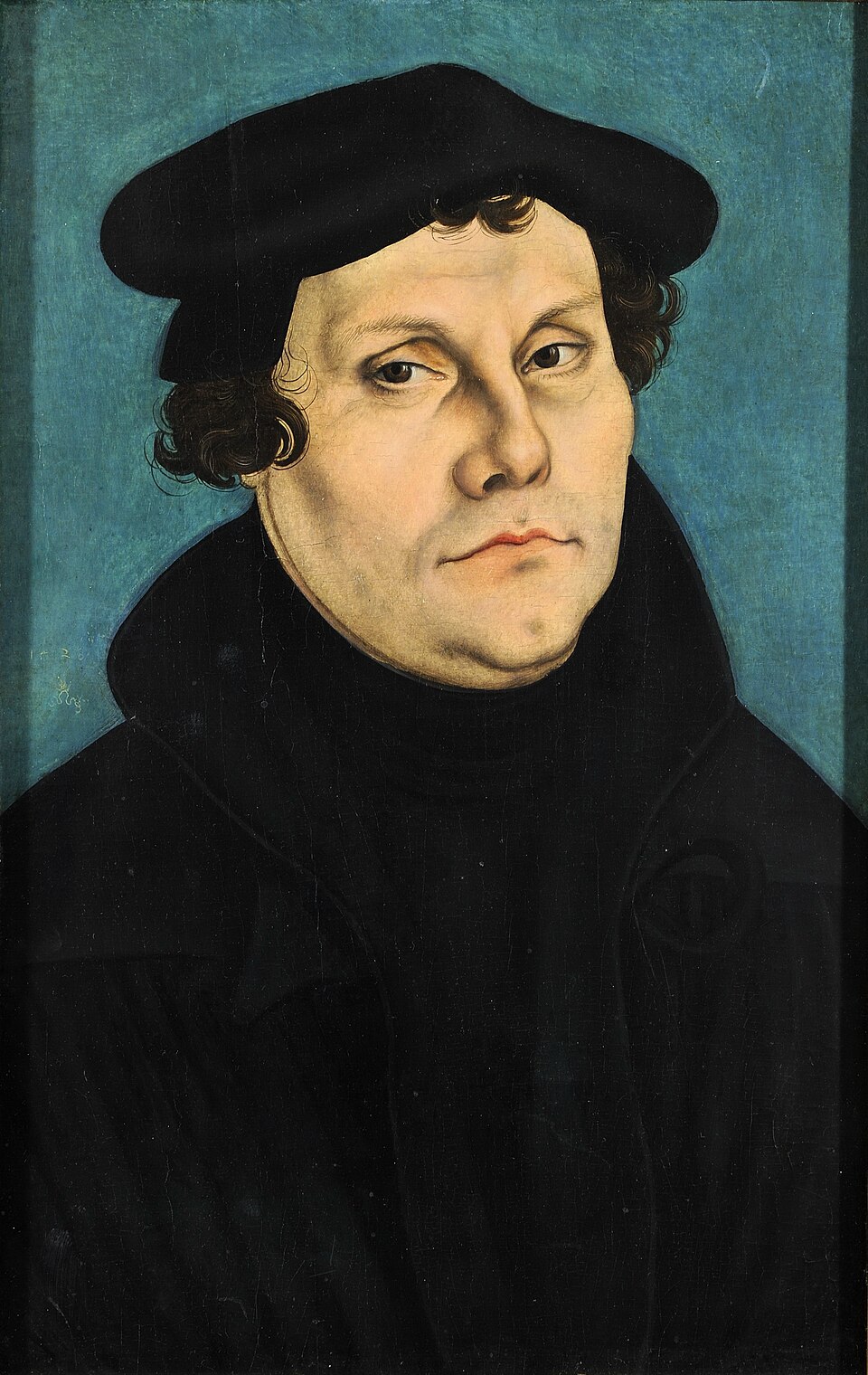
The person
Martin Luther, an Augustinian monk and professor of theology at the University of Wittenberg, ignited the Protestant Reformation with his Ninety-Five Theses on October 31, 1517. His disputation on indulgences challenged the papal practice of selling forgiveness, asserting that true repentance is a lifelong calling and that salvation comes through faith in God's grace rather than the purchase of pardons.
Luther's disputation on indulgences crystallized the theological and ethical grievances that launched the Reformation, transforming Western Christianity. His insistence on the primacy of scripture and the individual believer's direct relationship with God reshaped religious thought and practice, influencing subsequent movements for religious freedom and social reform.
Life in motion
Drag to travel through time · Ctrl/⌘ + scroll or pinch to zoom · Select a moment for the full account
Luther began teaching theology at the University of Wittenberg.
Why it matters: This position became his base for the Reformation.
Wikipedia ↗Operating system
Luther redefines repentance as a lifelong, inward transformation that manifests in outward works, rejecting the sacramental system of confession and satisfaction as the sole path.
Evidence: Theses 1-4: 'Our Lord and Master Jesus Christ, when He said Poenitentiam agite, willed that the whole life of believers should be repentance.'
The pope cannot remit guilt or penalties beyond those he has imposed; his authority is delegated, not absolute, and does not extend to purgatory.
Evidence: Theses 5-6: 'The pope does not intend to remit, and cannot remit any penalties other than those which he has imposed either by his own authority or by that of the Canons.'
Luther criticizes the deceptive preaching of indulgences that leads people to rely on pardon letters for salvation, condemning the commercial exploitation of believers' fears.
Evidence: Theses 27-28: 'They preach man who say that so soon as the penny jingles into the money-box, the soul flies out [of purgatory]. It is certain that when the penny jingles into the money-box, gain and avarice can be increased...'
The real treasure is the Gospel of the glory and grace of God, not indulgences or temporal riches; it overturns human values.
Evidence: Theses 62-64: 'The true treasure of the Church is the Most Holy Gospel of the glory and the grace of God. But this treasure is naturally most odious, for it makes the first to be last.'
Bishops and pastors must guard their flocks from the false teachings of pardon preachers and prioritize the Word of God over indulgences.
Evidence: Theses 69-70: 'Bishops and curates are bound to admit the commissaries of apostolic pardons, with all reverence. But still more are they bound to strain all their eyes and attend with all their ears, lest these men preach their own dreams instead of the commission of the pope.'
The faithful raise legitimate 'scruples' about papal practices, and suppressing them by force rather than reason harms the church.
Evidence: Theses 82-90: 'Why does not the pope empty purgatory...? To repress these arguments and scruples of the laity by force alone, and not to resolve them by giving reasons, is to expose the Church and the pope to the ridicule of their enemies...'
Luther argues that faith in Christ, not works, justifies and frees the believer.
Evidence: Faith alone is the means by which the soul receives the word of God and is justified (Sample 2).
Christians are free from the law and external ceremonies for salvation, yet serve others in love.
Evidence: A Christian is free from all things, needs no works for justification, but serves neighbors voluntarily (Sample 3).
Luther criticizes the Roman Court as corrupt and as a source of spiritual bondage.
Evidence: The Church of Rome is 'more corrupt than any Babylon or Sodom' (Sample 1).
The Word alone is necessary for the soul's life and salvation, and preaching it is central to Christian ministry.
Evidence: The soul can do without everything except the word of God (Sample 2).
All Christians are priests and kings in Christ, with access to God and the duty to intercede for others.
Evidence: All who believe are kings and priests in Christ (Sample 3).
Read through your work
Leaders
Luther's leadership was a mix of visionary advocacy and pragmatic organization. He inspired millions with his message of justification by faith and the authority of scripture. Yet he struggled to manage the movement he started, as diverse factions interpreted his ideas differently. He eventually relied on secular princes to protect his church, making compromises that had long-term consequences. Leaders can learn from his ability to articulate a compelling vision and use the media to spread it, but also from his failure to build cohesive governance structures.
In his words
“Our Lord and Master Jesus Christ, when He said Poenitentiam agite, willed that the whole life of believers should be repentance.”
“Every truly repentant Christian has a right to full remission of penalty and guilt, even without letters of pardon.”
“The true treasure of the Church is the Most Holy Gospel of the glory and the grace of God.”
“They preach man who say that so soon as the penny jingles into the money-box, the soul flies out [of purgatory].”
“Why does not the pope empty purgatory, for the sake of holy love and of the dire need of the souls that are there, if he redeems an infinite number of souls for the sake of miserable money with which to build a Church?”
“The assurance of salvation by letters of pardon is vain, even though the commissary, nay, even though the pope himself, were to stake his soul upon it.”
“Christians are to be taught that if the pope knew the exactions of the pardon-preachers, he would rather that St. Peter's church should go to ashes, than that it should be built up with the skin, flesh and bones of his sheep.”
“This unbridled preaching of pardons makes it no easy matter, even for learned men, to rescue the reverence due to the pope from slander, or even from the shrewd questionings of the laity.”
“A Christian man is free from all things; so that he needs no works in order to be justified and saved, but receives these gifts in abundance from faith alone.”
“The Word of God cannot be received and honoured by any works, but by faith alone.”
Put into practice
Luther's challenge to indulgences shows that even religious authorities can be wrong, and individuals have the right and duty to question them when they violate foundational principles.
Luther's critiques highlight the dangers of financial gain being disguised as spiritual benefit, advocating for transparency and accountability in monetary transactions involving faith.
Luther emphasizes that true repentance results in works of love, not just purchasing pardons or performing rituals.
Luther called for Christians to be taught the truth about indulgences, highlighting the need for education to counteract misleading propaganda.
Luther urges resolving doubts with reasons rather than force, advocating for a reasoned approach to reform.
Luther concludes that following Christ entails suffering, not just peace and prosperity, which resonates with enduring personal and societal challenges.
Liberty comes from faith, not from external observances.
Relying on good deeds for self-worth can lead to pride and hypocrisy.
Words of truth can transform lives.
Read with judgment
Martin Luther's greatness lies in his relentless courage to question institutional authority when it contradicts foundational truths. As an Augustinian monk and theologian, he did not merely criticize the sale of indulgences; he redefined the very nature of repentance and salvation. His Ninety-Five Theses (1517) were not a sudden rebellion but a scholarly disputation grounded in scripture and reason. Luther's insistence that 'the whole life of believers should be repentance' (Thesis 1) reframed Christianity as an inward, lifelong transformation rather than a transactional system. His doctrine of justification by faith alone, articulated in 'Concerning Christian Liberty' (1520), democratized access to God, asserting that every believer is a priest. This radical idea empowered individuals to interpret scripture for themselves, leading to the Reformation's profound impact on Western civilization, including modern concepts of religious freedom and individual conscience. His greatness, however, was not without flaws, as his later writings on Jews and peasants reveal the darker side of his zeal.
Luther's central contradiction is between his advocacy for Christian liberty and his authoritarian enforcement of his own theological views. He championed the freedom of the individual from papal authority and ceremonial laws, yet he fiercely opposed the radical reformers and peasants who applied similar principles to social and political realms. He criticized the pope's power but relied on secular princes to establish and protect his reformed church. He emphasized faith alone, but his teachings led to new orthodoxies and divisions. This tension is evident in his violent condemnation of the Peasants' War (1525) and his harsh polemics against Anabaptists and Jews. His belief in the liberty of conscience did not extend to those who disagreed with him, revealing a paradox: the champion of freedom became an enforcer of his own interpretation of truth, highlighting the challenge of sustaining reform without becoming the institution he opposed.
Luther's shadow side includes his anti-Semitic writings, particularly 'On the Jews and Their Lies' (1543), which advocated violence against Jewish communities. This treatise, written late in his life, stands as a dark stain on his legacy and was later exploited by Nazi propaganda. His response to the Peasants' War was similarly brutal; he urged authorities to 'smite, slay, and stab' the rebels, leading to the deaths of thousands. These actions contradict his earlier emphasis on Christian love and freedom. Additionally, his rejection of reason in theological matters, while elevating faith, sometimes led to dogmatism and the suppression of dissent. His failure to control the radical wing of the Reformation resulted in fragmentation, and his reliance on state power created a precedent for church-state entanglement that had both positive and negative consequences. These aspects remind us that great reformers are not infallible and their zeal can lead to harm when it overrides compassion.
Luther's modern relevance is profound. His challenge to institutional corruption resonates in movements that demand accountability and transparency in organizations. His principle that individuals have the right and duty to question authority when it violates core values is foundational to whistleblowing and ethical leadership. His emphasis on inner conviction over outward compliance speaks to contemporary debates about authenticity and integrity in personal and professional life. Luther's insistence on making scripture accessible through translation parallels modern efforts to democratize knowledge and information. His notion of the priesthood of all believers influences egalitarian movements and the empowerment of laity in religious and secular institutions. At the same time, his life warns of the dangers of ideological extremism and the need for critical self-reflection. In an age of misinformation and institutional mistrust, Luther's methods of reasoned disputation and reliance on primary sources offer a model for constructive dissent.
To learn from Luther, start by reading his primary works, such as the Ninety-Five Theses and 'Concerning Christian Liberty.' Engage with his arguments critically, not just as historical artifacts but as challenges to modern assumptions. Practice his method of questioning authority: identify areas where institutions or systems you depend on have deviated from their foundational principles and consider raising your concerns based on evidence and reason, not just emotion. Emulate his courage to challenge the status quo, but also heed the lessons of his failures: temper zeal with humility and compassion, and recognize the complexity of social reform. Luther's practice of ongoing repentance can inspire a habit of self-examination and continuous learning. In your own life, cultivate the discipline of 'faith alone' by prioritizing your core values over external validations. Finally, remember that reform is a process; Luther's Reformation took years and faced many setbacks, so be patient but persistent in your efforts.
An ideal entry point is the Ninety-Five Theses itself, particularly the opening and concluding sections. Theses 1-4 define true repentance as a lifelong attitude, immediately reframing the reader's understanding. The concluding theses (82-95) offer a sharp critique of papal practices and the need for reasoned resolution. This document is accessible, concise, and encapsulates the essence of Luther's early reform. For a deeper understanding, 'Concerning Christian Liberty' expands on justification by faith and the liberty of believers, making it a comprehensive yet readable treatise. Both texts are available in modern English translations, and their historical context can be found in introductory histories of the Reformation.
The human network
historical figure
Luther references St. Peter's authority and the comparison of papal power to Peter's, insisting that even Peter could not grant greater graces than the Gospel. Shows Luther's engagement with tradition and apostolic authority.
historical reference
Luther cites St. Lawrence's saying that the treasures of the Church are the poor, but notes it was said in his own time. Demonstrates Luther's use of early church tradition to argue against the current understanding of treasure.
Adversary/Correspondent
Luther wrote to Leo X, expressing respect for him personally but condemning the papal court. Shows Luther's nuanced stance: opposing corruption, not the person.
Continue the inquiry
Calvin continued and systematized Lutheran concepts of justification by faith and the authority of Scripture, but diverged on predestination and ecclesiology.
Reformation · Grace · Scripture authority
Erasmus criticized church abuses and called for reform, but differed from Luther on free will and the pace of change, leading to a famous debate.
Humanism · Church reform · Theology
More opposed Luther's movement, defending Catholic theology and papal authority, exemplifying the Catholic-Protestant split.
Catholicism · Controversy · Conscience
Founder of the Jesuits, he spearheaded the Catholic Counter-Reformation, responding to Luther's challenges with spiritual renewal and education.
Reformation · Spiritual renewal · Church authority
Medieval theologian whose scholastic method Luther critiqued.
Faith and reason · Grace and works
Source shelf
link
Martin Luther
View source →link
Martin Luther
View source →reference
Wikipedia contributors
View source →reference
Wikidata contributors
View source →Source basis: The analysis is rooted in primary sources: Luther's 'Ninety-Five Theses' (1517) and 'Concerning Christian Liberty' (1520), both provided in the source catalog. The theses offer specific propositions on repentance, indulgences, and papal authority, while the treatise articulates his doctrine of justification by faith and the priesthood of all believers. Contextual sources include Wikipedia and Wikidata, which provide biographical details and timeline events. Quotes from the theses and the treatise are cited directly. The interpretation draws on these materials to construct a nuanced portrait, highlighting both Luther's contributions and paradoxes.
Direct answers
Luther's main argument was that the sale of indulgences was a corrupt practice that misled believers into thinking they could buy forgiveness. He insisted that true repentance is a lifelong process, and that only God can forgive sins. The pope has no authority to remit penalties beyond those he imposes, and salvation comes through faith, not money.
Luther taught that Christians are free from the requirements of the law for salvation; faith alone justifies. This differed from the prevailing Catholic teaching that both faith and good works were necessary for salvation. Luther argued that good works flow from faith, not that they earn God's favor.
Initially, no. He aimed to reform practices and correct abuses within the Church. He appealed to the pope and church councils, but after being excommunicated and condemned at the Diet of Worms, his movement solidified into a separate church. His intent was reform, but circumstances led to division.
Luther's translation made the Bible accessible to ordinary people in their native language, breaking the Church's monopoly on Latin scripture. This empowered individuals to read and interpret the Bible themselves, fostering literacy and influencing the development of a unified German language.
Luther's condemnation of the Peasants' War and his virulently anti-Semitic writings have significantly tarnished his legacy. These writings contradict his earlier emphasis on Christian love and freedom, showing that his zeal could turn into intolerance. Modern historians acknowledge these aspects while still recognizing his contributions to reform.
It means that every Christian has direct access to God and does not need a special priestly class to mediate. Luther argued that all believers are priests in Christ, capable of offering spiritual sacrifices and praying for others. This concept undermined the Catholic Church's hierarchical authority and promoted spiritual equality.