



1610
Launch of the Prince Royal
Built and launched the Prince Royal, a large warship.
Why it matters: One of his major achievements, leading to disputes.
Wikipedia ↗Shipbuilder · 1570–1647 AD
Shipwright and Commissioner of the Navy (1570–1647)
The defining question
How did Phineas Pett navigate the treacherous waters of royal patronage, professional rivalry, and personal ambition to become one of the most influential shipwrights of his era?
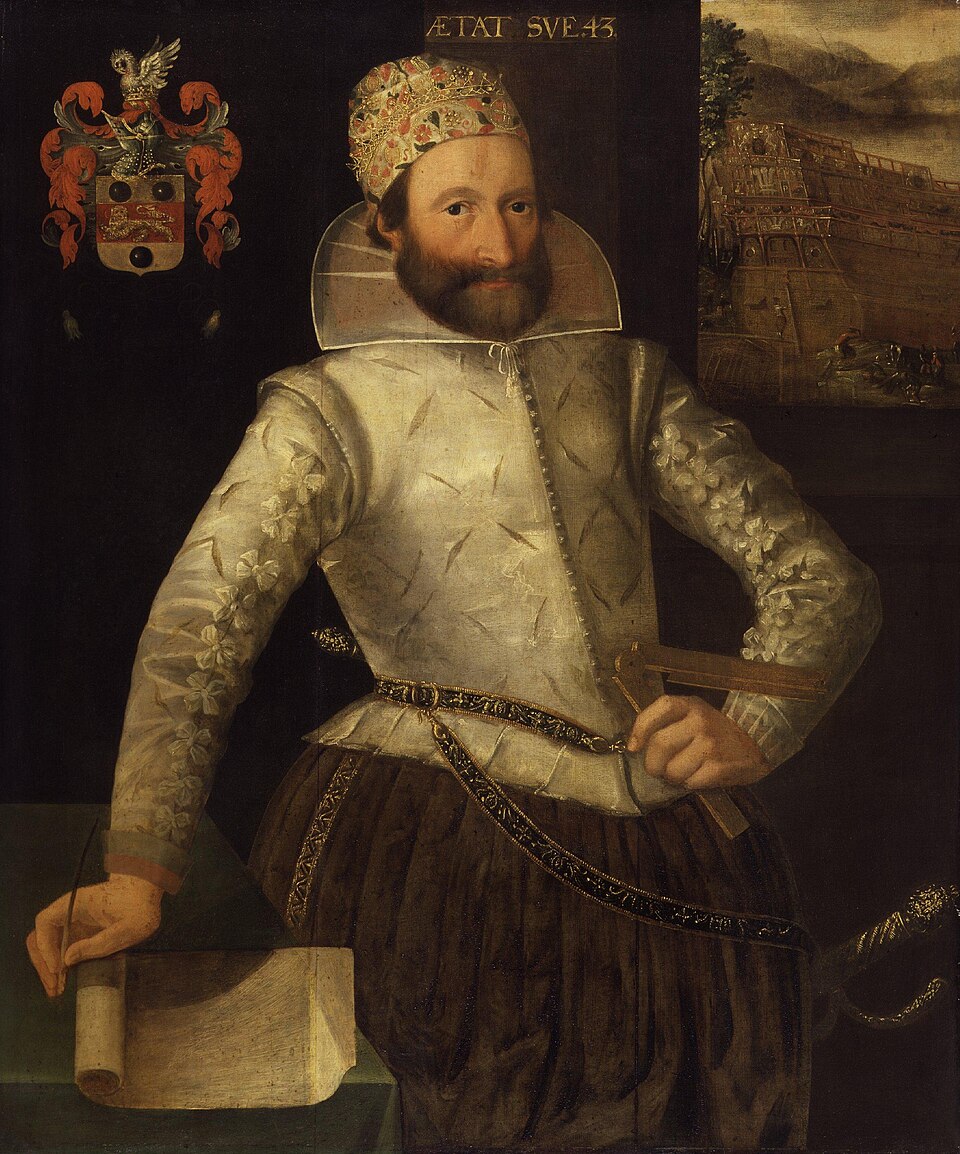
The person
Phineas Pett was an English shipwright and naval administrator, born in 1570. He rose to prominence as a master shipwright under James I and Charles I, building notable ships such as the Prince Royal and the Sovereign of the Seas. His autobiography, written from 1612 to 1640, details his career, conflicts with rivals, and service to the Crown. He became a Commissioner of the Navy in 1631 and died in 1647.
Pett's career exemplifies the intersection of technical skill, court patronage, and political intrigue in early Stuart England. His autobiography offers a rare first-hand account of naval shipbuilding and administration during a period of expansion and reform, revealing the challenges of navigating royal favor and institutional rivalries.
Life in motion
Drag to travel through time · Ctrl/⌘ + scroll or pinch to zoom · Select a moment for the full account
Built and launched the Prince Royal, a large warship.
Why it matters: One of his major achievements, leading to disputes.
Wikipedia ↗Operating system
Pett was at the forefront of English ship design, building the Prince Royal (1610) and the Sovereign of the Seas (1637), which were among the largest and most advanced ships of their time. His methods influenced naval architecture for generations.
Evidence: The autobiography details his construction of the Prince Royal and the Sovereign, including the selection of timber, framing, and launching. The editor's notes highlight that he was 'slightly in advance of his contemporaries in the profession of shipbuilding.'
Pett's career depended heavily on the favor of monarchs (James I and Charles I) and princes (Henry and Charles), who protected him from enemies and provided financial support. This patronage was both a blessing and a source of conflict with his superiors.
Evidence: Pett records direct interviews with Prince Henry and King James, who supported him against rivals. The editor notes that Nottingham, James I, and Charles I 'shielded him against the consequences of his misdeeds.'
Pett faced intense opposition from fellow shipwrights and naval officials, including William Burrell and Edward Stevens, leading to official inquiries and personal attacks. His autobiography often frames these conflicts as conspiracies against him.
Evidence: The editor's introduction discusses how Pett's privileged access to the Crown 'brought Pett into conflict with the latter on many occasions.' Pett describes Burrell's 'malicious practice' and the 'combination' against him.
Despite royal favor, Pett suffered from chronic financial difficulties due to low official salaries, speculative ventures, and debts. He accumulated significant debt from failed ventures like the Destiny and the Spy, which burdened him for years.
Evidence: The editor notes that Pett's 'bad speculations' in the Destiny and other ships 'made serious inroads into his capital and burdened him with a load of debt.' He received patents for baronetcies to raise money.
Pett frequently expressed gratitude to God for deliverance from dangers at sea and during his career, reflecting the religious sensibilities of his time. He also showed kindness to his family members, supporting his unfortunate siblings.
Evidence: In the autobiography, Pett writes 'giving God thanks for his merciful deliverance' after a storm. The editor comments on his 'kindness towards his unfortunate brothers and sisters' and his religious expressions.
Pett was involved in Arctic exploration and colonial ventures, assisting Captain Thomas Button in selecting a ship for the Northwest Passage, and being a member of the Virginia Company. This shows his broader interests beyond shipbuilding.
Evidence: The editor notes Pett's friendship with Button and his subscription to the Virginia Company. In the text, Pett describes 'accompany Captain Thomas Button to make choice of a ship for the North-west Passage.'
Read through your work
Leaders
As a leader, Phineas Pett balanced the demands of a growing navy with the whims of a capricious court. He demonstrates that leadership often requires navigating between ruthless competition and royal favor. His ability to motivate men, as seen in his organization of the royal wedding festivities, and his persistence in pursuing ambitious projects like the Sovereign of the Seas, are hallmarks of effective leadership. Yet, his failure to manage conflicts transparently and his personal financial entanglements show the dangers of mixing public office with private gain. Leaders today can learn from Pett's political acumen and technical vision, but also from his lapses in ethics and communication. His legacy, documented in his autobiography, reveals how leadership is not just about outcomes but also about storytelling and institutional memory.
In his words
“The 1st of August, being Saturday, the Prince's Highness being to take his progress from Richmond, I rode from Chatham to Richmond, accompanied with Captain John King and Mr. John Reynolds, then master gunner of the Prince. The next day, being Sunday, I waited on his Highness to chapel and at dinner; he had this day a great deal of private conference with me concerning affairs of consequence.”
“About the 8th day of July I paid the company of the Resistance for their voyage, and presently graved her for another, and at the same time I was sent for by the Lord Admiral of England, to Hampton Court, to give an account about the proceedings of the survey, made a little before at Chatham, of the state of the Navy; and then I was also sent for to attend the Prince at Richmond, to give his Highness satisfaction concerning the proceedings therein, which he took as an affront, because I had not…”
“The 6th day of January I went from Chatham to Woolwich to dock the Honour and the Defiance. On the 9th day we opened the gates and brought in the Defiance; the next day proved so much wind as we could not stir the Honour from her moorings, so that she was not docked till the night tide; the 11th day the gates were shut in and caulked.”
“In the end of this month I caused the little Disdain, Prince Henry's pinnace, to be rigged and fitted for me to take the air of the sea to the river's mouth.”
Put into practice
Pett's career shows the importance of understanding and managing relationships with powerful patrons, while also being aware of rivalries and political factions.
Pett simultaneously served as a royal shipwright, private shipowner, and trader. While this brought income, it also led to accusations of corruption and personal financial losses.
Despite financial troubles and professional setbacks, Pett persisted, eventually achieving high office and building the Sovereign of the Seas.
Pett was assisted by friends like Sir John Trevor and Captain John King, and by family members, showing the value of a strong network.
Pett wrote an autobiography, ensuring his name and achievements were remembered. This has shaped historical understanding of his life and work.
Pett's direct access to the king and prince gave him advantages but also made him enemies. Using patronage effectively without alienating superiors is a delicate balance.
Read with judgment
Phineas Pett's greatness lay in his masterful integration of technical mastery, royal patronage, and political navigation. As a shipwright, he designed and built the Prince Royal (1610) and the Sovereign of the Seas (1637), vessels that were among the largest and most advanced of their era, pushing English naval architecture forward. His autobiography reveals a craftsman who understood the material demands of shipbuilding—timber selection, framing, and launching—while also grasping the social mechanics of the Stuart court. By cultivating direct relationships with Prince Henry and later Charles I, he secured protection and resources that allowed his innovations to flourish. His career demonstrates that technical excellence alone is insufficient; it must be coupled with the ability to secure and wield institutional support, especially in a patronage-driven state.
Pett's life embodies a persistent tension between meritocratic aspiration and aristocratic privilege. On one hand, he rose through sheer skill and hard work, devising innovative ship designs and meticulously documenting his craft. On the other, he repeatedly relied on royal favor to bypass customary checks, as when he reported directly to Prince Henry over his superior Sir Richard Bingley, a move that breached protocol and bred resentment. His autobiography frames his success as God-given and righteous, yet it also records his 'bad speculations' and failed ventures like the Destiny and Spy, which were only rescued by selling baronetcies. This contradiction—advancing by both competence and favoritism, while believing in his own virtue—is the core of his complex legacy.
Pett's shadow side included a pattern of financial mismanagement and questionable dealings. Despite royal support, he repeatedly fell into debt due to speculative ventures, which the editor attributes to 'bad speculations' that 'made serious inroads into his capital.' His private trading with the Resistance, mixing naval and commercial purposes, raised ethical questions and likely contributed to conflicts of interest. He also engaged in patronage battles that sometimes prioritized personal vendettas over the Navy's efficiency, as seen in his prolonged feud with William Burrell, which led to multiple inquiries and wasted time. His reliance on royal protection allowed him to escape consequences, but it also fostered an environment of favoritism that may have harmed institutional morale. Pett's failure to manage his finances and his combative nature reveal a man of great skill but flawed judgment.
Pett's story resonates today in the challenges of navigating complex organizational politics while pursuing excellence. In an era of rapid technological change, his ability to merge traditional craftsmanship with innovative designs parallels contemporary leaders who must balance heritage with disruption. His experience with patronage underscores the modern reality of sponsorship and networks in career advancement, while his conflicts warn of the dangers of political infighting that can derail institutional goals. His financial struggles highlight the pitfalls of conflating personal ventures with official duties, an issue still relevant in public-private partnerships. Moreover, his autobiography's survival due to Samuel Pepys's transcription demonstrates the power of self-documentation in shaping legacy—a lesson for leaders in the age of digital footprints.
To learn from Pett, one must study his blend of technical proficiency and political acumen. For modern professionals, this suggests investing deeply in skill development while actively building relationships with key stakeholders. Pett's practice of presenting miniature models to Prince Henry to secure commissions illustrates the importance of visual and tangible demonstrations of capability to win patronage. His career also teaches the value of documenting one's work meticulously, as his autobiography provides a blueprint for self-advocacy and legacy building. However, his failures caution against overextending into conflicting roles without transparency. Adopting a dual focus on mastery and strategic networking, while maintaining ethical clarity, can help replicate his successes and avoid his missteps.
The best entry point into Phineas Pett's life is his autobiography, specifically the sections covering the period 1611-1612, where he details his daily docking operations, his leisure trips on the Disdain, and his interactions with Prince Henry. These passages offer a vivid first-person account of his professional routine and his privileged access to the Prince. For a broader context, the editor's introduction provides a scholarly analysis of his career, including his conflicts and financial troubles, which helps frame the narrative. Starting with the July 1611 entry about the naval survey and the Prince's displeasure offers a compelling moment of political tension that encapsulates the challenges of court patronage.
The human network
Patron
Prince Henry, son of James I, was a major patron of Pett, personally interested in naval affairs and supporting Pett against his enemies. Prince Henry's favor gave Pett access and protection, but also provoked jealousy.
Friend and Mentor
Sir John Trevor, Surveyor of the Navy, was an 'especial friend' and supported Pett, including in the construction of the Prince Royal. Trevor's support was crucial in Pett's early career.
Rival
William Burrell was a fellow shipwright who became Pett's greatest enemy, working to discredit him. Their rivalry led to multiple inquiries and disputes.
Professional Associate
Pett assisted Button in choosing a ship for the Northwest Passage expedition, showing their collaboration. Demonstrates Pett's involvement in exploration.
Patron
King Charles I, as prince and king, also favored Pett, commissioning the Sovereign of the Seas. Charles's patronage enabled Pett's greatest work.
Rival
Edward Stevens, another master shipwright, was one of Pett's main competitors and opponents in the Prince Royal inquiry. Their conflicts reflect professional jealousies.
Continue the inquiry
Son and successor, who became Commissioner of the Navy at Chatham, continuing the Pett shipbuilding dynasty.
Shipbuilding · Naval Administration · Family Legacy
Pepys, as Secretary to the Admiralty, transcribed Pett's autobiography, showing its historical value. Both were naval administrators with diaries.
Naval history · Diary writing · Administration
Baker was a leading shipwright before Pett, and they worked together on repairs, representing the older generation of shipbuilding.
Shipbuilding techniques · Royal Navy
Waymouth was a rival shipwright and explorer; Pett criticized his navigation, but they also had professional interactions.
Exploration · Ship design · Professional rivalry
A close friend and naval officer who accompanied Pett on voyages and supported him.
Naval friendship · Seamanship
Source shelf
link
Phineas Pett
View source →reference
Wikipedia contributors
View source →reference
Wikidata contributors
View source →Source basis: The quality analysis draws primarily on Pett's autobiography (source 153), which provides firsthand accounts of his shipbuilding projects, conflicts, and daily activities. The editor's preface and introduction to that volume offer critical interpretations of his career, including his patronage relationships, financial difficulties, and professional rivalries. Wikipedia (source 164) supplies a factual timeline and career milestones, while Wikidata (source 165) serves as a structural reference. Quotes 572 and 573 illustrate his interactions with Prince Henry and the political fallout from the naval survey. The themes and lessons extracted from these sources have been used to assess his greatness, contradictions, and relevance without overstepping the evidence.
Direct answers
Phineas Pett built the Prince Royal, launched in 1610, which was one of the largest and most advanced warships of its time, and the Sovereign of the Seas, launched in 1637, which was the most powerful ship in the English navy. He also constructed smaller vessels like the pinnace Disdain and was involved in repairing ships like the Defiance. His shipbuilding innovations influenced English naval architecture for generations.
Prince Henry, the heir to the throne, was deeply interested in naval affairs and became Pett's principal patron. This relationship gave Pett direct access to the highest levels of power, protecting him from enemies and securing commissions for his ships. However, it also provoked jealousy among his superiors, as Pett could bypass the normal chain of command. Henry's premature death in 1612 was a setback, but Pett later gained the favor of Charles I.
Yes, Pett experienced significant financial failures. His investments in the ships Destiny and Spy were bad speculations that left him heavily in debt for years. He also faced professional setbacks, including accusations of corruption and conflicts with rivals that led to inquiries. Yet, despite these failures, he recovered through royal patronage and eventually reached the top of his profession.
Pett wrote an autobiography covering the years 1612 to 1640. This detailed account includes his daily activities, political conflicts, and spiritual reflections. The manuscript was later transcribed by Samuel Pepys, who recognized its historical value. It was finally published by the Navy Records Society in 1918.
Pett was a member of the Virginia Company, one of the joint-stock companies involved in colonizing North America. His involvement shows his interest in colonial ventures beyond shipbuilding, though the extent of his participation is not well detailed in his autobiography.
Pett's main rivals were fellow shipwrights William Burrell and Edward Stevens. Their conflicts often revolved around professional jealousy and competition for royal favor. Burrell especially worked to discredit Pett, leading to official inquiries and public disputes. These rivalries are prominent in Pett's autobiography, where he portrays them as conspiracies against him.
Pett's autobiography is one of the few first-hand accounts of naval administration and shipbuilding in early Stuart England. It provides invaluable insights into the technical challenges of ship construction, the politics of the royal court, and the personal struggles of an ambitious craftsman. It also influenced later naval administrators and historians, and was preserved by Samuel Pepys.