



c. 383 BC
Foundation of the Academy
Plato founded the Academy in Athens, a school dedicated to philosophy and mathematics.
Why it matters: Establishment of the first institution of higher learning in the Western world.
Wikipedia ↗Philosopher · 427–347 BC
Philosopher of Justice and the Ideal State
The defining question
Is the just person happier than the unjust?
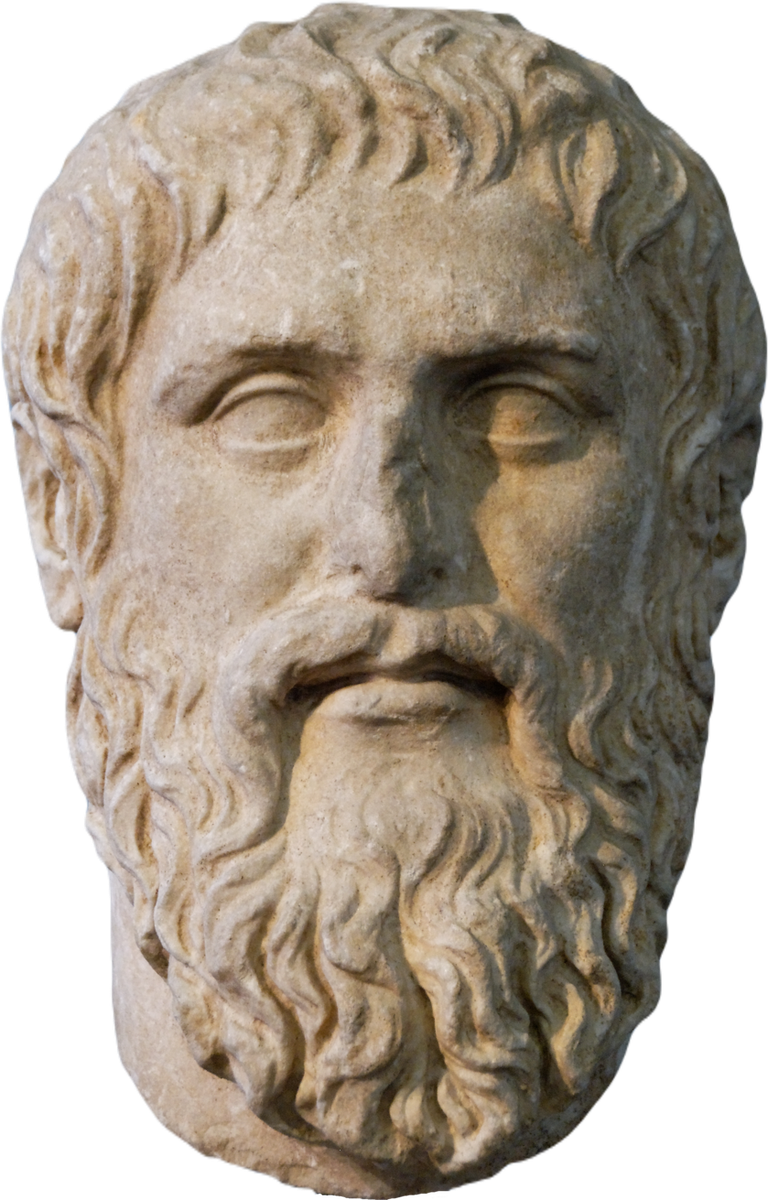
The person
Plato was an ancient Greek philosopher who wrote The Republic, a Socratic dialogue exploring justice, the ideal city-state, and the nature of the soul. He founded the Academy in Athens and was a student of Socrates and teacher of Aristotle.
Plato's The Republic is foundational to Western political philosophy, introducing concepts like the philosopher-king, the tripartite soul, and the allegory of the cave. His inquiry into 'why be just?' remains central to ethics and political theory.
Life in motion
Drag to travel through time · Ctrl/⌘ + scroll or pinch to zoom · Select a moment for the full account
Plato founded the Academy in Athens, a school dedicated to philosophy and mathematics.
Why it matters: Establishment of the first institution of higher learning in the Western world.
Wikipedia ↗Operating system
Plato defines justice as each part of the soul or city doing its proper function, leading to harmony. In the soul, reason rules, spirit supports, and appetite obeys. In the city, rulers, guardians, and producers each perform their own work.
Evidence: Justice in the individual is 'doing one’s own business and not being a busybody' (433a). In the state, justice is 'each one must perform the one function for which his nature is best suited' (433a).
Plato argues that the ideal state requires rulers who are philosophers, because only they have knowledge of the Form of the Good and can govern wisely. Philosophers must be compelled to rule, as they prefer contemplation.
Evidence: 'Unless either philosophers become kings in their countries or those who are now called kings and rulers come to be sufficiently inspired with a genuine desire for wisdom, there can be no rest from troubles' (473c-d).
The allegory illustrates the philosopher's journey from ignorance to knowledge. Prisoners in a cave see only shadows; one escapes, sees the sun (the Form of the Good), and returns to enlighten others, who resist.
Evidence: 'They would see the sun and not mere reflections of him in the water. They would be able to look at the sun itself' (516a-b). 'The prison-house is the world of sight, the light of the fire is the sun' (517b).
Plato divides the soul into three parts: reason (desires truth), spirit (honor and anger), and appetite (bodily desires). Justice in the soul occurs when reason rules with spirit as ally, keeping appetites in check.
Evidence: 'The soul has three parts: the rational, the spirited, and the appetitive' (439d-441c). 'The just man is the one who puts each part in its proper place' (443d).
Plato criticizes poetry and art for appealing to the lower parts of the soul and for imitating appearances rather than reality. He banishes poets from the ideal state because they corrupt citizens.
Evidence: 'Poetry feeds and waters the passions and desires... and makes them rule' (606a). 'We must ban all such poetry as that' (607a).
The highest object of knowledge is the Form of the Good, which illuminates all other Forms and is the source of reality and truth. It is beyond being and gives intelligibility to the world.
Evidence: 'The Good is the cause of knowledge and truth, and yet it is something else more beautiful than they' (508e-509a). 'The Good is not being, but beyond being in dignity and power' (509b).
Socrates insists that the purpose of life is to examine oneself and others, seeking virtue and wisdom above all.
Evidence: Socrates says, 'The unexamined life is not worth living' (Apology, 38a).
Socrates refuses to abandon his philosophical mission even under threat of death, valuing moral consistency over safety.
Evidence: He declares, 'I do nothing but go about persuading you all, old and young alike, not to take thought for your persons or your properties, but first and chiefly to care about the greatest improvement of the soul' (Apology, 30a-b).
Socrates claims his wisdom lies in recognizing his own ignorance, distinguishing him from those who falsely claim knowledge.
Evidence: He states, 'I am wiser than this man; for neither of us really knows anything fine and good, but he thinks he knows something when he does not, whereas I, as I do not know, do not think I know either' (Apology, 21d).
In the Crito, Socrates argues he must obey the laws of Athens even when they are unjust, because he has tacitly agreed to them by living in the city.
Evidence: Socrates says, 'Do you think that a city can continue to exist and not be overturned, in which the judgments of the courts are without force and are set aside by private individuals?' (Crito, 50b).
In the Phaedo, Socrates presents arguments for the immortality of the soul and faces death with calmness, believing it is a release from the body.
Evidence: Socrates argues, 'The soul is most like that which is divine, immortal, intelligible, uniform, indissoluble, and ever self-consistent and invariable, whereas the body is most like that which is human, mortal, multifarious, unintelligible, dissoluble, and ever self-different' (Phaedo, 80b).
Socrates portrays the philosopher as a gadfly, a divine gift to the city, who stirs people to virtue through questioning.
Evidence: He says, 'I have been appointed by the god to examine and test men' (Apology, 28e).
Read through your work
Leaders
Leaders of any organization will find Plato’s Republic a mirror. The ideal of the philosopher-king (473c-d) who governs with knowledge of the Good challenges leaders to base decisions on wisdom, not popularity. The Allegory of the Cave is a model for organizational change: your team may be comfortable with old assumptions; your job is to gradually reveal a larger reality. Plato’s tripartite soul (439d-441c) can be seen as the organization’s strategy (reason), culture (spirit), and operations (appetite). His failure in Syracuse warns leaders not to impose top-down ideals without buy-in. The Socratic example (Apology) shows that integrity sometimes costs everything.
In his words
“Mankind censure injustice, fearing that they may be the victims of it and not because they shrink from committing it.”
“I tell you that virtue is not given by money, but that from virtue comes money and every other good of man, public as well as private.”
“I neither know nor think that I know.”
“The difficulty, my friends, is not to avoid death, but to avoid unrighteousness; for that runs faster than death.”
“I would rather die having spoken after my manner, than speak in your manner and live.”
“For the fear of death is indeed the pretence of wisdom, and not real wisdom, being a pretence of knowing the unknown; and no one knows whether death, which men in their fear apprehend to be the greatest evil, may not be the greatest good.”
“No evil can happen to a good man, either in life or after death.”
“If you think that by killing men you can prevent some one from censuring your evil lives, you are mistaken; that is not a way of escape which is either possible or honourable; the easiest and the noblest way is not to be disabling others, but to be improving yourselves.”
Put into practice
Plato argues that a just society arises when each person does the work for which they are naturally suited, not interfering with others' roles.
Philosophers must be compelled to rule because they prefer contemplation to power; those who seek power are unfit to hold it.
Early education through stories and music molds character; the right stories cultivate reason and courage.
Plato bans poets because they stir irrational passions; art that misrepresents gods or heroes corrupts citizens.
The just person, with a harmonious soul, is happier than the unjust even without external rewards.
The Allegory of the Cave teaches that most people mistake shadows for reality; philosophy awakens us to truth.
Only those who grasp the Form of the Good are fit to govern; ignorance leads to chaos.
Socrates shows that it is better to suffer injustice than to commit it, and one should never act unjustly even when threatened with death.
Socrates' wisdom consists in knowing he knows nothing. Recognizing ignorance is the first step to knowledge.
Read with judgment
Plato's greatness lies in his invention of the dialogue form and his systematic integration of ethics, politics, epistemology, and metaphysics. He was the first Western thinker to argue that justice is not merely a social contract but an inner harmony of the soul, and that the just person is happier regardless of external circumstances. His Allegory of the Cave profoundly reframed education as a painful ascent from illusion to reality. He founded the Academy, the first institution of higher learning, which institutionalized philosophy as a discipline. His ability to dramatize ideas through Socrates gave philosophical inquiry a moral urgency that still resonates.
Plato advocates for a just society ruled by philosopher-kings who possess knowledge of the Form of the Good, yet his own attempts to realize this ideal in Syracuse ended in failure and near-death. He condemns poetry for stirring irrational passions, yet his dialogues are themselves masterpieces of dramatic literature. He insists that the just person is happier, yet his portrait of Socrates—the paradigm of justice—ends in execution. The tension between the ideal and the actual runs through all his work.
Plato's political experiments in Syracuse were catastrophic: his attempts to turn Dionysius II into a philosopher-king collapsed into intrigue, and he was imprisoned. His Republic proposes authoritarian measures—censorship of poets, a rigid class structure, eugenics—that modern readers rightly find disturbing. His hostility to democracy, born from Athenian democracy's condemnation of Socrates, leads him to a system that suppresses dissent. His theory of Forms, while brilliant, can be read as an escape from the messy, empirical world into a realm of pure abstractions.
Plato's questions are more urgent than ever: What is justice? Why be moral if it costs you everything? Who should rule? The Allegory of the Cave is a perfect metaphor for our age of algorithmic bubbles, fake news, and competing realities. His critique of democracy—that it degenerates into tyranny when freedom becomes license—prefigures concerns about populism. His insistence that knowledge, not popularity, should guide governance challenges modern anti-intellectualism. Yet his authoritarian solutions also caution against utopian schemes that sacrifice liberty.
Read the Republic as a dialogue, not a treatise: argue with Socrates at every turn. Test Plato's claims against your own experience: is the just person really happier? Does inner order produce outer peace? Apply the Allegory of the Cave to your own assumptions—what shadows might you be mistaking for reality? Practice Socratic ignorance: admit what you don't know, and question those who claim certainty. But also learn from Plato's failures: don't impose a blueprint on reality; recognize that ideal systems can become cages.
Start with the allegory of the cave in Republic Book VII, then read the Apology for a lived example of Socratic integrity. These two texts together give the core: the philosophical ascent to truth and the moral courage to live by it.
The human network
Teacher–Student
Plato's teacher and the main character in The Republic; Socrates' trial and death shaped Plato's philosophy. Socrates serves as the voice of Plato's ideas; the dialogue form and method of questioning derive from Socrates.
Subject
Plato's dialogues feature Socrates as the main speaker, recounting his trial, imprisonment, and death. Socrates is the philosophical hero whose ideas are preserved by Plato.
Continue the inquiry
Aristotle was Plato's student at the Academy and developed his own political philosophy in the Politics, critiquing Plato's ideal state.
Political philosophy · Virtue ethics · Theory of Forms
More's Utopia imagines an ideal society inspired by Plato's Republic, sharing the genre of political idealism.
Ideal state · Social criticism · Utopian literature
Marx’s critique of class society and vision of a classless state echoes Plato's concern for unity and justice, though Marx rejected idealism.
Social justice · Class structure · Role of the state
Nietzsche criticized Plato's otherworldly philosophy and his 'invention of the true world,' offering a contrast to Plato's idealism.
Critique of metaphysics · Revaluation of values · Power and morality
Rawls' theory of justice as fairness in A Theory of Justice is a modern liberal reinterpretation of social contract ideas found in The Republic.
Justice · Social contract · Distributive justice
As a Stoic philosopher, Epictetus similarly emphasized virtue and inner freedom in the face of external constraints, echoing Socratic themes.
Virtue · Death · Control
Sophocles' plays explore themes of law, conscience, and divine will, similar to the tensions in the Crito and Apology.
Justice · Law · Tragedy
Source shelf
link
Plato
View source →link
Plato
View source →reference
Wikipedia contributors
View source →reference
Wikidata contributors
View source →Source basis: This analysis is grounded in two primary sources by Plato: The Republic (source 23), a Socratic dialogue exploring justice, the ideal state, and the philosopher-king, featuring themes of justice as harmony, the tripartite soul, and the Form of the Good; and the Apology, Crito, and Phaedo (source 24), which present Socrates' trial, his defense of the examined life, his refusal to compromise principle, and his calm acceptance of death. Secondary context comes from Wikipedia (source 25) and Wikidata (source 26), which provide biographical timeline and political context.
Direct answers
Plato argues that justice in the soul—where reason rules, spirit supports, and appetite obeys—creates inner harmony and order, which is the source of true happiness. The unjust person, driven by insatiable appetites, is in constant conflict and thus miserable. This is the core thesis of The Republic, explored through the analogy of the city and the soul.
The allegory, in Republic Book VII, depicts prisoners chained in a cave, mistaking shadows for reality. One prisoner escapes, sees the sun (the Form of the Good), and returns to free the others, who resist. It represents the philosopher's journey from ignorance to enlightenment and the difficulty of educating those comfortable with illusion.
Philosopher-kings are rulers who have knowledge of the Form of the Good and govern with wisdom and justice. Plato argues they must be compelled to rule, as they prefer contemplation to power. He famously said in The Republic, 'Unless philosophers become kings... there can be no rest from troubles' for cities.
In The Republic, Plato bans poets from his ideal state because poetry appeals to the lower, irrational parts of the soul, stirring emotions and weakening reason. He also objects that poetry is mere imitation of appearances, far from the truth of the Forms. This critique is part of his broader concern for moral education.
Plato made three trips to Syracuse to tutor Dionysius II, hoping to create a philosopher-king. The attempts ended in failure: Dionysius proved uninterested in philosophy, and Plato was nearly killed or sold into slavery. These failures highlight the gap between ideal theory and messy political reality.
In the Apology, Socrates declares that 'the unexamined life is not worth living.' He means that the purpose of life is to seek virtue and wisdom through constant self-examination and questioning. This principle underlies the Socratic method and Plato's entire philosophical project, emphasizing moral integrity over mere survival.
Plato argues the soul has three parts—reason, spirit, appetite—and justice in the individual occurs when reason rules. Analogously, the just city has three classes: rulers (reason), guardians (spirit), and producers (appetite). This structural parallel between macrocosm and microcosm is central to The Republic.
Socrates, as portrayed in the Crito, argued that by living in Athens he had tacitly agreed to obey its laws, even when they condemned him unjustly. He also believed it is better to suffer injustice than to commit it, and that his philosophical mission required him to remain consistent and principled.