



1793
Began Canal and Steamboat Work
Developed plans for canals with inclined planes and began ideas for steam-powered vessels.
Why it matters: Foundation for his later steamboat achievements.
Wikipedia ↗Scientist & Inventor · 1765–1815 AD
Inventor of Steamboat Navigation
The defining question
How can I harness the power of steam to overcome natural obstacles and improve human transportation?
The person
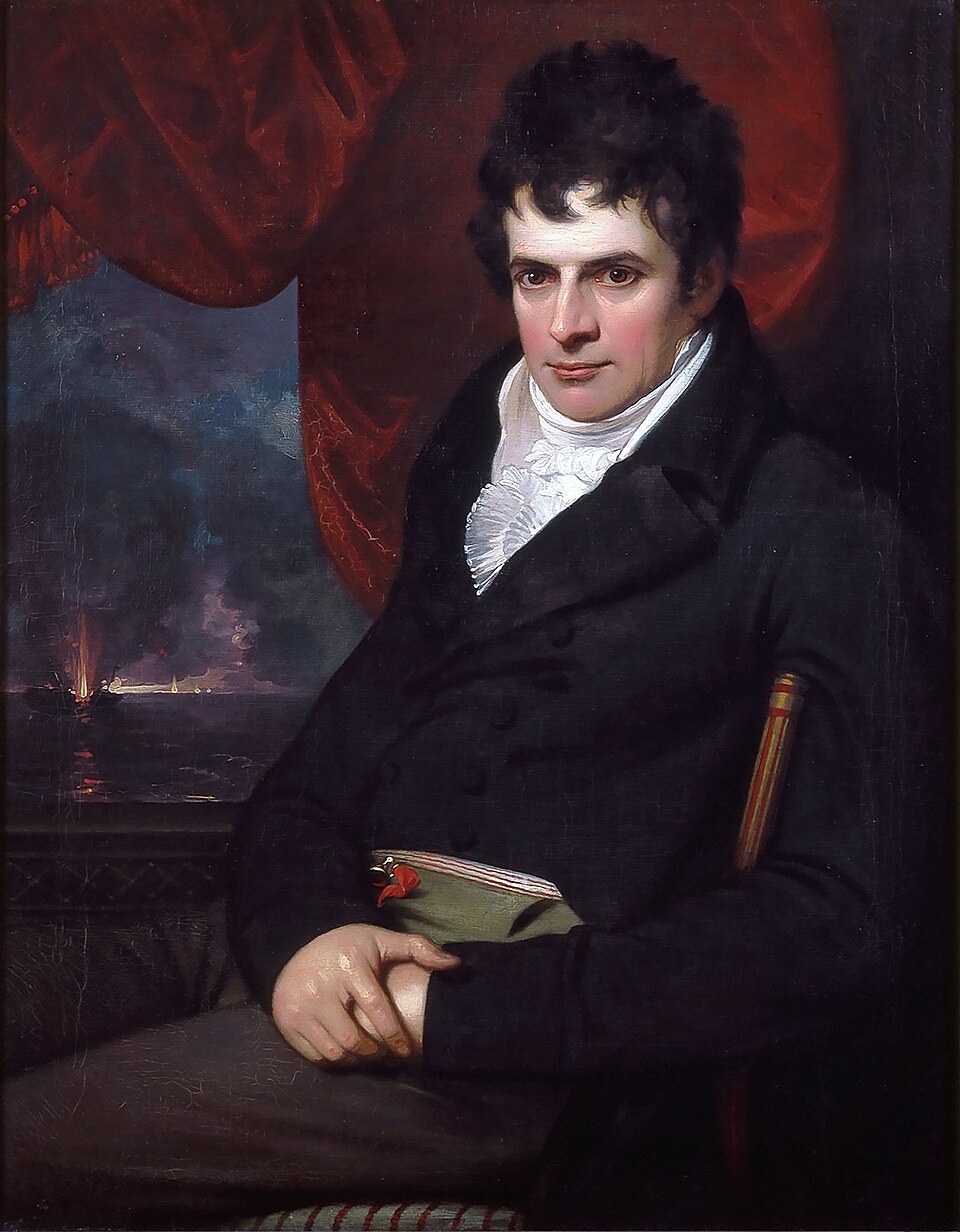
Robert Fulton was an American inventor and engineer best known for developing the first commercially successful steamboat, the Clermont, which navigated the Hudson River in 1807. Born on a farm in Lancaster County, Pennsylvania, he initially pursued a career as an artist, studying in London under Benjamin West. His interests shifted to engineering, leading to inventions such as a marble sawing mill, canal improvements, a submarine (Nautilus), and torpedoes. He partnered with Robert Livingston to build and operate steamboats on the Hudson and Mississippi Rivers, revolutionizing transportation and commerce in the United States.
Robert Fulton's successful demonstration of steamboat navigation on the Hudson River in 1807 proved the viability of steam-powered water transport, catalyzing the growth of American commerce, westward expansion, and global maritime travel. His work bridged art and engineering, and his perseverance in the face of financial and technical challenges exemplifies the spirit of American innovation.
Life in motion
Drag to travel through time · Ctrl/⌘ + scroll or pinch to zoom · Select a moment for the full account
Developed plans for canals with inclined planes and began ideas for steam-powered vessels.
Why it matters: Foundation for his later steamboat achievements.
Wikipedia ↗Operating system
Fulton's success was built on relentless effort and resilience in the face of failure, as seen when he worked for 24 hours without rest to salvage his wrecked steamboat on the Seine.
Evidence: Source describes Fulton working 'for twenty-four hours, without food or rest' to recover machinery from the broken boat, despite the permanent lung weakness that resulted.
Fulton's transition from a painter to an inventor demonstrates his versatile genius and ability to apply artistic creativity to practical problems.
Evidence: Source details his study of art in England, his success at the Royal Academy, and his subsequent pivot to engineering after observing the Duke of Bridgewater's canals and quarrying challenges.
Fulton's inventions were motivated by a desire to benefit his country, as he sought to improve internal navigation and naval defense for the United States and France.
Evidence: His letter to Barlow states, 'I feel infinitely more pleasure in reflecting on the immense advantage my country will derive from the invention.'
Despite public ridicule and doubt, Fulton's innovations ultimately won acclaim, illustrating the common trajectory of revolutionary inventions.
Evidence: The source describes how on the Clermont's first voyage, 'jeers' turned to 'cheers' as the boat moved against the current, and his ship was initially called 'Fulton's Folly.'
Fulton's success depended on partnerships with figures like Robert Livingston and Joel Barlow, who provided financial and social support.
Evidence: The source notes that Livingston financed Fulton's steamboat experiments and that Fulton lived with Barlow's family in Paris for seven years.
Fulton repeatedly faced setbacks, including the destruction of his first steamboat and Napoleon's rejection, yet he persisted and eventually succeeded.
Evidence: After the first boat sank, Fulton 'wasted not a moment in vain regret' and rebuilt, leading to a successful trial in Paris.
Fulton's dedication to his work often compromised his health, as he endured exposure and overwork, ultimately contributing to his early death.
Evidence: The source attributes his permanent lung weakness to the 24-hour rescue effort on the Seine, and his fatal illness to a cold caught while inspecting his shipyard in February 1815.
Fulton's relentless pursuit of submarine navigation across multiple countries demonstrates his innovative spirit and persistence in the face of bureaucratic resistance.
Evidence: Fulton's detailed letters and reports to the French and British governments show his persistence in promoting his invention despite repeated setbacks.
Fulton's submarine was a geopolitically charged invention, leading him to navigate the diplomatic landscapes of France and Britain during the Napoleonic Wars.
Evidence: The French Commission's report and Fulton's negotiations with the British Admiralty highlight how his invention was viewed through the lens of national security and warfare.
The technical difficulties of building and operating the Nautilus, including air supply, pressure resistance, and underwater steering, are documented in Fulton's meticulous reports.
Evidence: Fulton's report to Monge, Laplace, and Volney details his experiments with air reservoirs, glass windows, and steering mechanisms, showcasing his engineering ingenuity.
Fulton's experiences reveal the difficulties of securing government contracts for new military technologies, including delays, bureaucratic hurdles, and the need for arbitration.
Evidence: His correspondence with Lords Hawkesbury, Grenville, and Howick illustrates the complex contract negotiations and the eventual disappointment when the British government decided not to pursue the submarine.
Fulton predicted that his inventions could fundamentally change naval warfare and the balance of power among nations, a vision that was realized with the advent of submarines in the 20th century.
Evidence: His writings about the potential of submarine warfare to destroy traditional navies and alter the politics of Europe foreshadowed the role of submarines in World War I.
Read through your work
Leaders
Robert Fulton exemplifies a visionary leader who could inspire and execute. He had a clear goal—revolutionizing transportation—and rallied partners like Livingston. He communicated his vision vividly, whether in letters to Napoleon or public demonstrations. Yet leading innovation also means navigating bureaucracy, securing resources, and managing stakeholders. Fulton failed to persuade Napoleon, partly due to timing and preconceptions. He learned from that and adapted his pitch to the British, though that also ultimately failed. Leaders can emulate his strategic thinking: he sought monopolies and patents, built coalitions, and used media to his advantage. However, his over-centralizing tendencies and stubbornness led to conflicts. A key lesson is to balance visionary zeal with pragmatic engagement, and to take care of oneself to sustain leadership.
In his words
“There is nothing impossible.”
“The power of propelling boats by steam is now fully proved.”
“I feel infinitely more pleasure in reflecting on the immense advantage my country will derive from the invention.”
“I have it in my power to cause this obstacle which protects him to disappear. In spite of all his fleets and in any weather I can transport your armies to his territory in a few hours, without fear of the tempests and without depending upon the winds.”
“My steamboat voyage to Albany and back has turned out rather more favorably than I had calculated.”
“I overtook many sloops and schooners beating to the windward and parted with them as if they had been at anchor.”
“The Plunging boat is only for the purpose of carrying the bomb to where it may be used to Advantage.”
“I conceived every experiment of importance, to be proved in the most satisfactory manner hence I Quit the experiments on the Boat to try those of the Bomb Submarine.”
“I have made out a complete set of drawings and descriptions of my whole system of submarine attack.... These with my _will_, I shall put in a tin cylinder, sealed and leave them in the care of General Lyman, not to be opened unless I am lost.”
Put into practice
When Fulton's prototype sank on the Seine, he worked tirelessly for 24 hours to salvage it, showing unwavering resolve in the face of disaster.
Fulton's artistic training enhanced his engineering, allowing him to design aesthetically pleasing and functional machines.
Fulton's collaborations with Livingston and Barlow provided crucial funding, political connections, and emotional support.
Fulton was driven by a desire to benefit his country, which sustained him during difficult times.
Despite widespread doubt and ridicule, Fulton persisted, turning 'Fulton's Folly' into a triumph.
On the first voyage, Fulton stopped the boat to adjust the paddle wheels, leading to increased speed.
Fulton's habit of overworking and exposing himself to harsh conditions ruined his health and led to early death.
Fulton initially focused on river navigation but envisioned transatlantic steam travel, as voiced by Livingston.
Despite his fame, Fulton remained modest and kind to his workers, earning their respect and affection.
Read with judgment
Robert Fulton's greatness lies in his ability to translate bold vision into practical, demonstrable success. He did not invent the steamboat, but he made it commercially viable, and he did so by systematically addressing engineering challenges and securing key partnerships. His 1807 Clermont voyage turned skepticism into acclaim, proving that steam could outperform wind and current. Fulton's genius was not merely technical; it was his capacity to persist through public ridicule, financial risk, and physical hardship. He blended artistic creativity with mechanical precision, and his inventions—steamboat, submarine, torpedo—were each grounded in a deep understanding of physics and a relentless drive to solve real-world problems. He also had a knack for demonstrating viability, as seen in his successful submarine tests and the public trial of his steamboat on the Seine, which convinced influential audiences. His ability to navigate political and bureaucratic landscapes, even when facing rejection, underscores his strategic mind. Ultimately, Fulton's greatness is his legacy as a catalyst of the transportation revolution, transforming commerce and connectivity in America and beyond.
Fulton's life embodies the tension between idealistic patriotism and pragmatic self-interest. He proclaimed his inventions were for the 'immense advantage' of his country, yet he sold his submarine designs to both France and Britain, the latter being America's former enemy. He was an artist turned engineer, a visionary who could be calculating in contracts. He sought government patronage while decrying its slowness. He was a pacifist at heart, hoping his submarine would 'destroy' navies and foster peace, yet he developed weapons of war. His commitment to progress coexisted with a willingness to compromise principles, as when he supported Britain against France, raising questions about loyalty. This contradiction is not hypocrisy but a reflection of the complex interplay between ideals and opportunities in the early republic, where national interests were fluid and inventors had to navigate multiple patrons.
Fulton's shadow side includes his struggles with health due to overwork, his frustration with bureaucratic resistance, and his sometimes abrasive dealings with governments. His submarine and torpedo projects failed to gain lasting adoption, partly due to political hesitancy and the challenges of transitioning from prototypes to accepted weapons. He faced accusations of betraying principles by working for Britain, which strained his reputation. Financially, he was often embroiled in lawsuits and patent disputes. His single-minded dedication led to personal sacrifice, ultimately contributing to his early death from tuberculosis after a cold caught while inspecting his shipyard. Moreover, he did not fully solve the problems of steam navigation on western rivers, with the New Orleans steamboat encountering difficulties. His legacy is thus marked by unrealized ambitions and the harsh costs of relentless innovation.
In an age of disruptive technology and global challenges, Fulton's story resonates deeply. He demonstrates how inventors must not only have breakthrough ideas but also secure funding, build teams, and navigate complex political landscapes—lessons for today's entrepreneurs and innovators. His blend of art and engineering anticipates the need for interdisciplinary approaches. His perseverance against skepticism mirrors the challenges faced by pioneers in renewable energy, biotech, or AI. Fulton's international maneuvering highlights the global nature of innovation and the ethical dilemmas of dual-use technology. Moreover, his emphasis on public demonstration as proof of viability is a timeless strategy, from product launches to policy pilots. His life encourages us to think big, collaborate, and persist despite setbacks, while also warning of the personal costs of overwork and the ethical complexities of aligning profit with purpose.
To learn from Fulton, one must adopt his iterative, hands-on approach. He didn't just theorize; he built, tested, salvaged, and rebuilt. He embraced failure as a learning tool, as when his first steamboat sank on the Seine, yet he worked 24 hours to salvage it and achieved success later. He actively sought mentors and partners, like Benjamin West and Robert Livingston, recognizing that collaboration amplifies impact. He also understood the importance of prototyping—his submarine demonstration with a bomb was a compelling proof of concept. To emulate Fulton, one should: envision a transformative outcome, break it into achievable milestones, and persistently test and refine. Engage with potential skeptics, but let results speak. Cultivate a multidisciplinary skill set, combining technical expertise with creative problem-solving. And remember that meaningful innovation often requires navigating politics and securing patronage, so build a network of allies.
The best entry point to Fulton's life is the 1807 Clermont voyage, detailed in Sutcliffe's biography. That event encapsulates his vision, perseverance, and ultimate triumph. Reading Fulton's own letter describing the voyage reveals his joy and pride: 'My steamboat voyage to Albany and back has turned out rather more favorably than I had calculated.' This moment sets the stage for understanding his earlier struggles and later contributions, making it an ideal starting point for deeper exploration.
The human network
Close Friend and Host
Fulton lived with Barlow's family in Paris for seven years, and Barlow was a constant supporter and intellectual companion. Provided emotional and intellectual support during Fulton's formative years.
Mentor
West, a fellow American painter, guided Fulton's artistic development in London and introduced him to influential circles. Nurtured his early talent and facilitated his career transition.
Spouse
Fulton married Harriet Livingston, a cousin of Robert Livingston, after the Clermont's successful voyage. His marriage cemented family ties and brought personal happiness.
Patron
Commissioned Fulton's portrait and introduced him to influential friends, leading to his pivot to engineering. A turning point in Fulton's career.
Prospective Patron (rejected)
Fulton proposed using submarines and steamboats for an invasion of England; Napoleon dismissed the idea. A missed opportunity that could have changed history.
friend and confidant
Barlow was a close friend and advisor; Fulton entrusted him with his manuscripts and drawings. Barlow provided support and helped preserve Fulton's work.
potential patron
Fulton sought French support from Napoleon, who received him in audience but ultimately declined to adopt the submarine. Napoleon's rejection was a major setback for Fulton's plans.
British government official
Lord Hawkesbury induced Fulton to go to England and was involved in early negotiations. His involvement was crucial in bringing Fulton to England.
British government official
As Prime Minister, Grenville dealt with Fulton's contract and arbitration. His decisions affected the outcome of Fulton's British negotiations.
business partner
Fulton partnered with Livingston on the steamboat project, which they worked on after the submarine. Their partnership led to the successful Clermont steamboat.
Continue the inquiry
Both were American inventors and public figures who combined science with practical application for societal benefit.
Innovation · Public service · Perseverance
Fellow American inventor whose cotton gin revolutionized agriculture; both faced patent disputes and sought to profit from their inventions.
Invention · Industrialization
His improvements to the steam engine made Fulton's steamboat possible; both worked on practical applications of steam power.
Steam power · Engineering
Pioneered steam locomotion on land (Rocket locomotive), paralleling Fulton's work on water; both advanced steam-powered transport.
Steam transport · Innovation
Another steamboat pioneer who built a working steamboat in 1787 but failed commercially; Fulton succeeded after his death.
Steamboat · Competition
Bushnell also invented a submarine (Turtle) during the American Revolution, providing a comparative predecessor to Fulton's work.
Submarine technology · American inventors
Wilkinson was an early pioneer in underwater boats, and his designs were known to Fulton as part of the lineage of submarine development.
Submarine technology
Boyle's law on gas pressure is fundamental to submarine air supply, which Fulton had to account for in his designs.
Science and engineering · Air pressure
Source shelf
link
Sutcliffe, Alice Crary
View source →link
Parsons, William Barclay, 1859-1932
View source →reference
Wikipedia contributors
View source →reference
Wikidata contributors
View source →Source basis: This profile synthesizes evidence from Alice Crary Sutcliffe's biography (source 154) and William Barclay Parsons's focused account of Fulton's submarine work (source 155), supplemented by Wikipedia (156) and Wikidata (157) for contextual and biographical details. Key themes include perseverance through failure, the art-engineering transition, nationalism, innovation under skepticism, collaboration, and personal sacrifice. Quotes such as 'There is nothing impossible' (549) and 'The power of propelling boats by steam is now fully proved' (550) ground key insights. The submarine sources provide detailed reports and correspondence, offering insights into Fulton's engineering process and negotiations with governments. The synthesis distinguishes between Fulton's rhetorical ideals and his pragmatic actions, highlighting tensions in his career.
Direct answers
Robert Fulton's most significant invention was the commercially successful steamboat, specifically the Clermont (officially the North River Steamboat), which in 1807 traveled from New York City to Albany in 32 hours. This proved steam navigation was viable, spurring the growth of American commerce and the expansion of westward travel. Although he did not invent the steamboat, he made it practical and profitable, securing a lasting legacy.
Yes, Robert Fulton built and tested a functional submarine called the Nautilus in 1800, which he demonstrated for the French government. It was the first practical submarine, capable of plunging underwater and steering, though it was never adopted for military use due to political hesitancy. He also developed torpedoes intended to be deployed from the submarine.
His artistic training under Benjamin West enhanced his creativity and visual thinking, which influenced his engineering designs. He later applied this creativity to solve practical problems, blending aesthetics with functionality. However, his success was primarily due to his relentless hard work, technical skill, and ability to form strategic partnerships, not his art background alone.
Napoleon's commissioners examined the submarine and torpedoes but ultimately deemed them impractical or too unconventional for their current military needs. Fulton's proposal came late, and the French commission's report, while acknowledging potential, did not lead to a contract. Additionally, Fulton's insistence on financial compensation and control may have deterred the government, which was wary of the technology's complexity.
Fulton was strongly motivated by patriotism and a desire to benefit his country, as he expressed in letters: 'I feel infinitely more pleasure in reflecting on the immense advantage my country will derive from the invention.' He also sought to serve humanity, believing his submarine could end naval warfare and promote peace. This sense of larger purpose sustained him through setbacks.
Fulton treated failure as a learning opportunity. When his first steamboat sank on the Seine, he worked tirelessly for 24 hours to salvage it, and then rebuilt it successfully. He also refined his submarine designs based on trial and error, and despite government rejections, persisted in seeking support. His ability to bounce back and iterate was key to his eventual success.
Yes, Fulton's steamboat was initially ridiculed and called 'Fulton's Folly.' People doubted steam power could work. However, the successful Clermont voyage turned jeers into cheers, as the boat moved against the current and outpaced sailing vessels. This public demonstration silenced skeptics and demonstrated the viability of his invention.
Robert Livingston was Fulton's business partner and financial backer. They met in Paris in 1801 and agreed to develop a steamboat for American waters. Livingston secured the state monopoly on steamboat navigation, while Fulton provided the engineering expertise. Their partnership led to the Clermont's success and the expansion of steamboat services.