



1810
Graduates from Yale College
Morse graduated from Yale College with Phi Beta Kappa honors.
Why it matters: Educational foundation for his later work.
Wikipedia ↗Scientist & Inventor · 1791–1872 AD
Artist, Inventor, and Pioneer of the Electric Telegraph
The defining question
How can one balance diverse passions and turn setbacks into lasting contributions?
The person
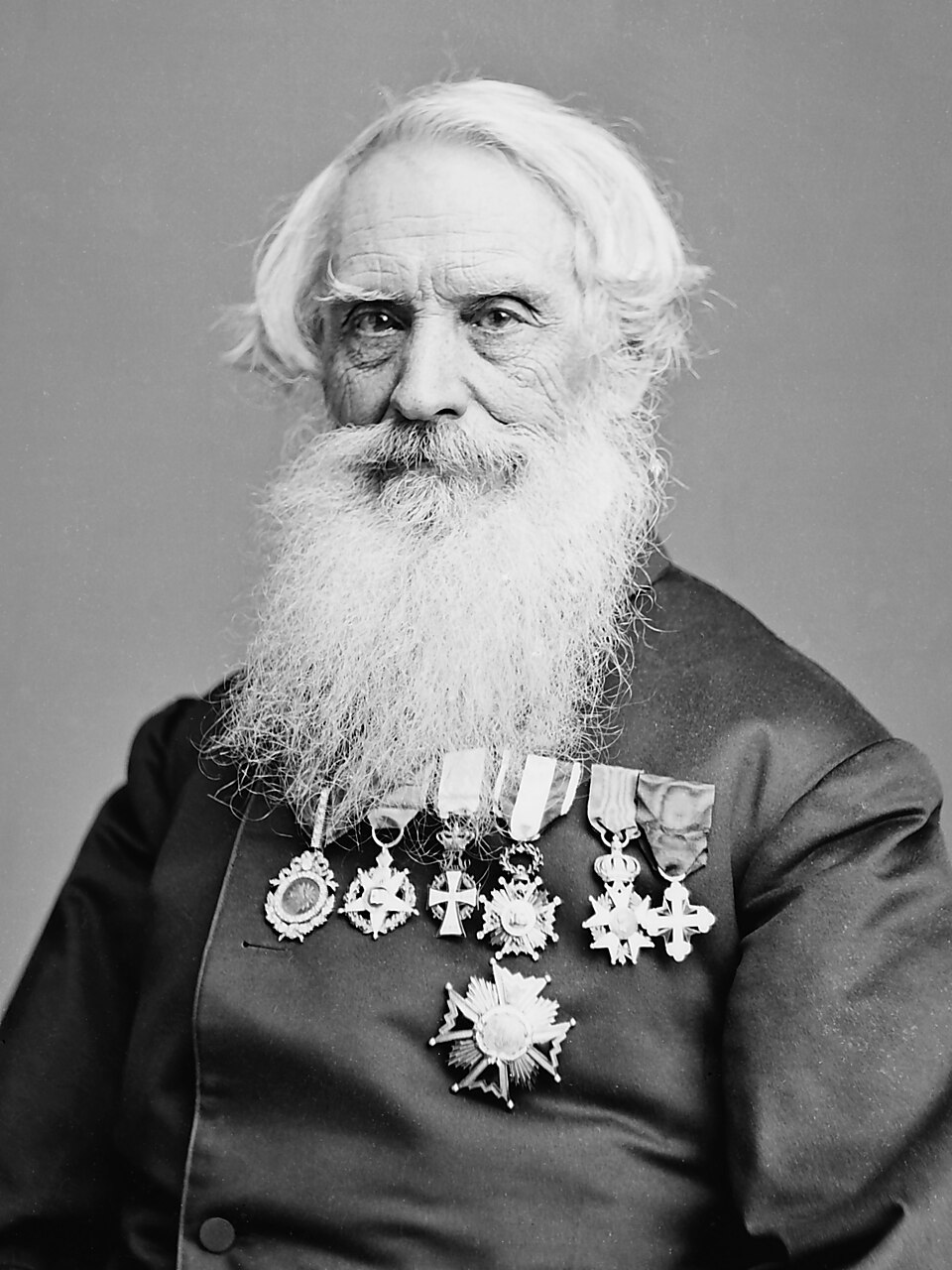
Samuel F.B. Morse (1791-1872) was an American painter and inventor. He first gained recognition as a portrait artist and founder of the National Academy of Design. Later, he turned his scientific curiosity to the electric telegraph, developing a practical system and the Morse code. Despite years of struggle and controversy, his invention transformed communication. He remained deeply religious and patriotic throughout his life.
Morse's life exemplifies the fusion of art and science, showing how a trained artist's keen observation and persistence could lead to a world-changing invention. His story provides lessons in perseverance, the importance of protecting intellectual property, and the challenges of evolving one's identity and ambitions.
Life in motion
Drag to travel through time · Ctrl/⌘ + scroll or pinch to zoom · Select a moment for the full account
Morse graduated from Yale College with Phi Beta Kappa honors.
Why it matters: Educational foundation for his later work.
Wikipedia ↗Operating system
Morse pursued painting fervently, aiming to elevate American art. He studied in England, painted historical scenes and portraits, and founded the National Academy of Design. His artistic training sharpened his observational and problem-solving skills, which later proved crucial in his telegraph work.
Evidence: In letters, Morse describes his dedication to art, his studies under Allston, and his pride in exhibiting at the Royal Academy. His son notes his artistic 'great ability' and that he 'is ranked with the best of our earlier painters.'
Even while painting, Morse experimented with color theories and materials, showing a natural inclination for scientific investigation. This curiosity later led him to the electric telegraph.
Evidence: Huntington's reminiscence says, 'Professor Morse's love of scientific experiments was shown in his artist life. He formed theories of color, tried experiments with various vehicles, oils, varnishes, and pigments. His studio was a kind of laboratory.'
Morse held a deep, literal Christian faith, viewing himself as an instrument of divine will. This faith guided his actions, gave him resilience, and at times influenced his political views.
Evidence: His son writes, 'He was born and brought up in a deeply religious atmosphere... he was perfectly sincere in his beliefs, and unfalteringly held himself to be an instrument divinely appointed to bestow a great blessing upon humanity.'
Morse was intensely patriotic, believing that American art and invention could match or surpass European achievements. He strove to elevate his country's cultural standing and later saw his telegraph as a gift to his nation and the world.
Evidence: In a letter, Morse says, 'I willingly resign it to my country, and feel happy that I can contribute a mite to her honor.' His son notes his patriotism: 'Next to love of God came love of country.'
Morse faced financial hardship, professional ridicule, personal losses, and legal battles, yet he persisted. His resilience was key to his eventual success.
Evidence: His son says, 'It is of absorbing interest... to note how he was forced to give up one ambition after another, to suffer blow after blow which would have overwhelmed a man of less indomitable perseverance.'
Morse's claim to the telegraph was contested, leading to prolonged disputes. He had to fight for his rights and legacy, but he ultimately won recognition.
Evidence: His son notes, 'For many years after his invention was a proved success, almost to the day of his death, he was compelled to fight for his rights; but he was a good fighter... and he has won out in the end.'
Read through your work
Leaders
Samuel Morse exhibited leadership in multiple arenas: as founder and president of the National Academy of Design, as a lobbyist for federal funding, and as the head of a team that built the telegraph. He motivated others, maintained integrity under pressure, and fought for his vision. His leadership was rooted in strong personal conviction, which inspired loyalty and persistence. However, his autocratic tendencies and inability to compromise on certain issues created conflicts with partners and rivals. Effective leaders today can learn from his successes and failures, particularly in managing collaborative innovation and navigating legal challenges.
In his words
“I know not in what terms to speak of Mr. Allston. I can truly say I do not know the slightest imperfection in him. He is amiable, affectionate, learned, possessed of the greatest powers of mind and genius, modest, unassuming, and, above all, a religious man.”
“I have been flattered by the newspapers which seldom praise young artists, and they do me the honor to say that my picture, with that of another young man by the name of Monroe, form a distinguishing trait in this year's exhibition.”
“I told him he never should yield a post like this to the Devil without a struggle; and, at any rate, I told him that the few Christians that there were (and, indeed, they are but as one to one thousand) could pray, and I thought it was high time.”
“I have been in the house almost ever since I came from home sifting the scheme of Universal Salvation to the bottom.”
“At eleven we had attained a height of at least two thousand feet and the precipices became frightful, sweeping down into long ravines to the very edge of the sea; and then the road would wind at the edge of the precipice two or three thousand feet deep.”
“Thus we left Marseilles, pursuing our way through what seemed to us a wild country, with many a dark ravine on our roadside and impending cliffs above us; a safe resort for bandits to annoy the traveller if they felt disposed.”
“I was married, as I wrote you I should be, on Tuesday morning last. We set out at nine o'clock and reached Amherst over bad roads at night.”
Put into practice
Morse faced many failures and rejections, from financial struggles as an artist to public ridicule of his telegraph idea. Yet he persisted, ultimately succeeding.
Morse's training as an artist—observing details, understanding systems—helped him in his scientific work.
Morse fought lengthy battles for legal recognition and patents for his telegraph.
Morse conducted his disputes with courtesy and fairness, avoiding dishonesty even when attacked.
Morse abandoned his artistic ambition when telegraphy consumed his life, showing flexibility in the face of new opportunities.
Morse's religious conviction gave him a sense of purpose and resilience.
Read with judgment
Morse's greatness lies in his ability to merge artistic perception with scientific inquiry, leading to the invention of the electric telegraph and Morse code. His training as a painter honed his observational skills and systematic thinking, which he later applied to solving the problem of long-distance communication. His perseverance through financial hardship, personal loss, and professional ridicule was crucial; he refused to abandon his vision even when others doubted. Moreover, his deep religious faith gave him a sense of purpose, viewing his work as divinely ordained, which fueled his resilience. His establishment of the National Academy of Design also showcases his leadership in elevating American art, demonstrating a multifaceted genius that transcended disciplines.
Morse was a devout Christian who believed in the literal truth of the Bible, yet he embraced scientific innovation that would transform society. He upheld traditional religious values while pioneering a technology that accelerated secular modernity. This tension is evident in his political views, where his religious convictions sometimes colored his stance on issues like immigration and slavery. Additionally, he was a patriotic American who fought for national honor, yet he had to defend his patent against international competitors and domestic rivals, revealing a conflict between his idealistic nationalism and the practical realities of intellectual property disputes.
Despite his monumental success, Morse had notable failures and blind spots. His artistic career, which he initially prioritized, did not achieve the lasting recognition he hoped for; his most famous paintings are now overshadowed by his invention. He also had a contentious relationship with fellow inventors like Joseph Henry and Alfred Vail, leading to bitter priority disputes. His staunch anti-Catholic and nativist views, expressed in writings like 'Foreign Conspiracy,' are a troubling aspect of his legacy. Furthermore, his patent litigation consumed years of his life, and he faced financial struggles even after the telegraph's success due to costly legal battles. These aspects reveal a man who, despite his brilliance, was not immune to prejudice and conflict.
Morse's life offers timeless lessons on the power of interdisciplinary thinking, as his artistic background uniquely positioned him to innovate in technology. His perseverance through adversity and willingness to pivot from art to invention resonate with today's dynamic career paths. His patent battles underscore the ongoing importance of intellectual property protection in a knowledge economy. Furthermore, his integration of faith and work raises questions about the role of personal beliefs in public life, a topic still debated. His nativist views serve as a cautionary tale about how even great minds can harbor biases, reminding us to critically examine our own assumptions. Overall, Morse's story is a rich source of insights for entrepreneurs, creators, and thinkers navigating complex modern challenges.
To learn from Morse, one should study his method of observation and systematic experimentation, as documented in his letters and journals. He kept detailed records, sought mentorship from figures like Allston, and was not afraid to ask questions. His ability to adapt is demonstrated when he shifted from painting to telegraphy; he didn't cling to a failing career but embraced new opportunities. To emulate Morse, cultivate diverse skills, maintain rigorous documentation, and build a supportive network. Also, learn from his mistakes: his patent disputes show the necessity of clear agreements and legal foresight. Finally, his determination in the face of criticism and financial hardship teaches resilience. Reading his letters provides insight into his thought process, making his journey a practical guide for perseverance and innovation.
The best entry point into Morse's life is his son's edited compilation, 'Samuel F. B. Morse: His Letters and Journals' (Volume I). This primary source offers intimate access to Morse's own words, revealing his personality, struggles, and ambitions. It includes letters, diary entries, and illustrations that bring his story to life. For a broader context, the Wikipedia article and Wikidata entry provide a concise overview and timeline. Newcomers should start with his early letters from England and his personal reflections, which humanize him before delving into his scientific achievements. This approach allows one to understand the man, not just the inventor, making his later successes more meaningful.
The human network
Teacher and Mentor
Morse was Allston's pupil in England, and Allston greatly influenced his artistic development. Allston was his primary artistic mentor and a lifelong inspiration.
Wife
Morse married Lucretia in 1818, and she supported him during his early careers. Marriage provided emotional and practical support.
Pupil and Associate
Huntington studied under Morse in the 1830s and later provided reminiscences of Morse's art methods. Shows Morse's influence as a teacher and fellow artist.
Patron
Alston commissioned portraits and was a generous supporter of Morse's art. Alston's patronage provided crucial income and recognition.
Father-in-law
Father of Lucretia, he and his wife welcomed Morse and provided family support. Family ties were important in Morse's personal life.
Continue the inquiry
Like Franklin, Morse was a self-taught inventor and scientist who combined practical innovation with public service, and both were influential in their respective fields.
Invention · Scientific curiosity · Patriotism
Edison, a later inventor, also transformed communication and industry, but differed in approach: Edison was more commercially focused, while Morse struggled financially and sought recognition.
Invention · Perseverance · Controversy
Bell's invention of the telephone built on telegraph technology, and he, like Morse, faced legal battles over patents and sought to improve communication.
Communication · Invention · Patent disputes
Stuart was a leading American portrait painter, and Morse aspired to such eminence; both contributed to American art, though Stuart was more commercially successful.
Art · Portrait painting · American identity
Trumbull was an older American painter and founder of the American Academy of Fine Arts, which Morse opposed, leading to the formation of the National Academy.
Art · Institutions · Conflict
Source shelf
link
Samuel Finley Breese Morse
View source →reference
Wikipedia contributors
View source →reference
Wikidata contributors
View source →Source basis: The primary source is 'Samuel F. B. Morse: His Letters and Journals' (Volume I), edited by his son, which provides letters, journals, and editorial commentary. This source offers rich evidence of Morse's artistic career, personal life, and character, with his son's preface acknowledging potential biases but asserting a balanced view. The Wikipedia article and Wikidata entry supplement with factual details and a timeline. The themes extracted from the source include his artistic ambition, scientific curiosity, religious conviction, patriotism, perseverance, and the controversies he faced. Lessons drawn emphasize perseverance, diverse skill integration, intellectual property protection, integrity, adaptability, and faith-guided values. This foundation enables a rigorous interpretation of Morse's life, distinguishing his principles from actual outcomes.
Direct answers
Samuel Morse invented the single-wire telegraph system and the Morse code, a method of encoding text through sequences of dots and dashes. He conceived the idea of the telegraph in 1832 and demonstrated a working model publicly in 1838. The first long-distance telegraph line was completed in 1844, with the message 'What hath God wrought.' His invention allowed near-instant communication over long distances, transforming business, news, and personal correspondence.
Morse's artistic training sharpened his observational skills and systematic thinking, which he applied to scientific experiments. As a painter, he developed theories of color and experimented with materials, treating his studio like a laboratory. This habit of careful observation and methodical testing helped him solve technical problems in telegraphy, such as signal relay and code design. His ability to visualize the transmission of messages likely aided his conceptualization of the telegraph.
Morse faced numerous challenges: financial difficulties, public skepticism, and technical hurdles. He spent years seeking funding, eventually receiving $30,000 from Congress in 1843 to build a test line. He also had to fend off competitors who claimed to have invented the telegraph, leading to lengthy patent disputes. His perseverance was tested by personal losses, including the death of his wife, but his conviction that his work was divinely ordained kept him going.
Morse was a devout Christian, believing in the literal truth of the Bible. He saw himself as an instrument of God's will, which gave him a sense of purpose and resilience. This faith guided his actions and provided comfort during hardships. However, it also shaped his political views, sometimes leading to controversial stances, such as his anti-Catholic writings. His son noted that his faith was 'the dominant note' of his character.
Yes, Morse had significant failures, particularly in his artistic career, which he initially pursued with great ambition. Though he gained recognition, he struggled financially and eventually abandoned painting for telegraphy. His patent battles also drained his resources and energy. Additionally, his political and religious writings, such as 'Foreign Conspiracy,' promoted nativist views that are now seen as prejudiced. These failures and controversies highlight his human imperfections.
Morse secured patents for his telegraph in the United States and several other countries. He actively defended his patent rights in court, most notably in the landmark case O'Reilly v. Morse in 1854, where the Supreme Court upheld his patent on the repeater system but limited the breadth of his claims. He also received financial compensation from European governments for the use of his invention. Despite this, he had to fight almost continuously to the end of his life.
Morse's lasting legacy is the telegraph and Morse code, which fundamentally changed the speed of communication and laid the groundwork for future technologies like the telephone and internet. He also contributed to American art by founding the National Academy of Design. His life story inspires with its themes of perseverance and interdisciplinary innovation, though his controversial views serve as a reminder that even great figures have flaws. His name lives on in 'Morse code' and 'Morse telegraph.'