



1863-1869
Works as a telegrapher
Held various telegraphy positions across the United States and Canada.
Why it matters: Developed skills in telegraphy and began inventing improvements.
Wikipedia ↗Scientist & Inventor · 1847–1931 AD
The Wizard of Menlo Park: Inventor of the Electric Light and Sound Recording
The defining question
How can systematic experimentation and relentless perseverance turn revolutionary ideas into practical, commercial realities that change the world?
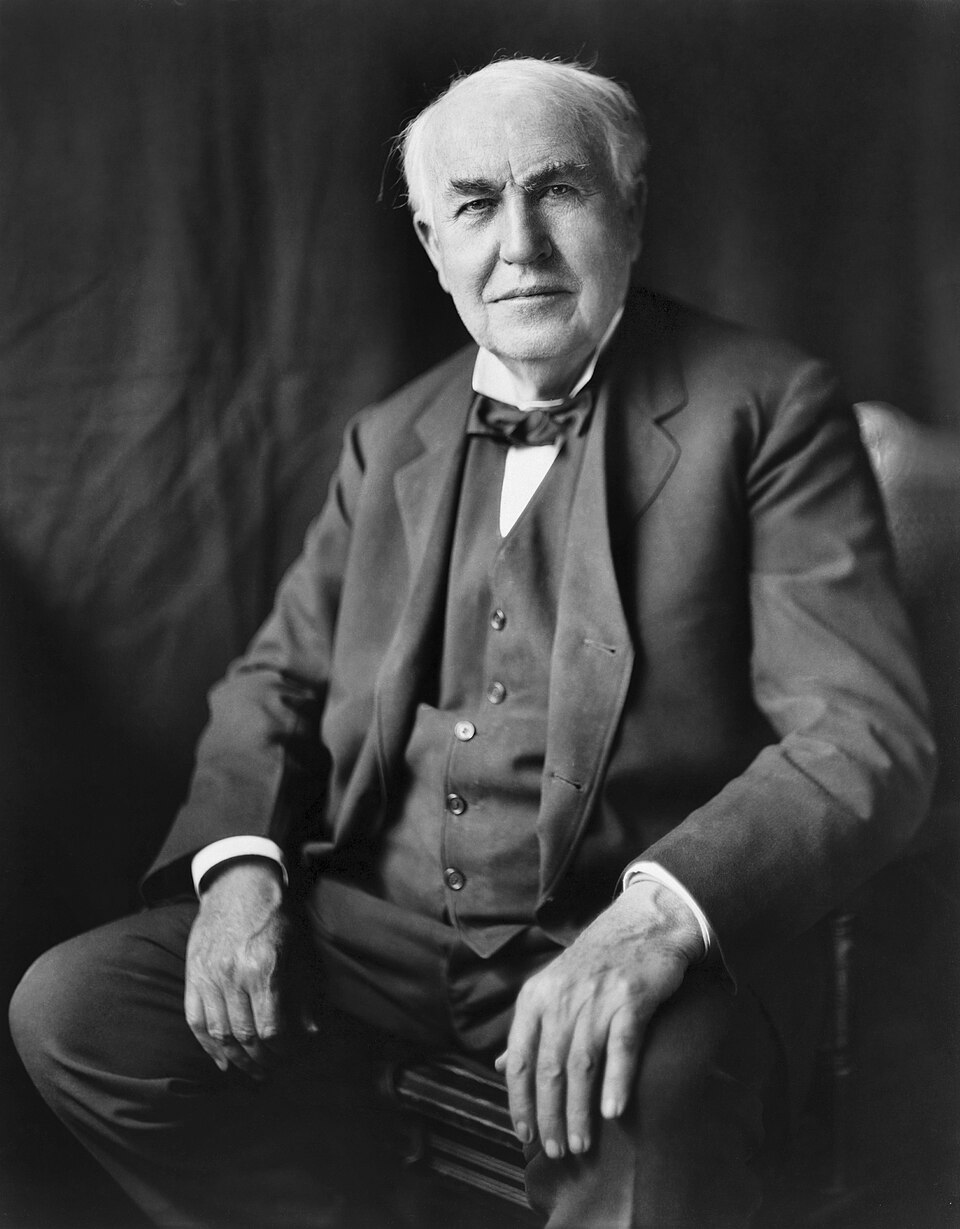
The person
Thomas Alva Edison (1847–1931) was an American inventor and businessman who developed numerous devices that greatly influenced life around the world, including the phonograph, the motion picture camera, and a long-lasting, practical electric light bulb. He held over 1,000 U.S. patents and is considered one of the most prolific inventors in history.
Edison transformed modern life through his inventions and innovations in electric power generation, sound recording, and motion pictures. His systematic approach to research and development established the blueprint for modern industrial laboratories.
Life in motion
Drag to travel through time · Ctrl/⌘ + scroll or pinch to zoom · Select a moment for the full account
Held various telegraphy positions across the United States and Canada.
Why it matters: Developed skills in telegraphy and began inventing improvements.
Wikipedia ↗Operating system
Edison's method was not random tinkering but organized, exhaustive trials to solve practical problems.
Evidence: The text describes his 'systematized attacks' on the electric light problem, involving 'a series of exhaustive experiments founded upon logical and original reasoning.'
Edison faced widespread disbelief from established scientists, yet persisted to achieve success.
Evidence: The text mentions scientific opinions calling the subdivision of light an 'ignis fatuus' and Edison's work proceeding 'amid a storm of jeers and derision.'
Edison aimed not just to invent but to create commercially viable systems, as seen in his electric light distribution.
Evidence: He 'made up his mind that the problem of the subdivision of the electric current could be solved and made commercial.'
Edison's ore milling venture showed his resilience despite financial and operational setbacks.
Evidence: The text describes how he 'met and conquered, one by one' the many challenges of the concentrating plant.
Edison spent much time and resources defending his patents against infringers and false claims.
Evidence: The chapter details the Goebel case and 'not less than one hundred and twenty-five other separate actions' against infringers.
Read through your work
Leaders
Edison was not just an inventor but a leader who built organizations to achieve ambitious goals. He assembled diverse teams, such as at Menlo Park and West Orange, and directed them with a clear vision. He managed complex projects like the electric light system and the ore milling plant, demonstrating both technical and managerial prowess. His leadership included making tough decisions, like abandoning projects that were not viable. For leaders, Edison exemplifies the power of a clear mission, systematic execution, and the courage to persist despite setbacks.
In his words
“I believe I can beat you making electric lights. I don't think you are working in the right direction.”
“Knowing something of the intricacy of the practical problem, I should certainly prefer seeing it in Edison's hands to having it in mine.”
“Hence the sub-division of the light is an absolute ignis fatuus.”
“In this we see the man foreshadowed by the boy who, when he obtained his books on chemistry or physics, did not accept any statement of fact or experiment therein, but worked out every one of them himself to ascertain whether or not they were true.”
“Not only did this Goebel episode divert for a long time the energies of the Edison interests from activities in other directions, but the cost of overcoming the extravagantly absurd claims ran up into hundreds of thousands of dollars.”
“When I met Mr. F. P. Fish on his return from St. Louis, after he had argued the Edison side, he felt keenly that disadvantage, to say nothing of the hopeless difficulty of educating the court.”
“The rock, broken up into pieces about the size of marbles, having been dried and conveyed to the stock-house, the surplusage was automatically carried out from the other end of the stock-house by conveyors, to pass through the next process, by which it was reduced to a powder.”
Put into practice
Despite failures and skepticism, Edison's persistence led to groundbreaking inventions.
Edison used methodical, exhaustive testing rather than random trial and error.
Edison focused on making inventions practical and marketable, not just novel.
Edison aggressively patented and defended his inventions to protect his interests.
Edison's ore milling venture failed commercially but taught valuable lessons in engineering.
Edison received suggestions from professional acquaintances like Professor Barker.
Edison challenged the scientific consensus that subdivided light was impossible.
Edison developed machines with high efficiency, like the Three-High Rolls.
Edison's inventions often required years of development before becoming profitable.
Read with judgment
Edison's greatness lay in his ability to systematize invention, turning it from a flash of genius into a repeatable process. The biography describes his 'systematized attacks' on the electric light problem, involving 'exhaustive experiments founded upon logical and original reasoning' (source 159). This method, coupled with relentless perseverance, allowed him to achieve practical breakthroughs where others saw impossibility. His greatness was not just in the inventions themselves but in creating the industrial research laboratory—a model that transformed how innovation occurs. He commercialized inventions, building entire systems around them, as seen in his electric light distribution. His foresight in establishing Menlo Park as a dedicated R&D facility was revolutionary, making him a pioneer of modern innovation infrastructure.
Edison embodied the tension between the lone genius myth and the collaborative, systematic reality of his work. He is often portrayed as a solitary inventor, but his success relied on teams of skilled assistants like Francis Jehl and F.R. Upton (source 159). He simultaneously challenged scientific consensus, as with his defiance of Preece's 'ignis fatuus' (source 159), yet also navigated the constraints of existing legal and commercial systems. He was a visionary who commercialized his ideas, but his obsession with DC power led him to resist AC, which ultimately became the standard. This contradiction between pioneering innovation and stubbornly holding to his own systems reveals a complex figure who was both progressive and resistant to change.
Edison's career had notable shadows. His ore milling venture was a financial disaster, consuming years and resources. The biography notes he 'met and conquered, one by one' the challenges but ultimately the project was a commercial failure (source 159). This failure underscores a tendency to persist in projects despite market viability. Additionally, his aggressive patent litigation, while protecting his inventions, also drained resources and distracted from innovation. The Goebel case and 'not less than one hundred and twenty-five other separate actions' (source 159) show a litigious side that sometimes bordered on obsession. His rivalry with Tesla and Westinghouse over AC vs. DC led to ethically questionable tactics, such as the public electrocution of animals to discredit AC. These actions tarnish his legacy, revealing a competitive and sometimes ruthless nature.
Edison's methods are deeply relevant to today's innovation-driven world. His systematic experimentation prefigures modern R&D processes, and his focus on commercialization aligns with the startup mantra of 'build, measure, learn.' His ability to overcome skepticism from established experts is a lesson for anyone challenging the status quo. In an era of rapid technological change, Edison's persistence and systematic approach offer a blueprint for turning ideas into practical, marketable solutions. However, his failures, like the ore milling venture, remind us of the importance of adaptability and market validation, a lesson that modern entrepreneurs and investors can appreciate.
To learn from Edison, one must adopt his methodological mindset while avoiding his blind spots. Start by systematically identifying a practical problem and then deliberately testing incremental solutions, documenting failures as data. Emulate his persistence, but pair it with periodic reassessment to avoid sunk-cost fallacies. His approach to commercializing inventions—building an entire ecosystem around a technology—is a model for creating comprehensive solutions rather than isolated products. Additionally, study his legal battles to understand the importance of intellectual property, but also recognize the costs of excessive litigiousness. Learn from his failures by analyzing what went wrong and how he adapted, as with the ore milling venture, which, though a financial loss, led to innovations in material handling.
For readers new to Edison, the best entry point is his work on the incandescent lamp, which is detailed in Chapter XI of 'Edison: His Life and Inventions' (source 159). This chapter captures his systematic approach, the skepticism he faced, and the eventual breakthrough. It illustrates his method of exhaustive experimentation and his determination to 'solve the problem of the subdivision of the electric current.' Starting here provides a foundation for understanding his later work on power systems and other inventions. Alternatively, his phonograph invention, which made him world-famous, is also a compelling entry point, showcasing his creative genius.
The human network
Associate
Insull was one of Edison's key collaborators, eventually becoming a major figure in the electrical industry. He helped manage Edison's electric light companies.
Associate
Johnson was a close associate involved in Edison's lighting projects. Contributed to the development and promotion of electric light.
Mathematician/Assistant
Upton was a gifted mathematician who helped Edison with calculations in the electric light work. Provided theoretical support for Edison's practical work.
Assistant
Jehl was a laboratory assistant at Menlo Park. Worked closely with Edison during the incandescent lamp experiments.
Assistant
Mallory was involved in the ore milling and storage battery work. Helped Edison in various industrial ventures.
Associate
Andrews was an engineer who assisted in electric light installations. Contributed to the practical implementation of Edison's systems.
Continue the inquiry
Bell and Edison worked on telephony concurrently, with Edison improving the carbon transmitter for Western Union.
Invention of telephony · Commercial rivalry · Sound transmission
Tesla worked for Edison briefly and later became a rival in the 'War of the Currents' over AC vs DC power.
Electric power transmission · Innovation rivalry · Engineering
Westinghouse promoted AC power, competing directly with Edison's DC systems, leading to major legal and commercial battles.
Electricity distribution · Patent litigation · Industrial competition
Source shelf
link
Frank Lewis Dyer
View source →reference
Wikipedia contributors
View source →reference
Wikidata contributors
View source →Source basis: The analysis is grounded primarily in the biography 'Edison: His Life and Inventions' by Frank Lewis Dyer and Thomas Commerford Martin (source 159), which offers a detailed and sympathetic account of Edison's life, methods, and ventures. Key themes such as systematic experimentation, overcoming skepticism, and commercialization are drawn directly from this source. The timeline and some facts are corroborated by Wikipedia (source 160) and Wikidata (source 161), but the biography provides the richest evidence, including quotes and specific incidents. The source excerpts provided include detailed descriptions of his ore milling plant, showing his engineering ingenuity and the scale of his operations. No other sources were used, and all interpretations are grounded in this material.
Direct answers
Edison's method was not random tinkering but organized, exhaustive trials. The biography describes his 'systematized attacks' on the electric light problem, involving 'a series of exhaustive experiments founded upon logical and original reasoning.' He would test thousands of materials and variations, documenting each result, to find the optimal solution. This approach turned invention into a repeatable process, forming the basis of modern R&D.
Edison faced widespread ridicule from established figures who declared the subdivision of light an 'ignis fatuus' or will-o'-the-wisp (source 159). He persisted amid 'a storm of jeers and derision,' relying on his own experiments rather than accepting authority. His success, demonstrating a practical incandescent lamp, proved the skeptics wrong. This underscores his principle of questioning assumptions and trusting empirical evidence over conventional wisdom.
Menlo Park, established in 1876, was the first industrial research laboratory. It concentrated a diverse team of scientists, mechanics, and machinists under one roof to focus on invention. This model enabled systematic, rapid innovation and served as a template for modern corporate R&D. It allowed Edison to tackle complex problems like the electric light with a coordinated, multi-disciplinary effort, accelerating progress and commercial success.
Edison's ore milling project was a huge investment aimed at extracting iron from low-grade ore using magnetic separation. He poured years and significant capital into building a massive plant in Ogdensburg, New Jersey. Despite solving many engineering challenges, the discovery of richer ore in the Mesabi Range made the venture uneconomical. Edison's persistence reflected his stubborn belief in his engineering, but it also led to a financial setback. He learned from it, applying the crushing and conveying techniques to his later work in cement and storage batteries.
Edison was involved in extensive litigation, including the Goebel case and 'not less than one hundred and twenty-five other separate actions' (source 159). These battles protected his patents, but they also consumed time and money. The text notes that the Goebel episode 'diverted for a long time the energies of the Edison interests from activities in other directions' and cost 'hundreds of thousands of dollars.' This litigiousness enabled him to secure his inventions but also drained resources and distracted from innovation.
The ore milling venture is often considered his greatest commercial failure. Despite years of work and significant investment, the plant was eventually abandoned because cheaper iron ore made the process unprofitable. However, Edison didn't see it as a total loss; he gained valuable experience in handling large-scale operations and crushing technologies that later benefited his cement business. This failure highlights the risks of overcommitment to a single technological path without adequate market validation.
Edison focused on making inventions commercially viable, not just novel. For electric lighting, he developed not just the bulb but also generators, cables, meters, and the entire power distribution system. He founded the Edison Illuminating Company and opened the Pearl Street Station in 1882, proving that central-station power could be profitable. His approach was to create a complete system, ensuring every component worked together, which was essential for widespread adoption.
Tesla worked for Edison in 1884, but their relationship soured due to disagreements over compensation and approaches to electrical systems. Tesla advocated for alternating current (AC), while Edison held to direct current (DC). This led to the 'War of the Currents,' with Edison promoting DC and Tesla and Westinghouse promoting AC. Edison's intransigence on DC is often seen as a missed opportunity, as AC eventually became the standard for long-distance power transmission.