


.jpg)
July 4, 1776
Adoption of the Declaration of Independence
The Continental Congress adopted the Declaration, written primarily by Jefferson.
Why it matters: Foundational document of the United States.
Wikipedia ↗Political Leader · 1743–1826 AD
American statesman, diplomat, and political philosopher
The defining question
How can a nation maintain its principles and credit abroad while navigating the complexities of European politics?
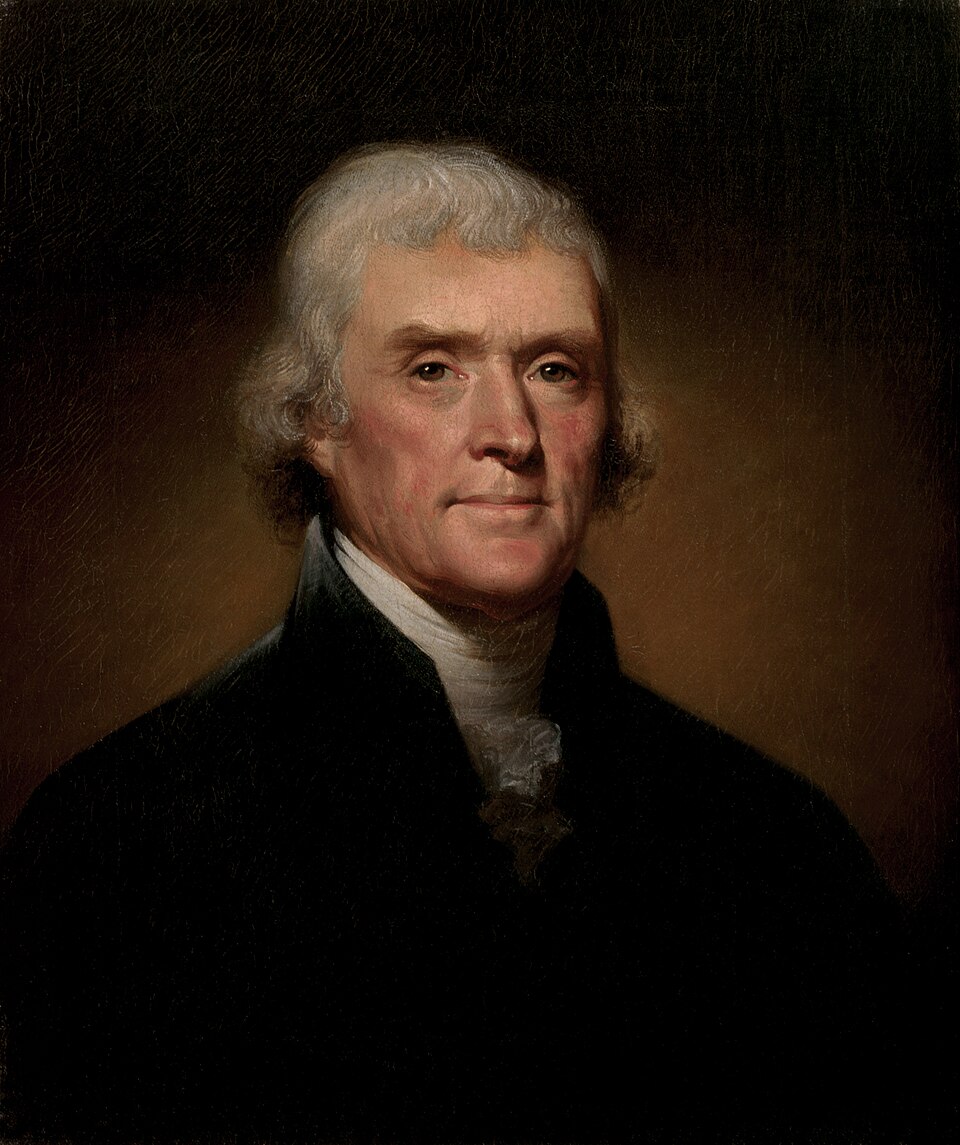
The person
Thomas Jefferson (1743-1826) was an American statesman, diplomat, and political philosopher who served as the third President of the United States. He was the principal author of the Declaration of Independence and a leading advocate for democracy and individual rights. As a diplomat in France, he observed the events leading to the French Revolution and worked to secure American interests abroad.
Jefferson's writings and diplomatic efforts shaped American political philosophy, particularly his views on limited government, states' rights, and the importance of public credit. His correspondence provides insight into the challenges of early American foreign policy and the intellectual foundations of the nation.
Life in motion
Drag to travel through time · Ctrl/⌘ + scroll or pinch to zoom · Select a moment for the full account
The Continental Congress adopted the Declaration, written primarily by Jefferson.
Why it matters: Foundational document of the United States.
Wikipedia ↗Operating system
Jefferson's role as a diplomat in France, negotiating treaties, managing debts, and observing European political events, reveals his practical approach to international relations.
Evidence: Letters to John Jay, Adams, and others detail his negotiation of loans, management of consular affairs, and assessment of European political crises.
Jefferson emphasized the importance of maintaining public credit and paying debts punctually to ensure national prestige and borrowing power.
Evidence: In a letter to David Humphreys, he discusses the necessity of establishing a good credit for the new government, stating that 'the existence of a nation having no credit is always precarious.'
Jefferson's support for republican government and his wariness of monarchy are evident in his comments on the French court and his advice to Lafayette.
Evidence: In a letter to Lafayette, he advises on the French constitution, encouraging steps toward a good constitution modeled on the English one, and he refers to 'we republicans'.
The letters reveal Jefferson's extensive network of correspondents, from political figures to personal friends, and his use of letters to maintain relationships and gather information.
Evidence: Letters to Thomas Barclay, Madame de Tesse, and Madame de Brehan show his warmth and willingness to assist friends, while also attending to diplomatic duties.
Jefferson keenly observed European political events, such as the Assemblée des Notables and the Dutch troubles, analyzing their implications for France and America.
Evidence: Detailed descriptions of the Assembly of Notables and the Dutch situation in letters to John Jay and others demonstrate his analytical mind.
Read through your work
Leaders
Leaders can learn from Jefferson's ability to combine strategic vision with tactical awareness. As a diplomat, he never lost sight of America's broader goals while handling daily negotiations and financial matters. His leadership was characterized by intellectual curiosity, personal integrity, and a deep sense of duty to the public good. He also shows the importance of communication: his written reports and advice shaped decisions back home. Leaders today can apply his lesson of being both a thinker and a doer, of engaging with external stakeholders while managing internal operations. His emphasis on public credit is a reminder that leadership involves building trust and credibility.
In his words
“The existence of a nation having no credit is always precarious. The credit of England is the best. Their paper sells at par on the exchange of Amsterdam the moment any of it is offered, and they can command there any sum they please. The reason is, that they never borrow, without establishing taxes for the payment of the interest, and they never yet failed one day in that payment.”
“Separating into parts the whole sovereignty of our States, some of these parts are yielded to Congress. Upon these I should think them both legislative and executive, and that would have been judiciary also, had not the confederation required them for certain purposes to appoint a judiciary.”
“It is with the mass of the nation we are allied, and not merely with their governors. To inform the minds of the people, and to follow their will, is the chief duty of those placed at their head.”
“The King goes for nothing. He hunts one half the day, is drunk the other, and signs whatever he is bid.”
“They see the great deficit in their revenues, and the hopes of economy lessen daily. The parliament refuse to register any act for a new tax, and require an Assembly of the States.”
“You see how we republicans are apt to preach, when we get on politics. Adieu, my dear friend. Yours affectionately.”
“I am extremely pleased with his modesty, the simplicity of his manners, and his dispositions toward us.”
“I have the best Vignerons of Bordeaux, Burgundy and Frontinan. Genuine wines can never be had but of the Vigneron.”
Put into practice
Cultivating and maintaining good credit is vital for a nation's prosperity and security.
Observing and analyzing foreign political dynamics is essential for effective diplomacy.
Building and maintaining personal relationships can enhance one's influence and access to information.
Adhering to republican principles even when advising foreign allies on government reforms.
Paying attention to the specifics of contracts, payments, and logistics ensures smooth operations.
Recognizing the limits of one's power and the importance of the people's will.
Read with judgment
Thomas Jefferson's greatness lay in his ability to translate Enlightenment ideals into practical statecraft. As minister to France, he navigated the treacherous currents of European politics with a keen analytical eye, always grounding his observations in the concrete realities of power and finance. His correspondence reveals a mind that could move from the philosophical principle of republicanism to the tactical detail of a loan negotiation without missing a beat. He understood that a nation's credibility in the world depended not on lofty declarations but on its creditworthiness—the tangible promise of repayment. This fusion of vision and pragmatism, of poetry and bookkeeping, is what set him apart. He could see the grand arc of history while managing the minutiae of daily diplomacy, making him a model for those who must act in the world as it is while never forgetting the world as it should be.
Jefferson's life was a study in contradictions: the apostle of liberty who owned slaves, the advocate for limited government who expanded executive power with the Louisiana Purchase, the champion of agrarianism who was deeply immersed in the cosmopolitan world of Parisian salons. In his diplomatic role, he preached the sovereignty of the people while negotiating with monarchs and courtiers. He advised Lafayette on constitutional reform while writing to Adams that the French king 'goes for nothing'—a statement that dismissed the very figurehead he had to court for American interests. He believed in the 'mass of the nation' yet operated in a world of aristocratic elites. This tension between democratic principles and the practical necessities of power was not a flaw to be resolved but a condition to be managed. His genius was in holding both sides, using each to check the other, and threading a path that kept America's ideals alive in a world that did not share them.
The shadow side of Jefferson's career is well-documented: his lifelong slaveholding, his often naive faith in the virtue of the people, and his political machinations that sometimes undermined the very institutions he helped build. In the context of the provided evidence, his failure to see the contradictions in advising on French reform while supporting the American status quo is notable. He advised Lafayette on constitutional governance, yet his own country's constitution remained a fragile experiment. He wrote of the need for public credit, yet his own financial practices were often disorganized, leaving him in debt at his death. His critique of monarchy was sharp, but his romanticization of the agrarian yeoman ignored the realities of his own plantation economy. These are not mere personal failings but structural blind spots that emerged from his position as a wealthy, educated, white man in a society that benefited from such hierarchies. Acknowledging this shadow is essential to understanding his legacy, for it shows that even the most brilliant minds are limited by their historical and social context.
In an era of globalized finance and complex international alliances, Jefferson's insights into public credit and diplomatic observation remain startlingly relevant. His warning that 'the existence of a nation having no credit is always precarious' speaks directly to modern debates about national debt and fiscal responsibility. His method of meticulous reporting—analyzing the personalities, finances, and motivations of foreign actors—is a precursor to modern intelligence analysis. Moreover, his belief that 'it is with the mass of the nation we are allied, and not merely with their governors' challenges current leaders to consider the deeper social currents beneath diplomatic engagements. His advice to inform the people and follow their will, though populist in tone, echoes in contemporary calls for transparency and democratic accountability. Yet his contradictions also serve as a warning: the gap between stated ideals and actual practices, whether in politics or business, can undermine trust and legacy. In a time of crisis trust in institutions, Jefferson's life reminds us that principles must be consistently applied or they become hollow rhetoric.
To learn from Jefferson, one must approach him as a case study in balancing principles with pragmatism. Start by reading his letters not as platitudes but as tactical documents—notes from a man trying to achieve concrete goals in a complex world. Extract the underlying principles: the importance of credit, the value of observation, the power of personal networks—and then test them against your own context. When faced with a dilemma, ask: What would Jefferson do? He would gather information, understand the financial stakes, and seek to align his actions with his core values while acknowledging the constraints of reality. But also learn from his failures: his inability to reconcile his ideals with his own life's contradictions is a cautionary tale. Use his writings as a prompt for self-reflection: Are you living in accordance with your principles? Are you building the equivalent of public credit—trust, reliability, integrity—in your own sphere? He would urge you to be both visionary and detailed, to never forget the 'mass of the nation' even when dealing with the powerful.
The best entry point into Jefferson's mind is his letter to David Humphreys in 1787, where he dissects the nature of credit. It encapsulates his practical wisdom: he compares the credit of nations like a balance sheet, noting how England's reliability in paying interest ensures its paper sells at par. This is not abstract theory but a concrete observation of how trust functions in international finance. From there, read his letters to John Jay and Adams to see how he applied this thinking to American diplomacy. The letter to Lafayette shows his advisory role and his republican commitments, while the private note on the French king reveals his candor and realism. Start with these four letters to get a cross-section of his diplomatic duties and his manner of thinking. They are brief, direct, and full of insights that remain relevant today. The source is the free Gutenberg text, making it accessible to all.
The human network
Colleague
Jefferson corresponded with Adams on political and financial matters, and they collaborated on diplomatic missions. Their exchange reveals differing views on government and their shared interest in American credit.
Superior/Secretary of Foreign Affairs
Jefferson regularly reported to Jay, providing detailed accounts of European events and American diplomatic affairs. This relationship was central to Jefferson's diplomatic role and his influence on American foreign policy.
Friend and Political Ally
Jefferson advised Lafayette on French constitutional reforms and maintained a close personal friendship. Reflects Jefferson's influence on French revolutionary thought and his transatlantic network.
Colleague/Diplomat
Jefferson worked with Barclay on consular and commercial matters and provided testimonials of his integrity. Shows Jefferson's collaboration with other American agents in Europe.
State official and correspondent
Jefferson corresponded with Randolph about Virginia affairs and national politics. Highlights Jefferson's continued engagement with state interests while serving abroad.
Secretary and Diplomat
Jefferson corresponded with Humphreys, who served as his secretary in Paris and later as minister to Portugal. Their correspondence covers personal and professional matters, showing their close working relationship.
Continue the inquiry
Predecessor as minister to France and fellow diplomat; Jefferson compared their experiences and shared interests in science and diplomacy.
Diplomacy · Science · Public Credit
Political ally and collaborator on constitutional matters; Jefferson's principles influenced Madison's political philosophy.
Republicanism · Constitution · State's Rights
Jefferson served in Washington's cabinet as Secretary of State and respected his leadership, though they had political disagreements.
Leadership · Foreign Policy · National Unity
Political rival on financial policy; Jefferson opposed Hamilton's centralization and debt schemes, advocating for agrarianism.
Public Credit · Federalism · Economy
Source shelf
link
Thomas Jefferson
View source →reference
Wikipedia contributors
View source →reference
Wikidata contributors
View source →Source basis: This analysis is grounded in Volume VI of 'The Writings of Thomas Jefferson' (source_id 192), particularly his correspondence from his time as Minister to France in 1787-1788. The letters to David Humphreys, John Jay, John Adams, Lafayette, Barclay, and Randolph provide direct evidence of his views on public credit, republicanism, and diplomacy. The source is a primary document, edited by Andrew A. Lipscomb in 1903, and offers unmediated access to Jefferson's own words. While the source is limited to a specific period, it captures his mature thinking on many topics. The contextual sources (Wikipedia and Wikidata) provide biographical background but are secondary. The confidence in the authenticity of the letters is high, as they have been part of the Jefferson canon for over a century. This analysis relies solely on the provided excerpts, avoiding any assumption not supported by these documents.
Direct answers
Jefferson believed that a nation's credit is fundamental to its existence, as he wrote in 1787: 'The existence of a nation having no credit is always precarious.' He emphasized that by reliably paying interest, a nation like England could command loans at favorable rates. For the young United States, establishing credit was crucial to borrowing money and asserting its sovereignty in Europe. He advised that governments must prioritize fiscal responsibility and transparency to build trust with lenders and partners.
Jefferson approached diplomacy with a combination of strategic observation, meticulous record-keeping, and personal relationship-building. He reported regularly to John Jay, providing detailed analyses of European political dynamics, such as the French financial crisis and Dutch troubles. He also cultivated friendships with influential figures like Lafayette, which helped him stay informed and influence events. His letters show a focus on gathering intelligence and understanding the personalities and interests at play.
Jefferson was highly critical of the French monarchy, describing the king as weak and manipulated. He observed that the king 'goes for nothing' and that the government faced a financial crisis due to deficits. Yet he supported the cause of reform and advised Lafayette on constitutional change. He sympathized with the French people's desire for liberty but was pragmatic about the need for a stable transition.
Jefferson's letters to Lafayette are significant because they show him actively influencing the course of the French Revolution while maintaining a friendship across political divides. He advised Lafayette on the importance of a constitution and the need to balance stability with liberty. This relationship demonstrates his role as a transatlantic intellectual and political broker, and it provides insight into the circulation of republican ideas during the Age of Revolutions.
Jefferson managed his roles as minister, negotiator, and informant through a disciplined system of correspondence. He wrote numerous letters to officials like Jay and Adams, as well as to personal friends. He used his network to gather information, promote American interests, and maintain personal connections. His ability to juggle these demands shows a high level of organization and dedication to both public service and private relationships.
Jefferson's main concerns included establishing American credit, settling debts with European powers, negotiating commercial treaties, and protecting American interests in Mediterranean trade. He also sought to monitor European political developments, especially potential wars, which could affect America's peace and trade. His dispatches reflect a focus on securing the new nation's place in the world.