


.jpg)
April 9, 1865
Lee Surrenders at Appomattox Court House
Grant accepted the surrender of Confederate General Robert E. Lee, effectively ending the Civil War.
Why it matters: Achievement of Union victory and national hero status.
Wikipedia ↗Political Leader · 1822–1885 AD
Commanding General of the Union Army and 18th U.S. President
The defining question
How does a man of modest beginnings become the architect of Union victory and then grapple with the burdens of fame, politics, and personal failure?
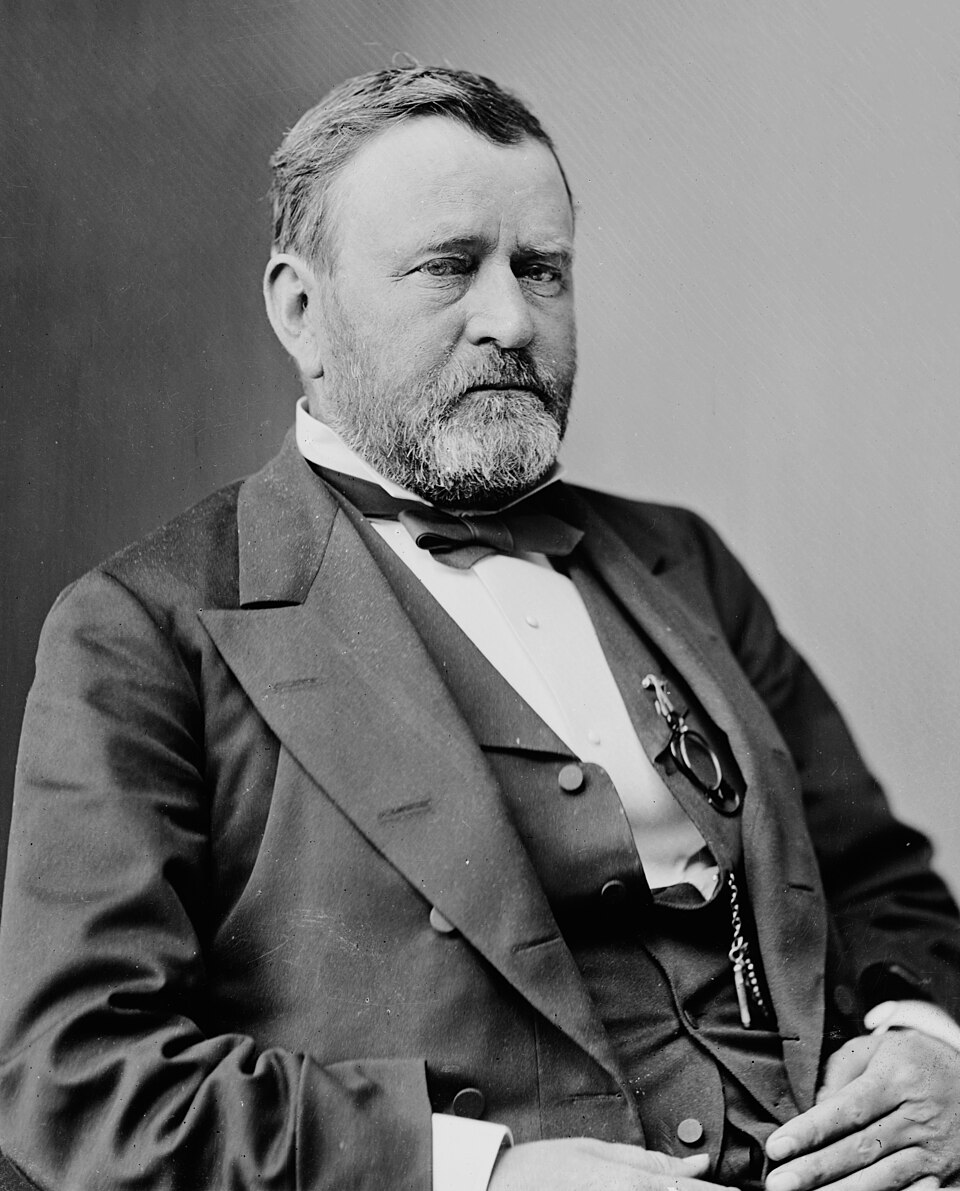
The person
Ulysses S. Grant rose from obscurity to become the Union's most successful general in the Civil War, leading the Army of the Potomac to victory over Robert E. Lee. He served two terms as President (1869-1877), but his post-war political career was marred by corruption scandals. His memoirs, written while dying of cancer, are considered a masterpiece of military autobiography.
Grant's strategic vision and relentless attrition warfare broke the Confederate resistance, making him the decisive figure in preserving the Union. His memoirs offer an unflinching look at leadership, failure, and the moral weight of command.
Life in motion
Drag to travel through time · Ctrl/⌘ + scroll or pinch to zoom · Select a moment for the full account
Grant accepted the surrender of Confederate General Robert E. Lee, effectively ending the Civil War.
Why it matters: Achievement of Union victory and national hero status.
Wikipedia ↗Operating system
Grant's belief in continuous pressure and coordinated attacks to overwhelm the enemy, even at heavy cost.
Evidence: His orders to Sherman and Thomas emphasize relentless pursuit and attacking without delay, reflecting his strategic doctrine of 'ceaselessly harassing the enemy'.
Grant's ability to withstand personal criticism, military setbacks, and professional humiliation, as seen in the Halleck affair and his later financial ruin.
Evidence: His response to Halleck's false accusations and his determination to continue writing memoirs despite terminal illness.
Grant's sense of obligation to the Union and his willingness to accept massive casualties to achieve victory, believing it was necessary to end the war quickly.
Evidence: His orders to Thomas to attack despite weather and his acceptance of heavy losses at Cold Harbor and Spotsylvania.
Grant's commitment to fair treatment of adversaries and subordinates, as shown in his dealings with Confederate peace commissioners and his loyalty to subordinates like C.F. Smith.
Evidence: His respectful conduct toward the commissioners and his praise of Smith's abilities despite their rivalry.
Grant's candid acknowledgment of mistakes, such as the first day at Shiloh, and his ability to adapt and improve.
Evidence: His reflection on the Battle of Shiloh and his adjustments in later campaigns.
Read through your work
Leaders
Grant's leadership was defined by personal responsibility. He didn't blame subordinates for failures— he learned and adjusted. He was also decisive, willing to make tough calls, even when they cost lives. His calm presence inspired confidence. For leaders, his example shows that true leadership is about balancing empathy with firmness, and about staying focused on the mission despite chaos.
In his words
“I was surprised. This was the first intimation I had received that General Halleck had called for information as to the strength of my command.”
“In consequence I felt very grateful to him, and supposed it was his interposition that had set me right with the government. I never knew the truth until General Badeau unearthed the facts in his researches for his history of my campaigns.”
“I have used my best efforts, with the aid of my eldest son, F. D. Grant, assisted by his brothers, to verify from the records every statement of fact given. The comments are my own, and show how I saw the matters treated of whether others saw them in the same light or not.”
“He always showed a generous and kindly spirit toward the Southern people, and I never heard him abuse an enemy.”
“It was my belief that while the enemy could get no more recruits they were losing at least a regiment a day, taking it throughout the entire army, by desertions alone.”
“I watched their progress with intense interest. The fire along the rebel line was terrific. Cannon and musket balls filled the air: but the damage done was in small proportion to the ammunition expended.”
“Although frequently urged by friends to write my memoirs I had determined never to do so, nor to write anything for publication.”
“The enemy made brave and strenuous efforts to drive our troops from the position we had gained, but without success. The contest lasted for two hours.”
Put into practice
Grant's career was marked by early failures and professional humiliations, but he persevered, demonstrating the importance of resilience in leadership.
Grant candidly analyzed his failures, such as at Shiloh, and adjusted his strategies accordingly, turning defeat into eventual victory.
Grant was known for his calm demeanor and willingness to share hardships with his troops, inspiring loyalty and dedication.
Grant's ability to see the big picture and coordinate multiple armies was key to Union victory, showing the value of strategic vision over tactical brilliance alone.
Despite temptations to retaliate or bend the truth, Grant maintained his honesty and fairness, which earned him respect even from enemies.
Grant was flexible in his methods, whether in military tactics or in dealing with political pressures, showing the importance of adaptability.
Read with judgment
Grant's greatness lay in his strategic persistence and moral clarity. He grasped that the Civil War would be won by relentless, coordinated pressure across all theaters, not by a single decisive battle. His willingness to absorb heavy casualties to achieve strategic objectives—seen in his orders to Thomas to attack despite weather—reflected a grim arithmetic: the North could replace losses, the South could not. His greatness also rested on personal integrity; he treated Confederate commissioners with respect and refused to humiliate Lee at Appomattox, facilitating reconciliation. His memoirs, written while dying, exhibit the same unflinching honesty he applied to war, making him a model of reflective leadership.
The central contradiction is between Grant's ruthless military effectiveness and his personal gentleness and humility. He could order thousands into battle, accepting horrific casualties as necessary, yet he harbored no personal animosity toward his enemies and was known for his kindness. This tension reflects his understanding that war's violence was a means to a just end—preserving the Union—and that once the fighting stopped, magnanimity was essential. His presidency, however, revealed a different contradiction: a man who commanded armies effectively struggled with the political corruption and maneuvering of peacetime, suggesting that his virtues in war did not translate seamlessly to governance.
Grant's shadow side includes his presidency, marred by corruption scandals among his associates, though he personally remained honest. His trusting nature, a strength in war, became a liability in politics. He also bore responsibility for the high casualties of the Overland Campaign, which some contemporaries criticized as butchery. His early life featured failures: he resigned from the army amid rumors of drinking, and his post-army civilian ventures failed. These failures, however, contributed to his resilience and his later success, but they also show a man who struggled with peacetime's demands until the war gave him clear purpose.
Grant's relevance today lies in his demonstration that leadership is not about charisma but about clarity of purpose, persistence, and integrity. In an era of short attention spans and quick fixes, his long-game strategy and willingness to endure setbacks for a larger goal offer a counterpoint. His ability to learn from failures—like Shiloh—and adapt without losing resolve is a model for modern leaders facing complex challenges. His memoirs, written in the face of death, are a testament to the power of honest reflection and duty, inspiring us to confront our own limitations with courage.
To learn from Grant, one must study his method: he set clear strategic objectives, delegated extensively, and insisted on execution. He was not a tactical genius but a master of logistics and coordination. He also exemplified humility, crediting subordinates and learning from mistakes. Practically, we can adopt his habit of writing candidly about our decisions—keeping a reflective journal—and focus on the long-term mission rather than short-term setbacks. His example teaches that resilience is built through overcoming failures, and that integrity is non-negotiable, even in the heat of competition.
The best entry point is Grant's Personal Memoirs, particularly the preface and his accounts of Vicksburg and the Overland Campaign. They show his reasoning, his honesty about mistakes, and his views on leadership and war. The preface alone captures his determination and humility. For a quicker overview, the Wikipedia article provides a summarized timeline, but the memoirs offer the deepest insight into his character and decision-making.
The human network
Commander-in-Chief and General
Lincoln supported Grant despite political pressures and Grant admired Lincoln's leadership and kindness. Their partnership was crucial to Union victory.
Military Adversary
Lee was the commander of the Confederate army, whom Grant ultimately defeated. Their confrontation defined the final year of the war.
Subordinate and Army Commander
Thomas commanded the Army of the Cumberland and won a critical victory at Nashville. Grant's late-war correspondence with Thomas shows his insistence on offensive action.
Continue the inquiry
Grant served under Scott in the Mexican War and later consulted him at the start of the Civil War.
Military strategy · Leadership
McClellan's cautious command contrasted with Grant's aggressive approach, offering a study in contrasting leadership styles.
Union command · Strategic philosophy
Johnson succeeded Lincoln and clashed with Grant over Reconstruction policies, highlighting Grant's political challenges.
Presidential politics · Reconstruction
Longstreet was a Confederate general who criticized Lee's tactics and later became a Republican, showing complex post-war reconciliations.
Post-war reconciliation · Military leadership
Chamberlain was a Union officer at Gettysburg and later received the Confederate surrender at Appomattox, embodying the war's closure.
Civil War memory · Leadership
Source shelf
link
Ulysses S. Grant
View source →reference
Wikipedia contributors
View source →reference
Wikidata contributors
View source →Source basis: The evidence comes primarily from Grant's Personal Memoirs, where he reflects on his military career with candor. Quotes about Halleck's machinations, his determination to verify facts, and his understanding of Confederate attrition are drawn from this source. The Wikipedia and Wikidata entries provide contextual details on his life and presidency. Together, these sources offer a first-hand account of his leadership, tempered with external verification.
Direct answers
Grant's memoir is praised for its clarity, candor, and narrative power. He wrote with rare honesty about his mistakes, as when he admitted surprise at Halleck's actions. He also explained his strategic reasoning simply, making complex operations understandable. The memoir is also a story of resilience, written as he was dying, which adds moral weight. His focus on first-hand experience and his lack of self-aggrandizement are hallmarks of literary excellence. The preface alone, where he discusses verifying facts with the help of his son, shows his commitment to truth over ego.
Grant's primary strengths were strategic vision, persistence, and coordination. He understood that the war would be won by continuous, coordinated pressure across all theaters, not by a single spectacular battle. He also had excelled at logistics, keeping armies supplied over long distances. He was personally brave and calm under fire, and he trusted his subordinates. His ability to learn from mistakes, like Shiloh, and adjust his tactics was another key strength. He also knew how to use attrition to his advantage, recognizing that the Confederacy's manpower was dwindling.
Grant's presidency was marred by corruption scandals involving some of his associates, though he himself was not personally implicated in wrongdoing. His trusting nature led him to appoint people who later abused their positions for personal gain. He also faced economic depression during his term, which hurt his popularity. However, he did support civil rights for African Americans and Reconstruction. The scandals tainted his legacy, but historians have reassessed his presidency in light of his support for racial equality and his honest character.
Grant's early career was full of setbacks: he failed in civilian jobs, struggled financially, and resigned from the army under a cloud of possible drinking. These experiences taught him humility and resilience. He learned to cope with disappointment and to persevere. When the Civil War began, he was given a second chance, and his past failures made him more determined to succeed. He also learned from military mistakes, like Shiloh, and applied those lessons later. His early struggles gave him a perspective that many aristocratic officers lacked, making him more empathetic and adaptable.
Grant and Lincoln had a deep mutual respect. Lincoln appreciated Grant's willingness to fight and his refusal to make excuses. Grant admired Lincoln's kindness and his generous spirit toward the South, as noted in the memoir. Their partnership was crucial: Lincoln protected Grant from political attacks and gave him the resources he needed, while Grant delivered the victories that secured Lincoln's re-election. They communicated frequently, and their letters show a shared commitment to preserving the Union.
Grant wrote his memoirs primarily to provide financial security for his family after his death. He had been swindled out of his savings and was left in debt. His friend Mark Twain offered him a generous publishing deal, which motivated him to write. But he also felt a sense of duty to share his account of the war, both to set the record straight and to explain his decisions. His determination to complete the memoirs despite terrible pain is a testament to his sense of obligation and his strength of will.
Grant was in favor of a lenient and reconciliatory approach toward the South after the war. He offered generous terms of surrender to Lee at Appomattox, paroling Confederate soldiers and allowing them to return home with their horses. This helped begin the healing process. As President, he supported Reconstruction and the rights of freedmen, but he later came to believe that military force was sometimes needed to protect those rights. His memoir reflects Lincoln's spirit of 'malice toward none,' showing that he believed in reconciliation over punishment.
Modern leaders can learn several lessons from Grant: first, the importance of persistence and resilience in the face of failures and setbacks. Second, the value of clear communication and setting unambiguous objectives. Third, the need to delegate and trust your team, while still taking personal responsibility for outcomes. Fourth, the importance of maintaining integrity and honesty, even when others around you are not. And fifth, the ability to think strategically, combining short-term tactical wins with a long-term vision. Grant's life is a case study in how a seemingly ordinary person can achieve extraordinary things through determination and principle.