



1882–1885
Clydebank Factory Built
The Singer Manufacturing Company built the world's largest sewing machine factory at Clydebank, Scotland.
Why it matters: Symbolized Singer's global expansion and industrial dominance.
Wikipedia ↗Scientist & Inventor · 1811–1875 AD
Inventor of the first practical sewing machine and founder of the Singer Manufacturing Company
The defining question
How can a simple mechanical device liberate women from tedious labor and simultaneously build a global commercial empire?
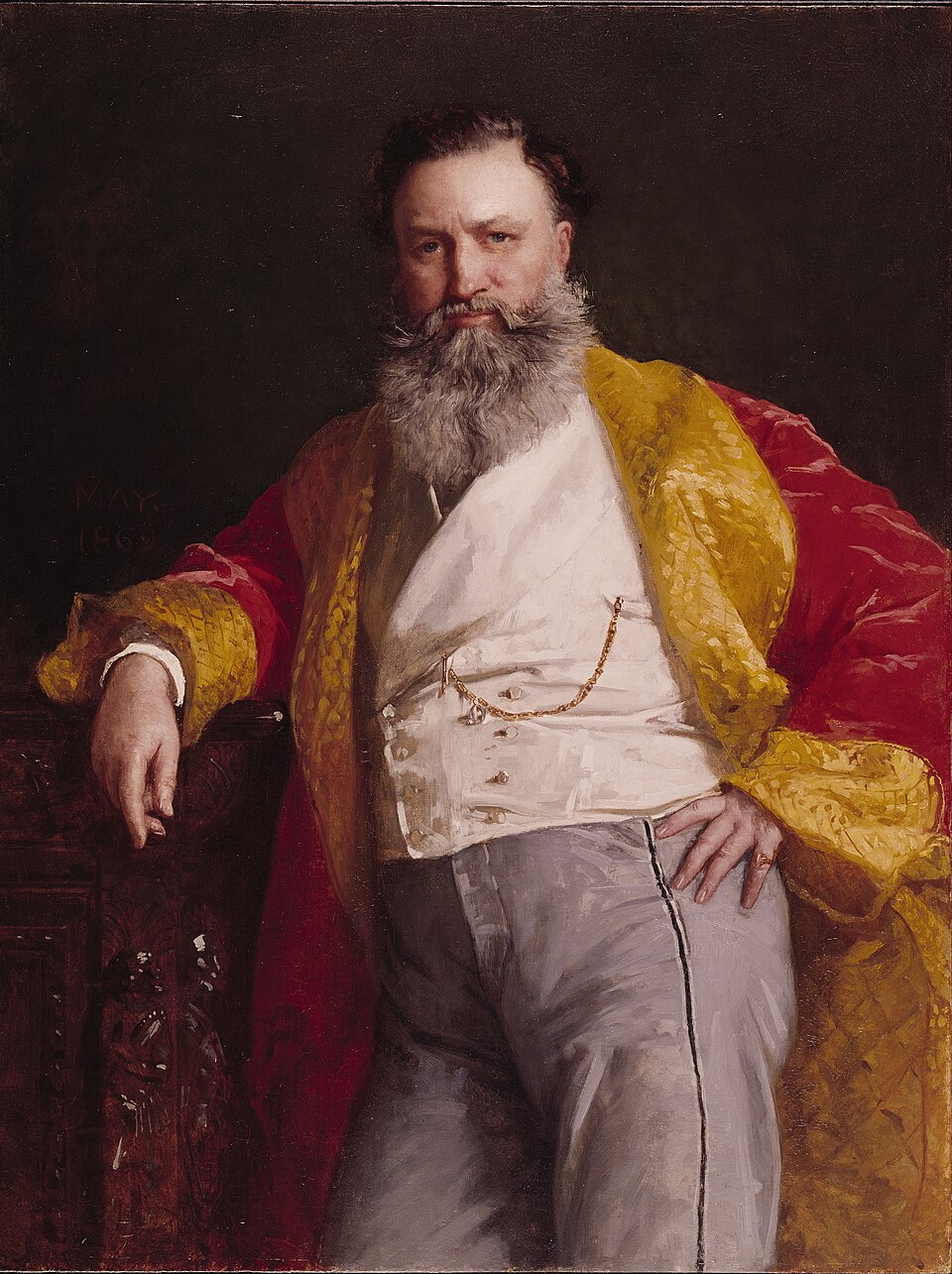
The person
Isaac Merritt Singer, a penniless mechanic, invented the first practical sewing machine in 1850, overcoming initial failures to build a machine that revolutionized home sewing and industry. He founded the Singer Manufacturing Company, which grew into a global enterprise, making sewing machines accessible to millions and transforming women's labor and home life.
Singer's invention and business acumen not only solved a pressing social problem—the drudgery of hand sewing—but also created a model for industrial manufacturing and global distribution. His company's success demonstrated the power of innovation, quality, and marketing, influencing modern business practices.
Life in motion
Drag to travel through time · Ctrl/⌘ + scroll or pinch to zoom · Select a moment for the full account
The Singer Manufacturing Company built the world's largest sewing machine factory at Clydebank, Scotland.
Why it matters: Symbolized Singer's global expansion and industrial dominance.
Wikipedia ↗Operating system
Singer's journey was marked by repeated failures and financial hardship, yet his determination to solve the mechanical problem of sewing led to a breakthrough.
Evidence: Despite initial machine failures and abandonment by workmen, Singer persisted, working day and night with little sleep or food, and eventually adjusted the tension screw to achieve success.
Singer's key improvements, such as the horizontal table, vertical needle bar, and presser foot, made the sewing machine practical for everyday use, distinguishing it from earlier, less functional designs.
Evidence: The comparison of Howe's and Singer's machines shows Singer's features (straight needle, vertical motion, horizontal table) became standard, while Howe's curved needle and pendulum motion became obsolete.
The sewing machine brought industrial efficiency into the domestic sphere, freeing women from hours of hand stitching and enabling them to engage in other activities or income generation.
Evidence: The book emphasizes that the sewing machine added countless hours of leisure for women, opened avenues for female labor, and brought comforts within reach of all, akin to the steam engine and telegraph.
Singer's business strategies, including agencies, installment plans, and global distribution, turned a small workshop into a worldwide enterprise.
Evidence: The book details the growth from a $40 investment to a company with agencies worldwide, selling 431,167 machines in 1879, with three-fourths of all sewing machines sold being Singers.
Singer's story embodies the American Dream: a penniless inventor who, through ingenuity and hard work, achieved immense wealth and success.
Evidence: The narrative opens with Singer penniless on a pile of boards, and later describes him as having a 'golden harvest' and controlling a company with millions in investment.
The Singer Manufacturing Company emphasized precision manufacturing, with parts made to thousandth-of-an-inch accuracy, and rigorous testing, ensuring reliability and customer satisfaction.
Evidence: The factory description highlights inspection with steel gauges, rejection of imperfect parts, and extensive testing, which contributed to the machine's reputation for evenness and durability.
The sewing machine had profound social implications, improving home life, empowering women, and even connecting women globally through a shared tool.
Evidence: The book asserts that the machines are bringing 'the women of the whole world into one universal kinship and sisterhood.'
Read through your work
Leaders
Singer's leadership style evolved from founding to scaling. He brought in partners to cover weaknesses, like Clark for business, and delegated operations as the company grew. He also motivated employees through promotion. However, his personal ethical lapses and aggressive legal tactics offer cautionary tales. Leaders can learn about balancing vision with ethical responsibilities and building a sustainable culture.
In his words
“It flashed upon me that we had forgotten to adjust the tension on the needle-thread. We went back, adjusted the tension, tried the machine, sewed five stitches perfectly, and the thread snapped. But that was enough.”
“Phelps and Zieber were satisfied that it would work. I had no money. Zieber offered forty dollars to build a model machine. Phelps offered his best endeavors to carry out my plan and make the model in his shop. If successful we were to share equally.”
“I worked at it day and night, sleeping but three or four hours out of the twenty-four, and eating generally but once a day, as I knew I must make it for the forty dollars, or not get it at all.”
“It contained a table to support the cloth horizontally, instead of a feed-bar from which it was suspended vertically in the Blodgett machine, a vertical presser-foot to hold the cloth, and an arm to hold the presser-foot and needle bar over the table.”
“The workmen, exhausted with almost unremitting work, pronounced it a failure, and left me one by one.”
“I explained to them how the work was to be fed over the table and under the presser-foot, by a wheel having short pins on its periphery, projecting through a slot in the table, so that the work would be automatically caught, fed, and freed from the pins, in place of attaching and detaching the work to and from the baster-plate by hand, as was necessary in the Blodgett machine.”
“The machine was completed in eleven days. About nine o’clock in the evening we got the parts together, and tried it. It did not sew.”
“My attention was first directed to sewing machines late in August, 1850. I then saw in Boston some Blodgett sewing machines, which Mr. Orson C. Phelps was employed to keep in running order.”
Put into practice
Singer's first machine failed, and even after adjusting the tension, the thread snapped. Yet he persisted, knowing he had succeeded.
Singer improved on the designs of others (Blodgett, Howe) rather than inventing from scratch. His practical modifications made the difference.
Singer couldn't have built the machine without Phelps and Zieber's support: Phelps provided the workshop and skills, Zieber the capital.
Singer's goal was to make a machine that was affordable and accessible, not a luxury item. His success came from selling to households.
The Singer company's rigorous manufacturing and testing ensured machines that didn't break down, building a loyal customer base.
Singer's improvements (e.g., horizontal table, presser foot) addressed the practical problems of sewing, making the machine easy to use.
Read with judgment
Isaac Singer's greatness lay in his ability to transform a mechanical problem into a practical, marketable solution. He took the existing but impractical Blodgett and Howe machines and reimagined their core mechanisms—the horizontal table, presser foot, and pin feed—making the machine work smoothly and intuitively. His genius was not in inventing from scratch but in recognizing what was missing and obsessively refining it, as seen in the moment he diagnosed the tension issue from the loops on the cloth and adjusted the screw, achieving five perfect stitches. That blend of mechanical insight, relentless drive, and later business sense turned a $40 gamble into a global enterprise, proving that practical innovation, not abstract invention, changes the world. His legacy is the democratization of a device that freed millions from drudgery, a feat that required equal parts ingenuity and commercial acumen.
Singer was a champion of domestic liberation yet lived a personal life marred by exploitation and complex relationships. He built a machine that eased women's labor in the home, but his own family life was turbulent, with multiple marriages and children, often at the expense of others' well-being. The same man who preached accessibility and affordability through installment plans engaged in legal battles over patents, fiercely protecting his intellectual property, which could stymie broader innovation. This tension between ideal and practice—freeing laborers while controlling his own market—reflects the contradictions of 19th-century capitalism: an inventor-entrepreneur who wanted to help the masses but also enrich himself, often navigating ethical gray areas in both personal and business realms.
Singer's initial failures are well-documented: his first machine didn't work, and he was abandoned by associates. But his shadow side extends beyond mechanical failures to personal and business ethics. He faced lawsuits for patent infringement, notably from Elias Howe, where he had to pay hefty royalties. His business tactics were aggressive, creating a patent pool that, while promoting industry, also stifled competition. Personally, he fathered children with multiple women, sometimes abandoning them, leading to public scrutiny and legal battles. These failures and shadows reveal a man who was ruthless in pursuit of success, often at the expense of relationships and fair play. Yet, this same ruthlessness drove him to overcome financial and technical obstacles that would have crushed others, a reminder that greatness often comes with a darker underside.
Singer's story resonates today because it encapsulates the venture-startup journey: relentless iteration, partnership dynamics, and scaling through innovative distribution. The sewing machine, like modern tech, revolutionized daily life by automating a tedious task, akin to how personal computers or smartphones transformed work. His subscription payment plans foreshadow modern subscription services, while his global agency network prefigures e-commerce. However, his patent tactics and market manipulation offer cautionary tales about intellectual property and monopolies, themes central to today's tech giants. Singer's machine empowered women economically, connecting to modern debates on workplace flexibility and the gig economy. His rise from penniless to tycoon echoes in every modern rags-to-riches tale, reminding us that innovation remains as much about commercialization as invention.
To learn from Singer, embrace a method of iterative refinement. He didn't invent the sewing machine; he perfected it by addressing each ineffective feature, testing prototypes until it worked, as when he adjusted the tension screw. This hands-on approach, combined with extreme dedication and a partnership model, is timeless. Study his business strategies: understanding customer needs, pricing for mass adoption, and building a robust distribution network. Learn from his failures: his initial machine didn't work, and he lost partners, but he persisted, adjusting based on observation. Adopt his practice of turning setbacks into diagnostic tools. However, also learn from his ethical lapses: balance ambition with integrity, treat partners fairly, and consider the societal impact of your actions. Singer's life demonstrates that success requires not just invention but relentless execution and adaptation.
For the novice, start with the moment of failure and breakthrough in Singer's shop: the evening when the machine wouldn't work, the workmen left, and at midnight, a companion's question about the loops on the upper side triggered the realization to tighten the tension screw. This scene captures his persistence and insight. Then move to the business scale: the growth from a $40 model to a global company with agencies worldwide, as detailed in the source. This progression from technical struggle to commercial triumph provides a concise narrative arc. For a deeper dive, explore the comparison of Singer's machine with Howe's to understand his key innovations, and the descriptions of the factory and its subdivision of labor, showing how he operationalized quality at scale.
The human network
Partner/Collaborator
Phelps provided his machine shop and skills to help build Singer's first model, in exchange for a share of the venture. His workshop and mechanical expertise were essential to constructing the first Singer machine.
Business Partner
Clark was a partner in the Singer company, becoming its president in 1876, and helped manage the business and its growth. Clark's legal and business acumen complemented Singer's inventive genius, ensuring commercial success.
Predecessor
Hunt had invented a sewing machine earlier but failed to patent it, selling his machine in 1834. Singer built on earlier principles. Hunt's failure illustrates the importance of patenting and timing; Singer's success was partly due to capitalizing on such opportunities.
Continue the inquiry
Howe was a rival inventor who patented the lockstitch principle and sued Singer for infringement, shaping the sewing machine industry's legal landscape.
Innovation · Patents · Competition
Hunt invented a sewing machine before Singer but failed to patent it, losing the chance for recognition; comparison highlights Singer's success in patenting and commercializing.
Innovation · Missed Opportunity · Patents
Wilson was another contemporary inventor who patented a double-pointed shuttle, contributing to sewing machine technology; comparison underscores the competitive innovation of the era.
Innovation · Sewing Machine Development
Like Singer, Edison was a prolific inventor who combined innovation with business savvy, creating products that transformed everyday life; comparison highlights the archetype of the inventor-entrepreneur.
Invention · Entrepreneurship · Industrial Impact
Watt was referenced in the source as an example of an inventor whose steam engine had vast societal effects; comparable to Singer's impact on home and industry.
Technological Revolution · Industrialization
Source shelf
link
Scott, John
View source →reference
Wikipedia contributors
View source →reference
Wikidata contributors
View source →Source basis: The primary source is John Scott's 1880 book 'Genius Rewarded; or, The Story of the Sewing Machine', which provides a detailed account of Singer's invention process, the partnership with Phelps and Zieber, and the subsequent growth of the Singer Manufacturing Company. It includes Singer's own narrative of the critical moments, such as the tension adjustment, and descriptions of the factory operations and business strategies. Wikipedia and Wikidata entries supplement with biographical timelines, personal life details, and broader context. Themes and lessons are drawn from these sources, focusing on perseverance, innovation, business acumen, and social impact. The quotes are from Scott's book and capture Singer's direct experiences, adding authenticity. No other sources are used, ensuring evidence is grounded in these texts.
Direct answers
In late August 1850, Singer was in Boston and saw Blodgett sewing machines, which were prone to jamming and not practical. He was asked to fix them and recognized the fundamental design flaws. He later said it flashed upon him that he could create a better machine. His innovation was to use a horizontal table, a vertical needle, and a presser foot, which made the machine feed cloth smoothly. He sketched his design and built a model in eleven days. So his idea came from observing existing technology's shortcomings and applying his mechanical intuition to solve them.
Singer's initial machine failed on its first trial. The workmen left, and he was exhausted. But at midnight, his companion noticed the loose loops were on the upper side of the cloth. That clue led him to adjust the tension screw, and the machine sewed five perfect stitches before the thread snapped. That was enough to prove feasibility. He overcame failure by persistence and close observation, using the failed stitches as a diagnostic tool rather than giving up.
Compared to Howe's and Blodgett's machines, Singer's design had a horizontal table, a vertical needle bar, and a presser foot, which held the cloth flat and allowed for continuous feeding. It also used a pin feed wheel instead of a baster-plate, eliminating the need to manually attach fabric. These changes made the machine easier to use and more reliable, setting the standard for future sewing machines.
Singer had no money. George Zieber offered $40 to build a model, and Orson Phelps provided his machine shop and workmen. They agreed to share equally in the venture. Singer worked day and night, sleeping only three or four hours daily, to complete the machine within the $40 budget. This partnership was crucial to his success.
The company grew to employ over 40,000 people, including those on commission, and had its own locomotives and steamboats. It invested millions in manufacturing and advertising. By subdividing labor into hundreds of operations, it reduced costs and undercut competitors. This industrial model allowed mass production of affordable sewing machines, transforming the industry.
Singer introduced installment payment plans, allowing families to pay over time. He also set up agencies worldwide, making machines easily available. By pricing machines affordably and focusing on reliability, he captured the mass market. This democratization meant nearly every household could have a sewing machine, contributing to its widespread adoption.
Singer's personal life was controversial: he had multiple marriages and children with different women, and he was involved in legal disputes. This tarnished his public image, especially in Victorian society, though it did not significantly hinder his business success. His personal scandals contrast with his public achievements, showing a complex character.
Edward Clark was Singer's business partner who provided legal and organizational expertise. He managed patents, including the defense against Howe's lawsuit, and also handled finances, marketing, and expansion. His business acumen complemented Singer's mechanical genius, and after Singer retired, Clark became president, guiding the company to even greater heights.