Scientist & Inventor · 1642–1727 AD

Isaac Newton

Author of the Principia, architect of classical mechanics

The defining question

How can the phenomena of nature be derived from mathematical principles?

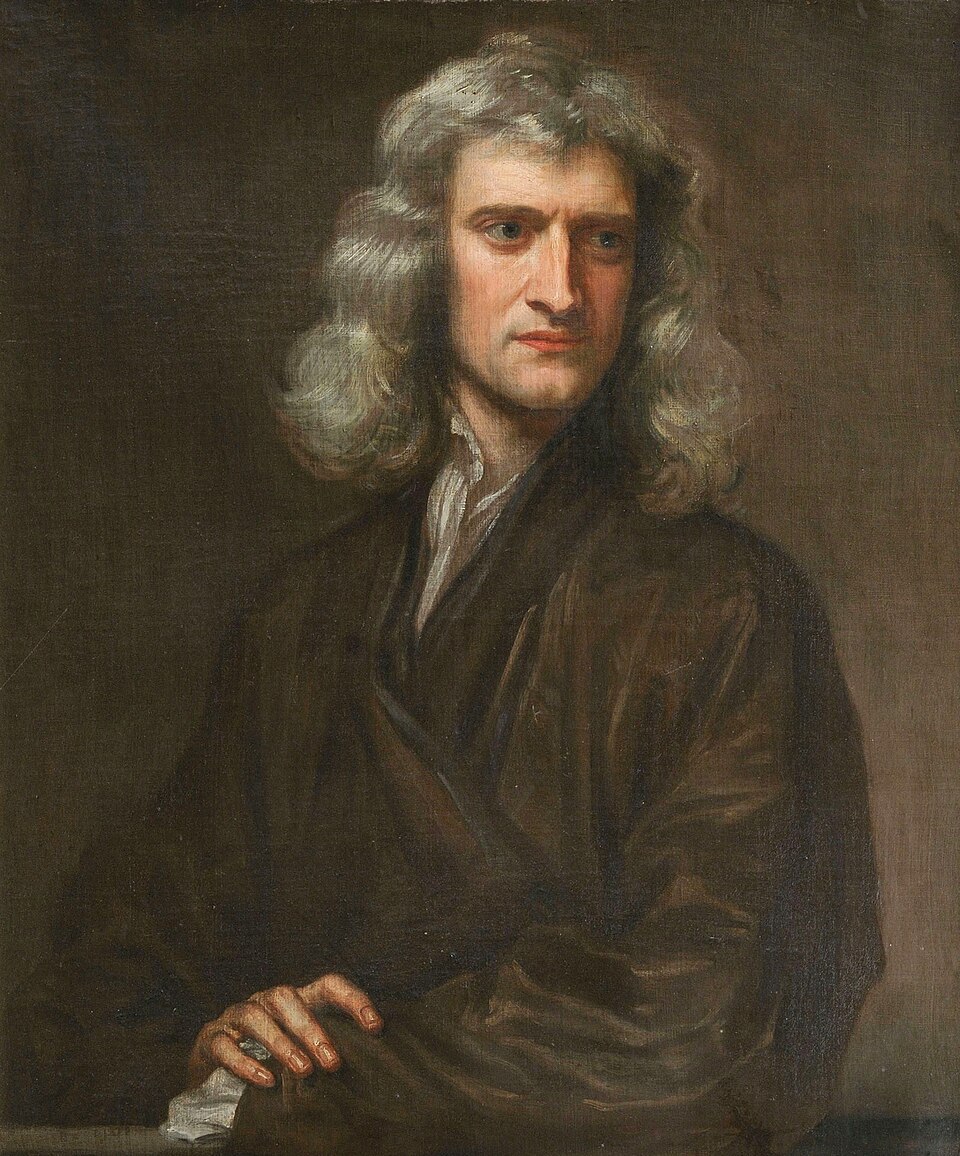
Portrait of Isaac Newton
Godfrey Kneller · Public Domain

The person

A life under examination

Who he was

Isaac Newton (1642-1727) was an English mathematician and physicist whose Principia Mathematica laid the foundations for classical mechanics and universal gravitation.

Why he matters

Newton's Principia is a seminal work that transformed natural philosophy, introducing mathematical laws that govern motion and gravitation, influencing science for centuries.

Life in motion

Timeline

15 sourced moments across the life of Isaac Newton

Drag to travel through time · Ctrl/⌘ + scroll or pinch to zoom · Select a moment for the full account

1665–1666

Development of Calculus and Theories of Light and Gravity

During the plague years at Woolsthorpe, Newton developed the calculus, began his work on optics, and conceived the law of universal gravitation.

Why it matters: Annus mirabilis; laid foundations for his major scientific works.

Wikipedia

Operating system

Core themes

01

Mathematical Principles of Nature

The Principia establishes a program of deriving natural phenomena from mathematical laws, rejecting occult qualities and employing geometry and analysis.

Evidence: In the Preface, Newton states his aim: 'to cultivate mathematics as it relates to philosophy' and proposes to investigate the forces of nature from phenomena, then demonstrate other phenomena from these forces.

02

Rational Mechanics and Geometry

Newton distinguishes rational mechanics (accurate demonstrations) from practical mechanics (manual arts), linking geometry to mechanical practice.

Evidence: Newton writes: 'Geometry is founded in mechanical practice, and is nothing else than that part of universal mechanics which accurately proposes and demonstrates the art of measuring.'

03

Universal Gravitation

The Principia derives the force of gravity that governs celestial bodies, explaining planetary motions, comets, the Moon, and the tides.

Evidence: In the Preface, he explains: 'from celestial phenomena, through propositions mathematically demonstrated in earlier books, are derived the forces of gravity by which bodies tend to the Sun and each planet.'

04

Method of Synthesis and Analysis

Newton employs a method of analyzing forces from motions and then synthesizing motions from forces, using geometry and limits.

Evidence: The Preface outlines: 'the whole difficulty of philosophy seems to be to investigate the forces of nature from phenomena, and then from these forces to demonstrate the remaining phenomena.'

05

Rejection of Vortices

Newton argues against Cartesian vortices for explaining planetary motion, showing they do not conform to observed Keplerian laws.

Evidence: In Book II, Prop. LIII, Scholium: 'Hence it is clear that the planets are not carried by corporeal vortices.' Then he details why vortex motion cannot follow Kepler's laws.

06

Comets and the Solar System

The Principia discusses comets as planets moving in very eccentric orbits around the Sun, their tails, and considers their periodic returns.

Evidence: In Book III, Newton states: 'We have said that comets are a kind of planet revolving in very eccentric orbits about the Sun.'

07

Experimental Philosophy

Newton's insistence on deriving principles from experiments and observations rather than hypotheses.

Evidence: He states in Opticks: 'My Design in this Book is not to explain the Properties of Light by Hypotheses, but to propose and prove them by Reason and Experiments.'

08

The Nature of Light and Color

Newton's discovery that light is composed of rays of different refrangibility, which produce the spectrum of colors.

Evidence: He defines simple and compound light, and describes experiments with prisms showing that colors are inherent properties of light.

09

The Method of Analysis and Synthesis

Newton's approach of breaking down phenomena into their constituent parts and then explaining them from established causes.

Evidence: In the conclusion, he explains: 'As in Mathematicks, so in Natural Philosophy, the Investigation of difficult Things by the Method of Analysis, ought ever to precede the Method of Composition.'

010

The Role of God in Nature

Newton's belief that the order and design of the universe imply a Creator, and his rejection of atheistic materialism.

Evidence: He argues that the uniformity of the planetary system is 'the Effect of Choice' and that the 'first Contrivance' of animals can only be the effect of 'the Wisdom and Skill of a powerful ever-living Agent.'

011

Active Principles and the Limits of Mechanism

Newton's recognition that gravity and other active principles are not occult qualities but general laws whose causes are yet unknown.

Evidence: He states: 'These Principles I consider, not as occult Qualities... but as general Laws of Nature, by which the Things themselves are form'd; their Truth appearing to us by Phaenomena, though their Causes be not yet discover'd.'

Read through your work

Key takeaways for...

Leaders

Newton's leadership and his role as President of the Royal Society

Newton's leadership, especially as President of the Royal Society (1703–1727), demonstrates effective governance and institutional building. He held the position for decades, overseeing a period of scientific flourishing. His ability to combine his scientific authority with administrative duties, such as his work at the Royal Mint, shows that leaders can excel in multiple domains. Newton's meticulous nature, evident in his experiments, likely translated into meticulous management. However, his relationship with other scientists, like his disputes with Hooke, suggests that leadership requires diplomatic skills as well as technical expertise.

  1. 01Lead by example: Newton's own rigorous work set a standard for others; demonstrate commitment and excellence.
  2. 02Foster a productive environment: As president of the Royal Society, he encouraged scientific exchange; leaders should create spaces for innovation.
  3. 03Balance multiple roles: Newton managed the Mint and the Society; effective leadership often requires juggling diverse responsibilities.
  4. 04Handle conflict carefully: Newton's disputes with Hooke show that scientific leaders must manage ego and competition constructively.
  5. 05Support future talent: Newton mentored and inspired others; invest in developing people.

In his words

Useful quotations

Et simili methodo ubi corpora duo simul demittuntur de locis diversis, inveniendi sunt motus utriusq; tam ante, quam post reflexionem; & tum demum conferendi sunt motus inter se & colligendi effectus reflexionis.
Philosophiæ Naturalis Principia MathematicaGo to passage
Sed quoniam durior est indivisibilium Hypothesis; & propterea Methodus illa minus Geometrica censetur, malui demonstrationes rerum sequentium ad ultimas quantitatum evanescentium summas & rationes, primasq; nascentium, id est, ad limites summarum & rationum deducere, & propterea limitum illorum demonstrationes qua potui breuitate præmittere.
Philosophiæ Naturalis Principia MathematicaGo to passage
Proinde in sequentibus, siquando quantitates tanquam ex particulis constantes consideravero, vel si pro rectis usurpavero lineolas curvas, nolim indivisibilia sed evanescentia divisibilia, non summas & rationes partium determinatarum, sed summarum & rationum limites semper intelligi, vimq; talium demonstrationum ad methodum præcedentium Lemmatum semper revocari.
Philosophiæ Naturalis Principia MathematicaGo to passage
Habitis autem umbilicis una cum axis longitudine (quæ vel est YH, vel si Trajectoria Ellipsis est, PH + SP; sin Hyperbola PH - SP) habetur Trajectoria.
Philosophiæ Naturalis Principia MathematicaGo to passage
16._ Unde, si dentur Orbium formæ & inclinatio ad invicem, & mutentur utcunq; corporum magnitudines, vires & distantiæ; ex datis erroribus & errorum temporibus in uno Casu colligi possunt errores & errorum tempora in alio quovis, quam proxime: Sed brevius hac Methodo.
Philosophiæ Naturalis Principia MathematicaGo to passage
2 resolutione virium) secundum lineas PS, ps ad centra tendunt, ut PI ad PQ, & pi ad pq; id est (ob similia triangula PIQ & PSF, piq & psf) ut PS ad PF & ps ad pf.
Philosophiæ Naturalis Principia MathematicaGo to passage
Casus cæteros, qui conclusiones minus elegantes exhibent, sigillatim percurrere longum esset: Malim cunctos methodo generali simul comprehendere ac determinare, ut sequitur.
Philosophiæ Naturalis Principia MathematicaGo to passage
Namq; Lucem successive propagari & spatio quasi decem minutorum primorum a Sole ad Terram venire, jam constat per Phænomena Satellitum _Jovis_, Observationibus diversorum Astronomorum confirmata.
Philosophiæ Naturalis Principia MathematicaGo to passage
æquale nn - aa - 2ao - oo seu ee - 2ao - oo; & radice per methodum nostram extracta, fiet DG = e - ao ÷ e - oo ÷ 2e - aaoo ÷ 2e^3 - ao^3 ÷ 2e^3 - a^3o^3 ÷ 2e^5 &c.
Philosophiæ Naturalis Principia MathematicaGo to passage
Simili methodo ex assumptis pluribus longitudinibus AH invenienda sunt plura puncta N: & tum demum si per omnia agatur Curva linea regularis NNXN, hæc abscindet SX quæsitæ longitudini AH æqualem.
Philosophiæ Naturalis Principia MathematicaGo to passage

Put into practice

Lessons worth keeping

Use mathematics to understand nature

Newton demonstrates that natural phenomena can be explained through mathematical laws.

Try it: This approach underpins modern physics and engineering.

Distinguish between exact and approximate methods

Newton emphasizes the difference between rational mechanics (exact) and practical mechanics (approximate).

Try it: Recognizing the limits of models in applied science.

Reject unsupported hypotheses

Newton rejects the vortex theory because it does not match observed astronomical laws.

Try it: Falsifiability and evidence-based thinking.

Analyze forces from motions

The method of analyzing forces from observed motions is powerful.

Try it: Reverse engineering in physics and other sciences.

Synthesize motions from forces

Once forces are known, predict motions.

Try it: Predictive modeling in science and technology.

Seek simplicity but acknowledge complexity

Newton's laws are simple, yet he acknowledges imperfections in his work.

Try it: Embracing complexity while seeking underlying simplicity.

Empiricism Over Speculation

Newton's method prioritized evidence from experiments over speculative hypotheses.

Try it: In science and business, base decisions on data rather than assumptions.

The Value of Incremental Progress

Newton published his work after years of refinement, emphasizing the importance of careful preparation.

Try it: Take time to polish work before public release.

Openness to Revision

Newton acknowledged that conclusions could be revised based on new evidence.

Try it: Maintain intellectual humility and adaptability.

Read with judgment

Greatness, contradiction, and use

What made them great

Newton's greatness lies in his ability to derive the fundamental laws of nature from empirical phenomena with mathematical rigor. The Principia establishes a program of 'rational mechanics' where geometry becomes the language of physics, replacing speculative vortices with exact laws of motion and gravitation. His method of analysis and synthesis—first investigating forces from motions, then demonstrating motions from forces—created a template for theoretical physics. In Opticks, he extended this rigor to experimental philosophy, proposing to prove properties of light by 'Reason and Experiments' rather than hypotheses. His insistence on limiting conclusions to what is supported by evidence, while acknowledging imperfections, set a standard for scientific inquiry. He unified celestial and terrestrial mechanics, showing that the same laws govern falling apples and orbiting moons, a profound intellectual leap that transformed humanity's understanding of the cosmos.

The central contradiction

The central contradiction in Newton's work is his dual commitment to deriving all from empirical phenomena, while also positing active principles like gravity whose causes remain unknown. He rejects 'occult qualities' in the Principia, yet in Opticks he considers gravity as a general law of nature, even though its underlying cause is undiscovered. He also combines rigorous mathematical deduction with a deep religious belief that the order of the universe implies a Creator, using natural philosophy to enlarge the bounds of moral philosophy. This tension between mechanistic explanation and providential design runs through his writings, reflecting his attempt to reconcile science with theology without compromising empirical rigor.

Lessons from failure

Newton's shadow side includes his solitary and secretive nature, evidenced by his reluctance to publish Opticks until pressed by friends, and his disputes with contemporaries like Robert Hooke over priority. His insistence on exactness could lead to harsh judgments of others' work. More substantively, his rejection of hypotheses, while powerful, sometimes bordered on dogmatism, as when he dismissed the wave theory of light. His alchemical and theological pursuits, though private, show a mind that sought unity beyond the strictly empirical, which could be seen as a tension with his public scientific persona. In the Principia, he acknowledges 'defects in a subject so difficult may be not so much reprehended as investigated,' hinting at his own awareness of incompleteness, but his intense rivalry and disputes suggest a personal failure to collaborate openly.

Modern relevance

Newton's methodology remains foundational for modern science and engineering. His distinction between rational and practical mechanics foreshadows the gap between theoretical models and applied approximations. His method of analysis and synthesis is echoed in the data-driven science and computational modeling of today, where we derive forces from observations and predict phenomena from forces. His insistence on evidence over hypothesis is more relevant than ever in an age of fake news and alternative facts. Moreover, his acceptance of gravity as a real force without knowing its cause encourages scientists to use effective theories even when a deeper theory is incomplete, as in quantum mechanics. His rejection of vortices demonstrates the importance of falsifiability: a theory that does not match observations must be abandoned, regardless of its appeal. Newton's integration of science and religion, though controversial, prompts reflection on the relationship between science and ultimate questions.

How to learn from them

To learn from Newton, one must adopt his methodological rigor: start from phenomena, derive mathematical principles, and then use those to predict new phenomena. This requires a patient, evidence-based approach, eschewing speculation without data. He teaches us to value craftsmanship and precision—his description of the art of experimenting, learned by practice, underscores the need for hands-on skill. His openness to revision, as expressed in Opticks, encourages intellectual humility: conclusions should be held with such exceptions as occur. He also models the power of interdisciplinary thinking, combining mathematics, physics, and even theology to gain deeper insights. By studying his works, especially the Principia's Preface and Opticks' Queries, we can learn to frame our own inquiries with a balance of creativity and discipline.

Best entry point

The best entry point into Newton's thought is the Preface to the Principia, where he outlines his grand vision: to cultivate mathematics as it relates to philosophy, deriving forces from phenomena and demonstrating other phenomena from those forces. This text is concise yet profound, setting the stage for his laws of motion and gravitation. Alternatively, for those interested in experimental science, the 'Advertisement I' and Query 31 from Opticks provide accessible summaries of his method and the role of God in nature. Both are rich in insight and relatively short, making them ideal for the first-time reader.

Continue the inquiry

Related greats

Galileo Galilei

Newton builds on Galileo's work on projectile motion; mentions Galileo's demonstration in Book II.

Motion · Projectile trajectory · Experimental physics

René Descartes

Newton refutes Cartesian vortices; Descartes' mechanical philosophy is the backdrop.

Mechanical philosophy · Nature of physical explanation

Johannes Kepler

Newton's laws of motion and gravitation explain Kepler's laws of planetary motion.

Planetary motion · Orbits · Celestial mechanics

Aristotle

Newton references Aristotle's description of a comet in Meteorology.

Comets · Celestial phenomena

Robert Hooke

Hooke was a contemporary scientist who also studied optics and had disputes with Newton over priority and the nature of light.

experimental philosophy · optics

Albert Einstein

Einstein's theories of relativity expanded on Newtonian physics, showing its limitations while building on its foundations.

fundamental physics · space and time

Source shelf

Recommended sources

link

Philosophiæ Naturalis Principia Mathematica

Isaac Newton

View source →

Source basis: The quality analysis of Newton is grounded in two primary sources: the Principia Mathematica (source 87) and Opticks (source 88), both by Newton himself. These provide direct evidence of his scientific methods, philosophical commitments, and stylistic approach. Additional context comes from Wikipedia and Wikidata entries (sources 89 and 90), which offer biographical and historical background. Quotes from the Principia, such as those about the limits of indivisibles and the method of analysis, illustrate his insistence on rigorous mathematical foundations. The Opticks excerpts emphasize his experimental philosophy and his vision for the generalization of the method to moral philosophy. These sources allow a nuanced interpretation that distinguishes his ideal principles from his actual outcomes, including his acknowledges imperfections and open questions.

Direct answers

Frequently asked questions about Isaac Newton

What is the Principia Mathematica and why is it important?

The Principia Mathematica, published in 1687, is Newton's magnum opus. It presents his three laws of motion and the law of universal gravitation, showing how these principles govern the motion of objects on Earth and in the heavens. It is important because it unified celestial and terrestrial mechanics, providing a mathematical framework that bolstered the Scientific Revolution and influenced physics for centuries. Newton stated his goal in the Preface: 'to cultivate mathematics as it relates to philosophy' and to investigate forces from phenomena, then demonstrate other phenomena from these forces.

What was Newton's method of analysis and synthesis?

Newton's method of analysis involves making experiments and observations, drawing general conclusions by induction, and proceeding from effects to causes. Synthesis consists of assuming those discovered causes as principles and explaining phenomena from them. In natural philosophy, analysis works from compounds to ingredients, and from motions to the forces producing them, while synthesis works from forces to motions. This method is described in Opticks, where Newton emphasizes that 'the Investigation of difficult Things by the Method of Analysis, ought ever to precede the Method of Composition.'

Why did Newton reject the vortex theory of planetary motion?

Newton rejected the Cartesian vortex theory because it did not conform to observed astronomical laws, particularly Kepler's laws of planetary motion. In the Principia, Book II, Prop. LIII, Scholium, he states, 'Hence it is clear that the planets are not carried by corporeal vortices.' He argued that vortex motion would not produce the observed relationships between planetary speeds and distances. His rejection exemplifies his principle of rejecting unsupported hypotheses and seeking explanations that match empirical evidence.

What did Newton discover about light and color?

In Opticks, Newton demonstrated that white light is composed of rays of different refrangibility, which produce the spectrum of colors when passed through a prism. He showed that colors are inherent properties of light, not modifications by the prism. He also discovered the phenomena of thin-film interference, now known as Newton's rings, and proposed a corpuscular theory of light. His goal, as he stated, was 'not to explain the Properties of Light by Hypotheses, but to propose and prove them by Reason and Experiments.'

How did Newton view the role of God in the universe?

Newton believed that the order and design of the universe imply a Creator. In Opticks, he argued that the uniformity of the planetary system is 'the Effect of Choice' and that the 'first Contrivance' of animals can only be due to the 'Wisdom and Skill of a powerful ever-living Agent.' He saw natural philosophy as enlarging the bounds of moral philosophy, revealing our duty toward God and others. He used science to support religious belief, not to undermine it.

What is Newton's legacy in modern science?

Newton's legacy is monumental: his laws of motion and gravitation underpin classical mechanics, which remains fundamental in engineering and physics. His methodological principles—making experiments, drawing conclusions by induction, and refining theories with exceptions—set the standard for evidence-based science. He also emphasized the use of mathematics to understand nature. While Einstein's relativity modified absolute space and time, Newton's equations are still accurate in everyday contexts. His rejection of unsupported hypotheses and his willingness to use effective theories without knowing ultimate causes are practices still used today.

Was Newton's work flawless?

No, Newton's work had limitations. He acknowledged imperfections in the Principia, noting 'defects in a subject so difficult may be not so much reprehended as investigated.' He left parts of Opticks incomplete, as he hadn't tried all experiments. His theory of light was eventually superseded by the wave theory. He also spent much time on alchemy and theology, which are not part of modern science. Yet his willingness to revise conclusions in light of exceptions is a strength that modern scientists emulate.

How can I apply Newton's methods to my own field?

Apply Newton's method of analysis and synthesis: start by collecting data, identify patterns, and derive general principles. Then apply those principles to predict new phenomena. Always test with experiments or observations, and be open to exceptions that require modification. Reject unsupported hypotheses in favor of evidence-based theories. Value craftsmanship and precision in your work, and don't rush to publish until you've satisfied yourself, like Newton did, but do share your work with trusted colleagues for feedback. His approach to problem-solving is transferable to any discipline.
