


.jpg)
1833
Family moves to St. Louis
After a river journey during which the boat caught fire, Eads's family arrived in St. Louis, nearly destitute.
Why it matters: St. Louis would become the base for his major works.
Wikipedia ↗Scientist & Inventor · 1820–1887 AD
Self-taught engineer who tamed the Mississippi with ironclads, a record-breaking bridge, and the jetties that opened New Orleans to world commerce
The defining question
How can an unlettered boy from the frontier, armed only with curiosity and grit, conquer the most powerful river on the continent and remake the nation's infrastructure?
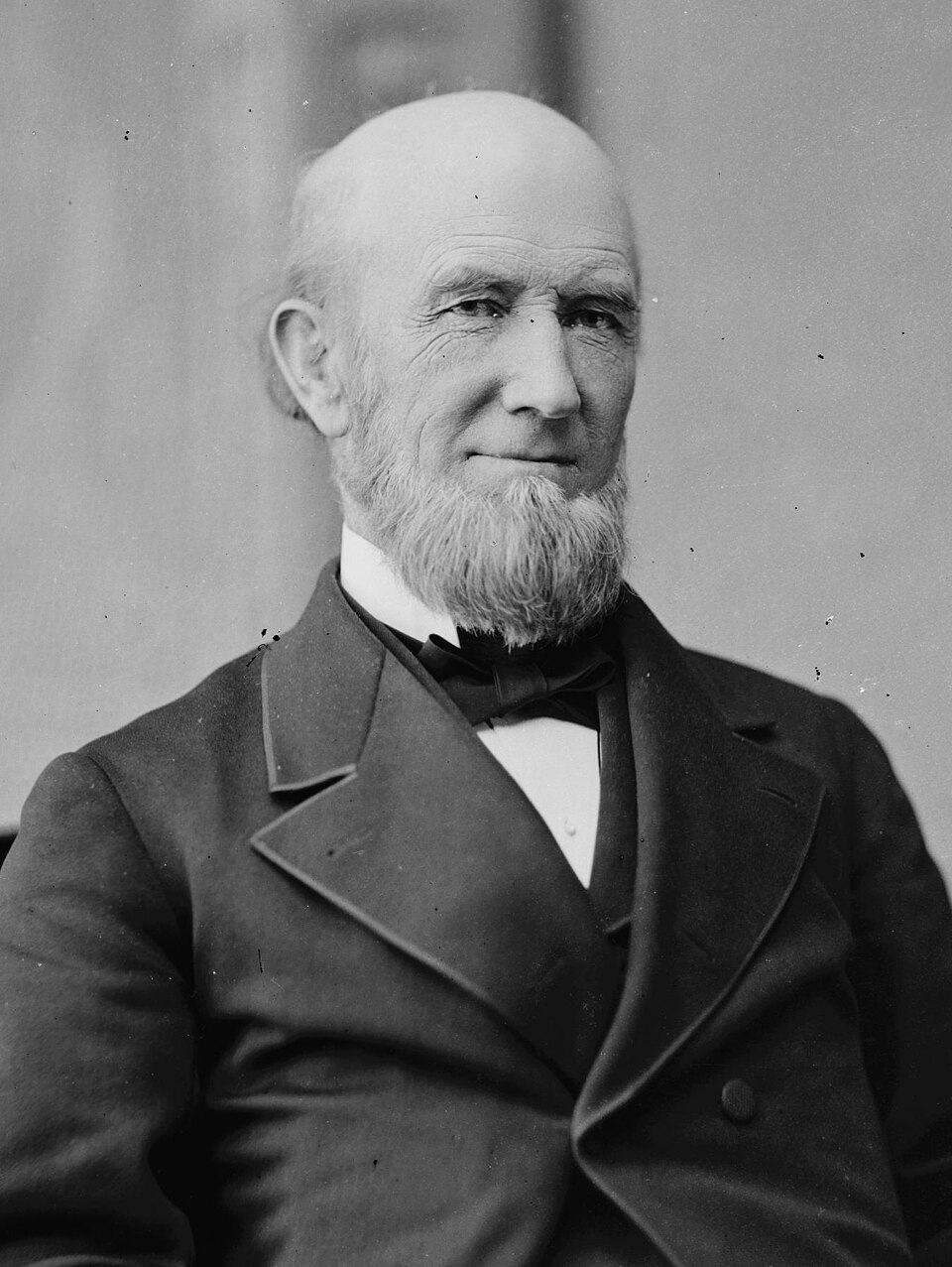
The person
James Buchanan Eads (1820-1887) was an American engineer and inventor who, despite no formal education, became one of the most innovative and successful engineers of his era. He built the first ironclad gunboats for the Union Navy, designed and constructed the iconic Eads Bridge in St. Louis, and developed the jetty system that gave the Mississippi River a deep-water channel to the Gulf of Mexico, transforming New Orleans into a major port. He spent his final years championing his boldest idea: a ship-railway across the Isthmus of Tehuantepec.
Eads's life demonstrates that engineering ingenuity, combined with relentless self-education and patriotic commitment, can overcome even the most formidable natural obstacles. His works not only shaped the course of the Civil War and the economic development of the American West but also established principles of river engineering that remain influential today.
Life in motion
Drag to travel through time · Ctrl/⌘ + scroll or pinch to zoom · Select a moment for the full account
After a river journey during which the boat caught fire, Eads's family arrived in St. Louis, nearly destitute.
Why it matters: St. Louis would become the base for his major works.
Wikipedia ↗Operating system
Eads's rise from a poor, self-taught boy to a leading engineer exemplifies the power of self-directed learning and relentless personal initiative.
Evidence: Without formal schooling, he studied scientific books in a patron's library at night, built a model steam engine at age eleven, and later said, 'I shall not die until I accomplish this work.'
Eads repeatedly invented new devices and methods, from his diving-bell salvage boats to the caissons used to sink bridge piers to unprecedented depths, and the use of willow mattresses in jetty construction.
Evidence: He held nearly fifty patents for inventions in naval warfare, bridge foundations, dredging machines, and ship-railway construction.
Facing constant opposition, financial strain, and physical fragility, Eads never abandoned his projects, often pushing forward even when the government delayed payments or critics ridiculed his plans.
Evidence: He completed the gunboats despite a nearly impossible deadline and financial risk, and he fought for years to get the jetty plan accepted.
Eads placed national need above personal gain, building the ironclads at personal financial risk and accepting punishing terms for the jetty contract to benefit the country.
Evidence: He wrote to Lincoln that the boats' completion was so important that it should be pushed 'without reference to how I was to be affected by delays.'
Eads's life and work were fundamentally shaped by the Mississippi River; he learned its ways intimately, and his greatest achievements were all designed to control or bridge it.
Evidence: The source notes that 'if ever Nature played a prominent part in the life of a man, the Mississippi did in that of Eads; for it became the opportunity for three of his chief works.'
Eads repeatedly attempted projects that experts deemed impossible, such as a 500-foot span bridge and a ship-railway across an isthmus, and often succeeded through careful reasoning and bold execution.
Evidence: He built the Eads Bridge with spans longer than any existing, and the jetties, which were called 'the greatest engineering feat ever accomplished.'
Eads's success underscores that practical experience, hard work, and study can be as effective as formal education, a theme the biographer explicitly discusses.
Evidence: The final chapter concludes that 'education is less important than the other two [talent and work],' and notes Eads would have valued education.
Read through your work
Leaders
Eads provides a powerful example of leadership, demonstrating how to inspire and mobilize people toward a shared goal. He was a visionary who could articulate his ideas so convincingly that others followed him. He also knew how to provide direction and delegate effectively, gathering a team of talented engineers and workers. He took responsibility and personal risks, setting a standard for commitment. Leaders can learn from his communication style, his ability to simplify complex challenges, and his perseverance in the face of setbacks.
In his words
“I shall not die until I accomplish this work, and see with my own eyes great ships pass from ocean to ocean over the land.”
“I cannot die; I have not finished my work.”
“His powers of persuasion, his charm of address, and the magnetism of his personality opened the hearts and purses of whomever he pleaded with in support of his engineering devices. He was a most lovable man.”
“a triumph of sagacity, pluck, and executive ability unsurpassed by any exploit in the military or civil history of the times.”
“There is no instance, indeed, in the world where such a vast volume of water is placed under such absolute and permanent control of the engineer, through methods so economic and simple.”
“He was so thoroughly in earnest that he convinced others by his own conviction.”
“Gradually the water keeps eating its way, until it forces a passage through the neck, and then the torrent rushes through in a cascade, with a roar that can be heard for miles.”
Put into practice
Eads, with no formal engineering education, educated himself through reading and practical experience, ultimately surpassing many formally trained contemporaries.
Eads's unwavering belief in his projects, even when they seemed impossible, allowed him to persist through financial, political, and physical challenges.
Eads's dedication to the Union cause led him to undertake the gunboat project at personal financial risk, setting a precedent for putting national interest above personal gain.
Eads's engineering successes often came from reducing complex problems to simple, underlying principles, such as using the river's own velocity to scour its bed.
Eads faced intense skepticism and outright ridicule, yet he chose to respond with clear explanations and sound arguments rather than engaging in petty disputes.
Eads consistently selected competent lieutenants and gave them credit, which was crucial for managing large-scale projects across distributed worksites.
Read with judgment
Eads's greatness lay in his ability to translate deep, empirical knowledge of the Mississippi River into engineering works that reshaped American infrastructure and military power. Self-taught and relentless, he combined practical experience—gained as a steamboat clerk and salvage diver—with rigorous self-study of scientific texts. His genius was his capacity to reduce seemingly impossible problems to simple, fundamental principles, such as using the river's own current to scour a deep channel through jetties. His three signature achievements—the Civil War ironclads, the Eads Bridge, and the South Pass jetties—each required not just technical innovation, but also extraordinary persuasion, persistence, and personal financial risk. He succeeded where experts failed because he trusted his own observations over conventional wisdom, and he had the magnetism to win support from skeptical politicians and investors.
Eads was a self-taught man who came to value formal education, a individualist who depended on skilled teams, and a patriot who risked personal fortune for national benefit. His life's work was to conquer nature's most powerful river, yet he approached it with profound humility, learning from its behavior rather than imposing abstract theories. He was often ahead of his time, as with the steel-arch bridge and the jetty system, yet his boldest vision—the ship-railway—remained unbuilt, marking the limit of even his powers of persuasion. This tension between boundless ambition and the constraints of mortality, economics, and politics defines his legacy.
Eads's relentless drive sometimes led him to overcommit. He took on the gunboat contract at personal financial risk, and the government's delays nearly bankrupted him. His final project, the Tehuantepec ship-railway, consumed his last six years and died with him, despite his conviction he would see it completed. While he was generally correct in his technical judgments, his persuasive charm could also be seen as lobbying, and his single-mindedness may have blinded him to the limits of what was politically feasible. The source notes that no one else could make a scheme appeal so well, but this also meant he risked staking his reputation on ventures that might not materialize.
Eads's story speaks to today's debates about education versus experience, the role of government in infrastructure, and the importance of persistence in innovation. In an era of rapid technological change, his self-education and hands-on learning model resonates with the maker movement and online learning. His ability to win support through clear argument and demonstrated competence, rather than credentials, is relevant for entrepreneurs and engineers. His jetty project, which used natural forces rather than brute-force dredging, offers a lesson in sustainable engineering. And his commitment to national service over personal gain is a reminder of the power of aligning one's work with the public good.
To learn from Eads, one should adopt his method of deep observation and first-principles thinking. He studied the river's behavior relentlessly and tested his ideas through small-scale experiments before scaling up. Aspiring engineers and leaders can emulate him by immersing themselves in the practical realities of their field, seeking out hands-on experience, and reading widely to fill gaps in formal knowledge. They should also learn to communicate their visions persuasively, backing them with sound evidence and a track record of integrity. Eads's life shows that persistence in the face of skepticism is often rewarded, but it must be coupled with financial prudence and political acumen to avoid overreach.
The best entry point to Eads's life is probably the story of the jetties, as it encapsulates his genius for simplicity and his ability to overcome formidable opposition. The biographer quotes an unnamed engineer saying, 'There is no instance, indeed, in the world where such a vast volume of water is placed under such absolute and permanent control of the engineer, through methods so economic and simple.' This demonstrates his core strength: reducing a complex problem to its essence and using nature's own forces to achieve the desired outcome.
The human network
military collaboration
Eads's gunboats were commissioned by Flag-Officer Foote, who commanded the Western Gunboat Flotilla. Shows the integration of Eads's engineering with military operations.
professional collaborator
Corthell was an engineer who wrote memoirs about Eads's jetties and assisted in his work. Shows the network of engineers who supported Eads's projects.
Continue the inquiry
Both were pioneering engineers of ambitious bridges in the 19th century; Roebling designed the Brooklyn Bridge, which also used caissons and steel, and faced similar skepticism.
Innovation · Persistence · Bridge engineering
British engineer who also tackled impossible projects like the Great Eastern ship and the Thames Tunnel; both were self-taught and worked on ambitious infrastructure.
Self-education · Innovation · Grand engineering visions
Bessemer's steel-making process made Eads's steel bridges possible; both advanced industrial technology that shaped modern infrastructure.
Technological innovation · Industrial advancement
Like Eads, Edison was a self-educated inventor with numerous patents who combined innovation with practicality and commercial success.
Self-education · Invention · Commercial application
As rival engineers for interoceanic crossing, their competing visions (canal vs. ship-railway) highlight different approaches to a major engineering challenge.
Interoceanic transit · Large-scale projects · Competition
Source shelf
link
How, Louis, 1873-1947
View source →reference
Wikipedia contributors
View source →reference
Wikidata contributors
View source →Source basis: The primary source is the biography by Louis How (1900), which provides detailed accounts of Eads's early life, gunboats, bridge, jetties, and ship-railway. The source catalog includes only this biography, a Wikipedia article, and a Wikidata entry, with the biography being the main content. The excerpts from the biography cover his early training, the difficulties of the bridge, and his final years, offering rich evidence for his character, methods, and achievements. The quotes are all from this biography, with medium confidence, as they are recorded from personal recollections.
Direct answers
Eads's greatest achievement is often considered the construction of the jetties at South Pass, which opened a deep-water channel to the Gulf of Mexico. Using a simple method involving willow mattresses and the river's own current, he deepened the channel to 30 feet, proving his critics wrong and transforming New Orleans into a major port. This success was recognized internationally and is seen as a quintessential example of his engineering genius.
Eads had little formal schooling. He educated himself by reading scientific books during his spare time, often at night, in the library of a patron. He also gained practical experience as a clerk on a steamboat and later through salvage operations on the river. He believed in learning by doing and studying the natural world directly, which gave him insights that formal engineers often lacked.
The Eads Bridge was the first steel-arch bridge in the world and had the longest spans of any bridge at the time. Eads used cantilever methods during construction and founded the piers on bedrock, which was deeper than previously attempted. He also introduced the use of steel, which was still rare in bridge building, and his innovative caisson design allowed work at unprecedented depths.
The ship-railway was a plan to transport ships across the Isthmus of Tehuantepec in Mexico on a giant platform on rails, as an alternative to a canal. Eads spent his final years promoting it, but he was unable to secure financing and political support. He died before it could be built, and the project remains unbuilt, illustrating the limits of his influence when faced with global competition and the scale of the undertaking.
Eads's patriotism was a driving force. He built the gunboats for the Union during the Civil War at great personal financial risk, prioritizing the national need over his own interests. He also took on the jetty project with favorable terms to the government, showing his commitment to the public good. His biographer notes that he was 'thoroughly in earnest' and able to convince others through his genuine devotion.