


_(cropped).jpg)
January 10/11, 49 BC
Crossing the Rubicon
Crossed the Rubicon River with Legio XIII Gemina, starting Caesar's Civil War.
Why it matters: Defied Senate; began civil war against Pompey and the optimates.
Wikipedia ↗Military Leader · 100–44 BC
Roman General and Author of the Gallic War Commentaries
The defining question
How can one man's account of war shape the destiny of a nation?
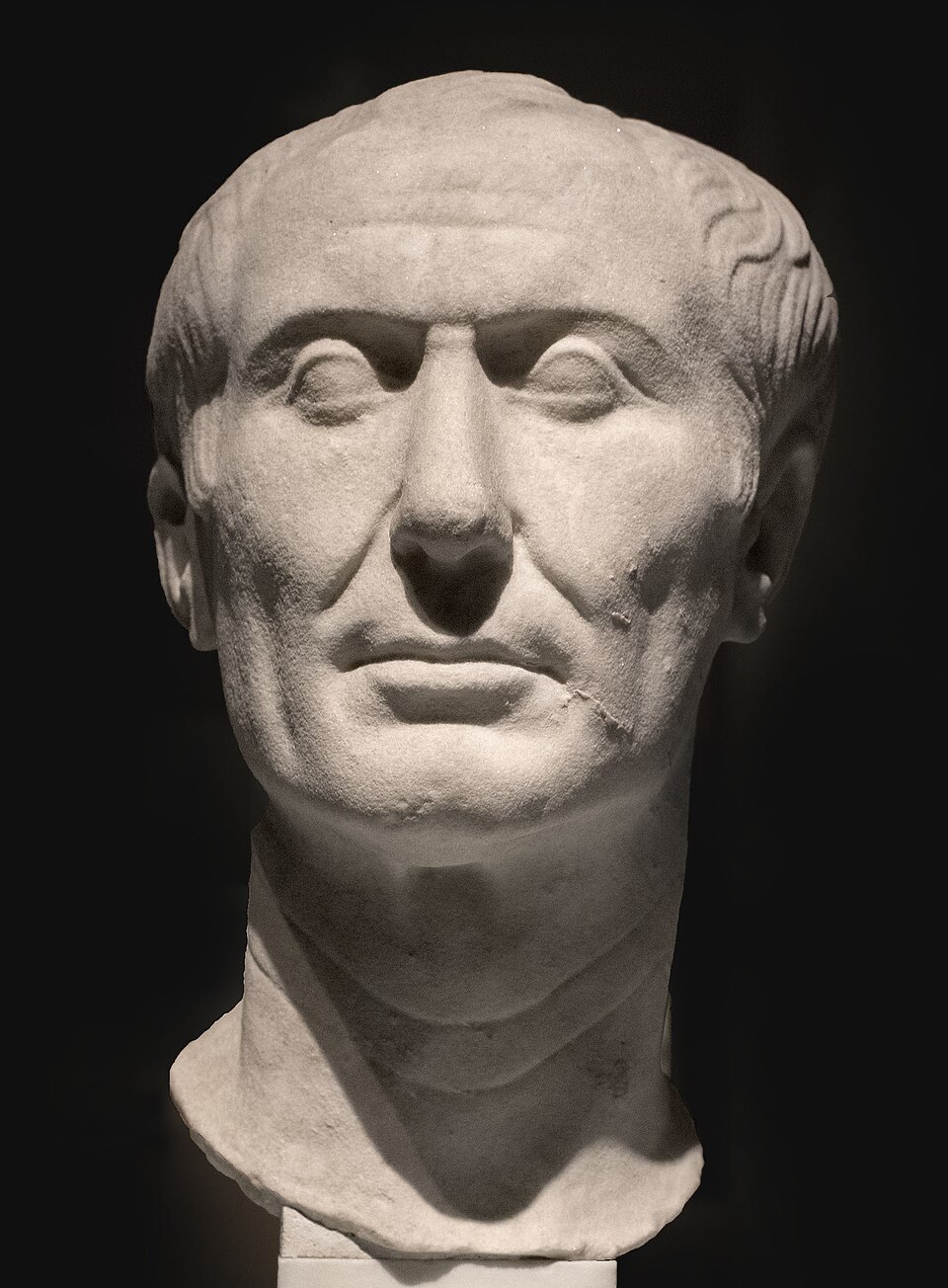
The person
Julius Caesar was a Roman military general, politician, and historian whose conquest of Gaul and subsequent civil war transformed the Roman Republic into the Roman Empire. His firsthand account of the Gallic Wars remains a classic of Latin literature and military history.
Caesar's Commentaries are a foundational source for understanding Roman military tactics, the conquest of Gaul, and the political ambitions that led to the end of the Republic. His writings blend self-justification with strategic insight, making them essential for studying leadership, propaganda, and historical narrative.
Life in motion
Drag to travel through time · Ctrl/⌘ + scroll or pinch to zoom · Select a moment for the full account
Crossed the Rubicon River with Legio XIII Gemina, starting Caesar's Civil War.
Why it matters: Defied Senate; began civil war against Pompey and the optimates.
Wikipedia ↗Operating system
Caesar demonstrates decisive command, tactical ingenuity, and the importance of speed and surprise. He emphasizes discipline, fortification, and adapting to local conditions.
Evidence: Caesar describes his rapid response to the Helvetian migration, his construction of a bridge across the Rhine in ten days, and his siege works at Alesia.
Caesar contrasts Roman order, discipline, and engineering with Gallic factionalism, impulsiveness, and reliance on personal valor over coordinated tactics.
Evidence: He notes the Gallic practice of druids, their divided states, and their tendency to break treaties, while highlighting their fierce independence.
The Commentaries present Caesar's actions as defensive, lawful, and sanctioned by the Senate, while subtly building his reputation as Rome's indispensable leader.
Evidence: Caesar repeatedly claims to act 'for the public good' and emphasizes the senators' approval of his actions, even when exceeding his provincial mandate.
Caesar's success depends on controlling rivers, mountain passes, and supply lines. He details his campaigns across the Alps, Rhine, and English Channel.
Evidence: His description of the logistics against the Belgae and his naval operations against the Veneti show careful planning and adaptation to terrain.
Caesar exploits Gallic internal divisions, using client kings and negotiated submissions to avoid full-scale wars whenever possible.
Evidence: He makes alliances with the Aedui and other tribes against the Helvetii, and later uses the Sequani to weaken the Suebi.
Caesar displays calculated clemency to win loyalty but also inflicts brutal punishments to deter resistance, such as enslaving entire tribes.
Evidence: After the surrender of the Aduatuci, Caesar sells 53,000 prisoners into slavery; yet he pardons many Gallic nobles who submit promptly.
The story is a first-person account of a carefully planned revenge against Fortunato for an unspecified insult. It delves into the justification and execution of vengeance.
Evidence: Montresor states, 'The thousand injuries of Fortunato I had borne as I best could, but when he ventured upon insult I vowed revenge.'
Montresor uses Fortunato's pride in his wine connoisseurship to lure him into the catacombs, feigning friendship and concern.
Evidence: Montresor says, 'I was rejoiced to see him... I thought I would never have done wringing his hand.'
Fortunato's vanity in his knowledge of wine makes him vulnerable. He dismisses Montresor's concerns about his health and insists on going to the catacombs.
Evidence: Fortunato: 'I will not die of a cough.' Montresor: 'True -- true.'
The catacombs represent the depths of Montresor's revenge, as well as the descent into madness and the ultimate burial place.
Evidence: The catacombs are described as 'deep' with 'foul' air, and Montresor chains Fortunato to a wall and seals him in.
Montresor shows no remorse, even after fifty years, raising questions about justice and evil.
Evidence: The story ends with 'Rest in peace,' but Montresor's account lacks repentance.
Caesar's command style, including his speed, discipline, and ability to inspire troops, is a central theme in the Commentaries.
Evidence: Throughout the Gallic War, Caesar describes his strategic decisions and the execution of battles, emphasizing his role as a decisive leader.
The Commentaries serve as a piece of political propaganda, portraying Caesar favorably to the Roman public and justifying his actions.
Evidence: Caesar writes in the third person, presenting his actions as necessary and in the interest of Rome.
The conquest of Gaul represents the expansion of Roman power and the subjugation of foreign peoples, reflecting broader themes of imperialism.
Evidence: Caesar details the campaigns against various Gallic tribes, including the Helvetii and the Belgae, and his subjugation of them.
The Gallic Wars provided Caesar with military prestige and wealth, which he later used to challenge the Roman Senate and ultimately led to the end of the Republic.
Evidence: The Commentaries highlight Caesar's growing power and influence, setting the stage for his later conflict with Pompey and the Senate.
Caesar's Commentaries are a model of concise, clear Latin prose and an important historical source, but they are also a subjective account.
Evidence: The Commentaries are written in the third person and are noted for their clarity and directness.
Caesar often attributes outcomes to fortune, reflecting the Roman belief in fate and the unpredictability of war.
Evidence: Occasional mentions of fortune in the text, such as when Caesar acknowledges the role of luck in his campaigns.
Caesar repeatedly emphasizes his clemency toward defeated foes, presenting it as both a moral virtue and a calculated political tool to win over enemies and consolidate support.
Evidence: Throughout the Civil War, Caesar pardons many who fought against him, as in the case of the soldiers at Corfinium whom he lets go free, asserting he did not want to 'increase the power of his enemies' but rather 'to win their good will.'
Caesar frames his defiance of the Senate as a defense of his legal rights as a Roman citizen and magistrate, emphasizing his willingness to submit to the law if others do likewise.
Evidence: He states that he 'always valued the dignity of the commonwealth and the rights of his office' and that he 'was ready to give up his command if the senate would do the same.'
Caesar's narrative highlights his mastery of rapid marches, bridging of rivers, and provisioning of troops, underscoring that logistics were as crucial as combat in his campaigns.
Evidence: His account includes detailed descriptions of building bridges over the Rhine and organizing supplies, such as when he 'gave orders that the fleet should assemble at Brundisium' and 'transported all his troops' rapidly.
Caesar wrote the Civil War to shape public opinion, presenting his cause as just and his opponents as corrupted by private ambition. He contrasts his own mercy with the cruelty of the Pompeians.
Evidence: He accuses his enemies of 'private grievances' and 'self-interests' while claiming he sought 'the public good.' He also highlights their brutality, like the massacre of Roman citizens at Alexandria.
Caesar paints the Senate as a body hijacked by a small faction, with Pompey at its head, who ignored precedent and the people's will. He details how threatened senators fled to Pompey's camp.
Evidence: He recounts that the tribunes who sided with him fled to his camp, and he asserts that the Senate 'had no regard for the rights of the people' and 'were governed by fear and partiality.'
Caesar does not shy from describing the horrors of war, yet he uses them to justify his actions or criticize his enemies. He presents war as often forced upon him, with peace as his preferred outcome.
Evidence: He laments the 'slaughter of citizens' in Spain and the 'cruelty of Pompey's commanders.' Yet he also notes his own attempts to negotiate peace before battles.
Read through your work
Leaders
Julius Caesar matters to leaders because their life offers a concrete study of joining responsibility with self-command and service.
In his words
“Thus, and by this contact with the earth, do I take possession of thee, O Africa!”
“Know that within a few days the king will come up with us, bringing with him sixty thousand legionaries, thirty thousand cavalry, one hundred thousand light troops, besides three hundred elephants.”
“He himself, though the matter was one of great difficulty and labour, yet thought it to be most expedient for all the ships to be brought up on shore and joined with the camp by one fortification.”
“He bade her fear nothing; for that his determination was to return with victory, and with the ensigns of the dignity he sought, or to return a corpse.”
“The soldiers of the seventh legion, having formed a testudo and thrown up a rampart against the fortification, took the place and drove them out of the woods, receiving only a few wounds.”
“The soldiers, being affected by this oration, frequently attempted to interrupt him whilst he was speaking, so that they appeared to bear with excessive anguish the suspicion of treachery, and when he was leaving the assembly they unanimously besought him to be of good spirits, and not hesitate to engage the enemy and put their fidelity and courage to a trial.”
Put into practice
Caesar consistently advocates for swift, overwhelming force to end wars quickly, believing that hesitation invites greater danger.
Caesar's success in Gaul relied on leveraging tribal rivalries, turning allies into clients, and pitting factions against each other.
Caesar's engineering projects (bridges, siege works, roads) were force multipliers that allowed him to move and supply armies rapidly.
Caesar often pardoned defeated leaders and tribes, integrating them into his network rather than making them desperate enemies.
Caesar authored the Commentaries to present his actions in the best light, shaping how history remembers him.
Caesar varied his tactics, equipment, and formations based on terrain, weather, and enemy type, from Alpine ambushes to naval battles.
Montresor's meticulous planning and fifty-year remembrance show how revenge can dominate a person's life.
Fortunato's pride in his wine expertise leads him into the trap.
Montresor's warm handshake and apparent joy at seeing Fortunato mask his deadly intent.
Read with judgment
Julius Caesar joined Military Strategy and Leadership, Roman versus Gallic Culture, Propaganda and Self-Justification with a life that made those principles consequential rather than merely theoretical.
Julius Caesar's ideals must be studied alongside the consequences, relationships, and institutional pressures visible in Fortunato's connection to their life.
Learning from Julius Caesar requires examining failures, blind spots, and outcomes as seriously as admired ideas. Greatness is evidence for study, not immunity from criticism.
Julius Caesar remains relevant wherever people face responsibility, uncertainty, competing incentives, and the challenge of turning principles into conduct.
Begin with Commentaries on the Gallic War, compare it with reliable reference sources, then test Decisive Action Trumps Prolonged Conflict in a real decision.
Start with Commentaries on the Gallic War. Read for the central ideas, then compare those ideas with the timeline and relationships on this page.
The human network
Adversary
Montresor's victim, a rival nobleman. The target of revenge.
Continue the inquiry
Both were military geniuses who expanded their empires through rapid conquest and self-mythologizing histories.
Military Strategy · Leadership · Legacy
Caesar's Commentaries were studied by Napoleon; both used military campaigns and propaganda to seize power.
Military Strategy · Propaganda · Autocracy
Both emphasized strategy, intelligence, and adaptability; Caesar's actions often align with principles in The Art of War.
Strategy · Deception · Logistics
Like Caesar, Xenophon wrote a firsthand military account (Anabasis) combining narrative with self-justification.
First-person narrative · Military command · Survival
A leader who used written accounts to shape his legacy and faced similar challenges of nation-building.
Political leadership · Military command · Self-presentation
Author and political leader who used writing to define national identity and his own role, akin to Caesar's Commentaries.
Political writing · Nationalism · Personal narrative
Source shelf
link
Julius Caesar
View source →link
Julius Caesar
View source →reference
Wikipedia contributors
View source →reference
Wikidata contributors
View source →Source basis: This profile draws on Commentaries on the Gallic War, The Civil War, Julius Caesar — Wikipedia, Julius Caesar — Wikidata. Source-backed claims and quotations retain provenance where available.
Direct answers
Julius Caesar was a Roman military general, politician, and historian whose conquest of Gaul and subsequent civil war transformed the Roman Republic into the Roman Empire. His firsthand account of the Gallic Wars remains a classic of Latin literature and military history.
Caesar's Commentaries are a foundational source for understanding Roman military tactics, the conquest of Gaul, and the political ambitions that led to the end of the Republic. His writings blend self-justification with strategic insight, making them essential for studying leadership, propaganda, and historical narrative.
Caesar consistently advocates for swift, overwhelming force to end wars quickly, believing that hesitation invites greater danger.
The core ideas highlighted by this profile are Military Strategy and Leadership, Roman versus Gallic Culture, Propaganda and Self-Justification, The Role of Geography and Logistics.
Julius Caesar joined Military Strategy and Leadership, Roman versus Gallic Culture, Propaganda and Self-Justification with a life that made those principles consequential rather than merely theoretical.
Montresor's victim, a rival nobleman. The target of revenge.
Start with Commentaries on the Gallic War, The Civil War, Julius Caesar — Wikipedia, Julius Caesar — Wikidata, then compare primary texts with reliable historical reference sources.