



December 2, 1804
Coronation as Emperor
Napoleon crowns himself Emperor of the French at Notre Dame, with Pope Pius VII in attendance.
Wikipedia ↗Military Leader · 1769–1821 AD
Emperor of the French and Military Theorist
The defining question
How can a commander decisively concentrate force at the critical point despite uncertainty?
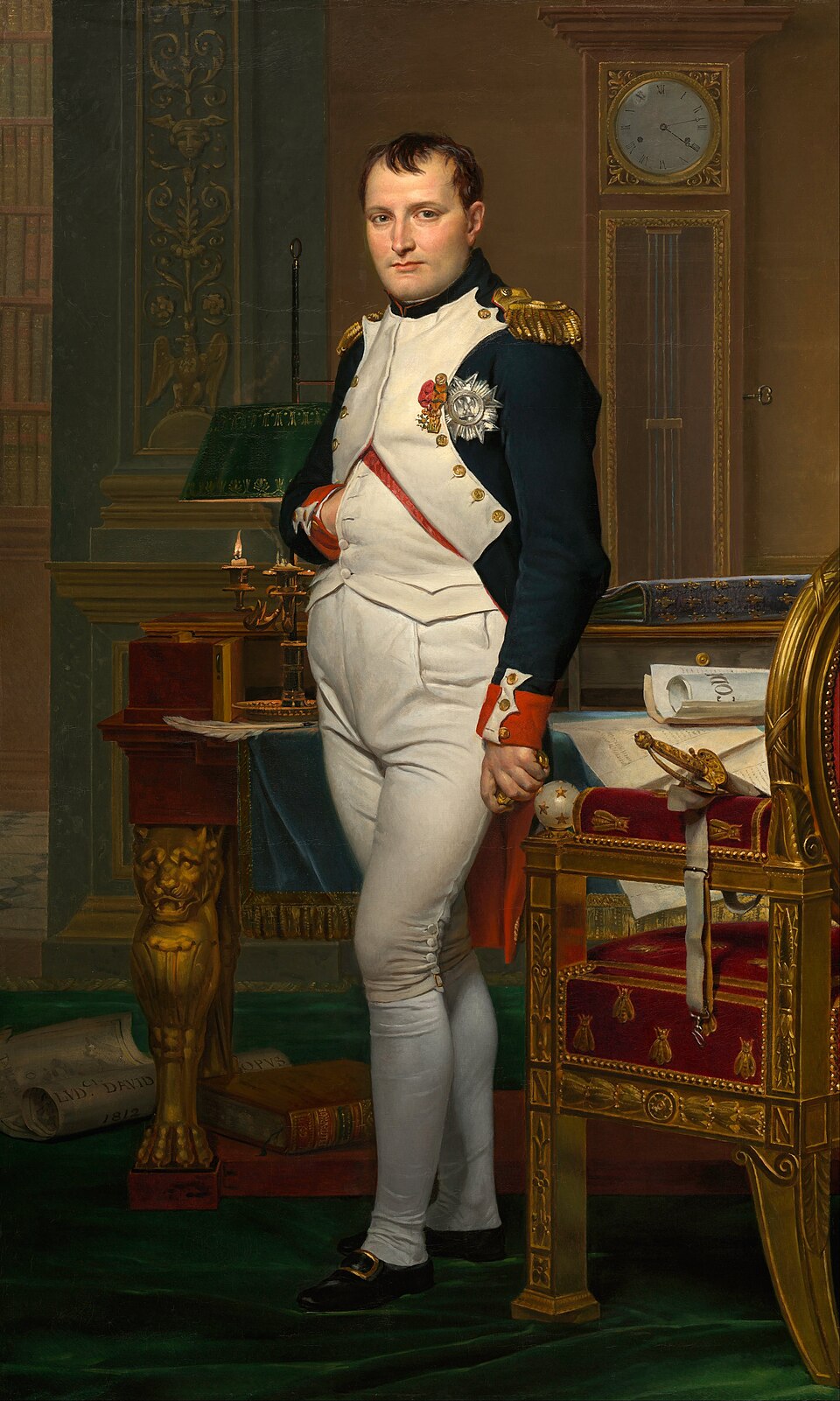
The person
Napoleon Bonaparte was a French military leader and emperor who conquered much of Europe in the early 19th century. His maxims distill principles of warfare based on his campaigns.
His military maxims remain a foundational text for strategic thinking, emphasizing speed, concentration, and morale.
Life in motion
Drag to travel through time · Ctrl/⌘ + scroll or pinch to zoom · Select a moment for the full account
Napoleon crowns himself Emperor of the French at Notre Dame, with Pope Pius VII in attendance.
Wikipedia ↗Operating system
Napoleon stresses the offensive as essential for victory, arguing that waiting for the enemy invites defeat.
Evidence: Maxim I: 'The frontiers of states are either large rivers, or chains of mountains, or deserts. Of all these obstacles, it is the most difficult to overcome, but when once passed, the invasion becomes easy.'
He advocates for massing troops at the decisive point to achieve local superiority.
Evidence: Maxim X: 'The strength of an army, like the power in mechanics, is estimated by the mass multiplied by the rapidity of movement.'
Rapid maneuvers and surprise attacks are key to disrupting enemy plans.
Evidence: Maxim XIV: 'The most difficult thing in war is to make a movement, the object of which is unknown to the enemy.'
The moral force of troops is critical; a leader must inspire confidence and courage.
Evidence: Maxim XLII: 'In war, as in the art of the actor, the first quality is the moral.'
Secure supply lines and a well-chosen base are fundamental to sustained operations.
Evidence: Maxim XX: 'An army ought to have but one line of operation, which must be well chosen and kept in good order.'
Knowing the enemy's positions and intentions is essential for planning.
Evidence: Maxim XXIX: 'A general should never trust to the information of partial spies; he ought always to reconnoitre in person.'
Calculated risks are necessary; indecision leads to failure.
Evidence: Maxim XLIV: 'A commander-in-chief cannot take counsel of his fears.'
Napoleon's relentless work ethic and ability to function on minimal sleep, often dictating multiple letters and orders simultaneously.
Evidence: Constant notes that Napoleon worked incessantly, often dictating to several secretaries at once and sleeping only a few hours.
Napoleon had a quick temper and little patience for inefficiency or delays, which sometimes led to harsh outbursts.
Evidence: Constant recounts how Napoleon would kick tables and throw objects when frustrated, but his anger subsided quickly.
Napoleon's military campaigns were marked by rapid movement, decisive battles, and meticulous planning, as seen in his Italian campaign.
Evidence: Constant describes Napoleon's ability to inspire troops and his detailed attention to logistics and timing.
Napoleon's deep affection for his wife Josephine, despite her infidelities and their eventual divorce, is a recurring theme.
Evidence: Constant recounts Napoleon's passionate letters to Josephine and his devastation when she failed to join him in Italy.
Napoleon displayed both magnanimity and cruelty, simplicity and grandiosity, making him a figure of paradox.
Evidence: Constant notes that Napoleon could be kind to servants yet ruthless to enemies, and that he despised flattery but loved adulation.
Read through your work
Leaders
Leaders across domains can learn from Napoleon's ability to inspire loyalty and execute with speed. His personal reconnaissance and addressing soldiers by name demonstrate visible leadership. Constant's memoir reveals his relentless work ethic, but also his temper—leaders must control emotions to maintain respect. His principle of combining mass and rapidity is a model for strategic initiatives. However, his failures teach that even the best strategy requires adaptability and respect for constraints. The Russian campaign is a masterclass in ignoring warning signs. A great leader balances decisive action with humility.
In his words
“The first qualification in a general-in-chief is a cool head--that is, a head which receives just impressions, and estimates things and objects at their real value.”
“When you have resolved to fight a battle, collect your whole force. Dispense with nothing. A single battalion sometimes decides the day.”
“It is an approved maxim in war, never to do what the enemy wishes you to do, for this reason alone, that he desires it.”
“An army ought to have only one line of operation. This should be preserved with care, and never abandoned but in the last extremity.”
“Peruse again and again the campaigns of Alexander, Hannibal, Cæsar, Gustavus Adolphus, Turenne, Eugene, and Frederick. Model yourself upon them. This is the only means of becoming a great captain, and of acquiring the secret of the art of war.”
“The first qualification of a soldier is fortitude under fatigue and privation. Courage is only the second; hardship, poverty and want, are the best school for a soldier.”
“A general of ordinary talent occupying a bad position, and surprised by a superior force, seeks his safety in retreat; but a great captain supplies all deficiencies by his courage, and marches boldly to meet the attack.”
“The transition from the defensive to the offensive is one of the most delicate operations.”
“In war, it is not the business of an advanced guard to fight, but to observe the enemy, in order to cover the movements of the army.”
“Nothing can excuse a general who takes advantage of the knowledge acquired in the service of his country, to deliver up her frontier and her towns to foreigners. This is a crime reprobated by every principle of religion, morality and honor.”
Put into practice
Napoleon insists on massing superior forces at the critical time and place, even if it means accepting risk elsewhere.
Passive defense rarely wins; constantly seek to seize the initiative and force the enemy to react.
A single, well-protected line of operation ensures supply and retreat options are safe.
Personal reconnaissance and visible leadership boost morale and generate accurate intelligence.
Indecision is worse than a flawed decision; act boldly after assessing odds.
The moral force of troops is the decisive factor; inspire confidence and purpose.
Napoleon's ability to work long hours with little sleep allowed him to outpace rivals.
Napoleon's quick temper could be detrimental, but he used it to enforce standards.
Napoleon's ability to personally inspire troops was key to his success.
Read with judgment
Napoleon's greatness stemmed from his ability to concentrate overwhelming force at the decisive point with extraordinary speed. His maxim 'strength of an army, like power in mechanics, is mass multiplied by rapidity' captures his operational genius. He personally reconnoitered, inspired troops by name, and worked 16-hour days, outpacing rivals through sheer energy and tactical brilliance. His Italian campaign remains a textbook example of rapid maneuver and decisive battle, forcing Austria to sue for peace in months.
Napoleon preached the offensive yet his empire collapsed when he invaded Russia, a catastrophic defensive failure. He understood morale's primacy but his own hubris alienated allies and overextended his forces. He championed meritocracy yet crowned himself emperor, installing family on thrones. His maxims emphasize calculation, but his later campaigns ignored logistics and weather, leading to disaster.
Napoleon's impatience and temper, documented by his valet Constant, sometimes clouded judgment. He kicked tables and threw objects when frustrated. More critically, his refusal to delegate and obsessive centralization meant his system crumbled when he overreached. The Peninsular War demonstrated strategic inflexibility: unable to suppress guerrilla warfare, he bled troops. Ultimately, he failed to adapt to coalition warfare at Leipzig, where numerical superiority defeated speed.
In a world of information overload and fast-moving markets, Napoleon's emphasis on concentration, speed, and personal leadership is more relevant than ever. Leaders must identify the critical point—whether a product launch, a market niche, or a strategic pivot—and commit resources decisively. His caution against indecision resonates in startup culture where 'move fast' is gospel. Yet his failures remind us that speed without logistics and coalition-building leads to burnout and isolation.
Study his maxims as a diagnostic toolkit for competitive strategy, but pair them with historical accounts of his campaigns to see consequences. Practice personal reconnaissance: gather firsthand data before deciding. Audit your energy use—Napoleon worked relentlessly but also napped strategically. Embrace calculated risk but institutionalize checks to prevent overreach. Most importantly, learn from his Russian disaster that even brilliant strategies fail when they ignore logistics and political constraints.
Start with Maxim X: 'The strength of an army... is estimated by the mass multiplied by the rapidity of movement.' Apply it to your current project: what is your decisive point, and how can you amplify mass and speed there? Then read Constant's Memoirs for the human side—how Napoleon's daily habits, temper, and relationships shaped his decisions.
The human network
valet
His personal valet and memoirist, who observed his daily habits. Provides intimate portrait of Napoleon's private life.
Continue the inquiry
Both wrote aphoristic military classics emphasizing deception, speed, and intelligence.
Offensive Action · Surprise · Intelligence
Applied similar principles of rapid maneuver and personal leadership in World War II.
Speed · Leadership · Offensive Action
Both combined military and political leadership, writing commentaries on their campaigns.
Leadership · Offensive Action · Concentration of Force
Both were young conquerors who created vast empires through rapid campaigns and personal charisma.
Conquest · Leadership · Youth
As contemporary leaders, both were Enlightenment thinkers who reformed law and education, but Napoleon's methods were authoritarian.
Reform · Centralization · Legal codes
His ultimate adversary at Waterloo; both were tactical geniuses with contrasting styles: Napoleon bold, Wellington cautious.
Military command · Rivalry · Battlefield tactics
Source shelf
link
Napoleon I (Emperor of the French)
View source →link
Louis Antoine Fauvelet de Bourrienne
View source →reference
Wikipedia contributors
View source →reference
Wikidata contributors
View source →Source basis: The analysis draws primarily on Napoleon's own 'Military Maxims' (source 42) and the intimate memoirs of his valet Louis Constant Wairy (source 43). The maxims provide distilled strategic principles with varying reliability due to translation and compilation. Constant's detailed observations offer credible insights into Napoleon's private life, work habits, and character contradictions, though memory bias exists. Wikipedia provides factual timeline and context.
Direct answers
Concentration of force at the decisive point, expressed in his maxim 'strength = mass × rapidity.' This means deploying overwhelming resources where they can achieve breakthrough, even at the expense of other areas. It's the foundation of his victories and a key lesson for competitive strategy.
According to his valet Constant, yes. Napoleon routinely worked 16-18 hour days, slept only a few hours, and dictated to multiple secretaries simultaneously. His relentless energy was a competitive advantage. However, this workaholism also contributed to his micromanagement and inability to delegate.
His love for Josephine and subsequent divorce for dynastic reasons reveal a tension between emotion and pragmatism. Constant notes his passionate letters and devastation. This emotional depth humanizes him but also shows his capacity for ruthless decisions, a key duality in his character.
The invasion of Russia in 1812. He violated his own maxims by overextending supply lines, ignoring the vast distances, and underestimating the enemy's resolve. The catastrophic retreat destroyed the Grande Armée and triggered his downfall. It exemplifies strategic overreach.
Yes, but with caution. Principles like concentration of force, maintaining the offensive, and personal reconnaissance translate well to competitive strategy. However, blindly applying maxims without adapting to context leads to failure. Use them as heuristics, not rules.
Louis Constant Wairy served as Napoleon's premier valet for many years and wrote intimate memoirs. Constant provides firsthand accounts of Napoleon's daily habits, temper, work ethic, and relationships. His perspective is rare for its access to private moments, though it may be colored by loyalty.
He led from the front, personally reconnoitering and addressing soldiers by name. Constant recounts how he shared hardships and recognized individual valor. His maxim 'the first quality is the moral' emphasizes morale as decisive. This personal engagement built fierce loyalty, though it also risked his safety.
It means combining large forces with fast movement to achieve overwhelming impact at a specific point. For example, in his Italian campaign, Napoleon marched his army rapidly to attack isolated Austrian forces before they could concentrate. The result was local superiority despite overall numerical parity.