



1494
Restoration of the Florentine Republic
Florence restored the republic, expelling the Medici family that had ruled for some sixty years.
Why it matters: Set the stage for Machiavelli's later career in the republican government.
Wikipedia ↗Political Leader · 1469–1527 AD
Florentine diplomat and political theorist who redefined statecraft
The defining question
How can a ruler maintain power and stability in a world where traditional morality and human nature conflict?
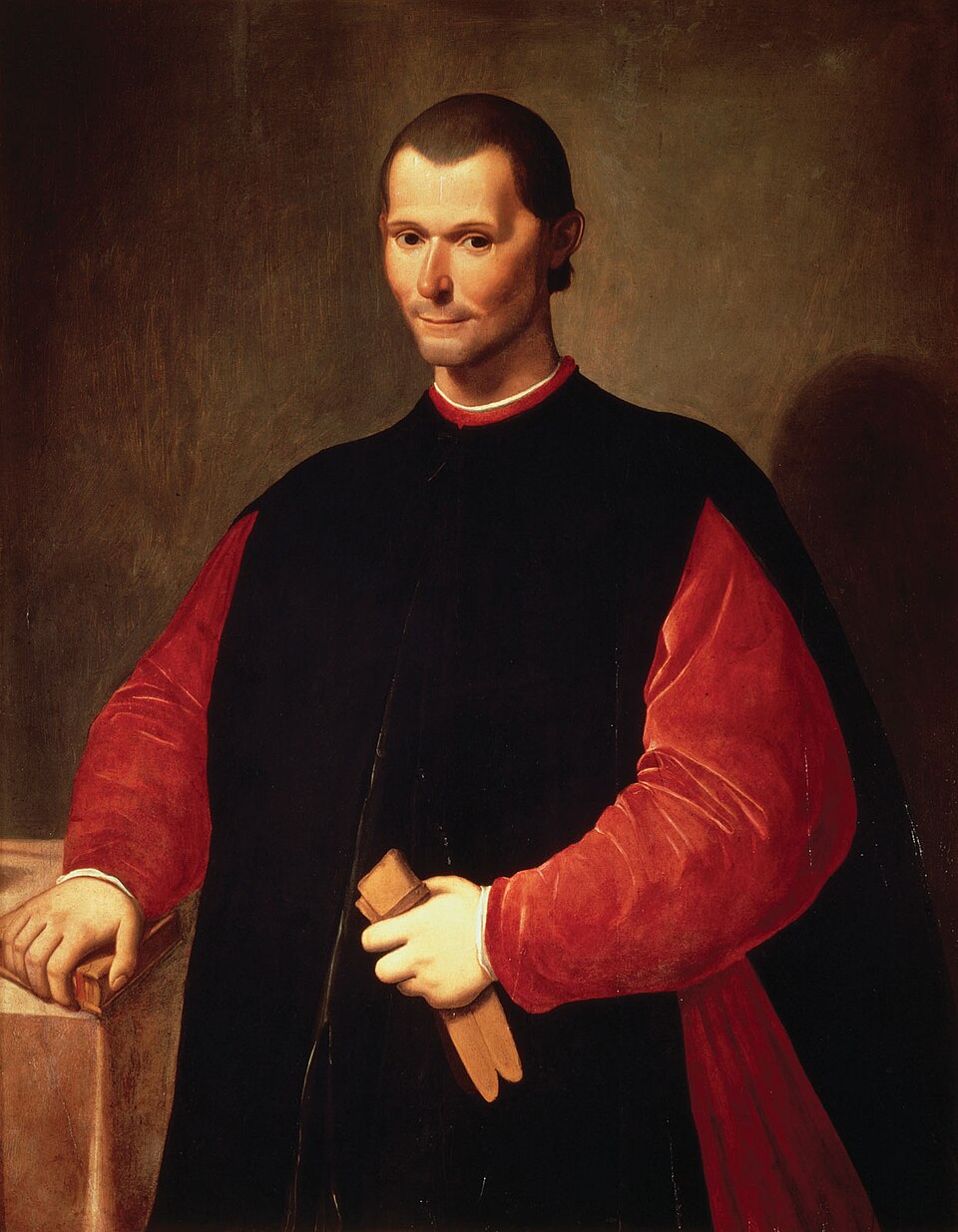
The person
Niccolò Machiavelli (1469–1527) was a Florentine diplomat, philosopher, and writer whose treatise 'The Prince' (1513) systematically laid out the art of acquiring and maintaining political power. Drawing on his own diplomatic experience and historical examples, he argued that rulers must sometimes act immorally for the sake of state stability. His work challenged traditional Christian political ethics and introduced the concept of raison d'état.
Machiavelli's 'The Prince' is the foundational text of modern political realism, breaking with centuries of idealistic advice to rulers. It coined the term 'Machiavellian' and remains a touchstone for understanding power, leadership, and the tension between ethics and effectiveness.
Life in motion
Drag to travel through time · Ctrl/⌘ + scroll or pinch to zoom · Select a moment for the full account
Florence restored the republic, expelling the Medici family that had ruled for some sixty years.
Why it matters: Set the stage for Machiavelli's later career in the republican government.
Wikipedia ↗Operating system
Machiavelli famously argues that a prince must be willing to use deceit, cruelty, and other immoral means if they are necessary for the stability and security of the state. The end — a secure, well-ruled state — justifies actions that would otherwise be condemned.
Evidence: From the source: 'many have imagined republics and principalities which have never been seen or known to exist in reality... he who neglects what is done for what ought to be done, sooner effects his ruin than his preservation.' Also: 'a prince, and especially a new prince, cannot observe all those things which give men a reputation for virtue, because in order to maintain his state he is often forced to act contrary to faith, contrary to charity, contrary to humanity, contrary to religion.'
Machiavelli argues it is far safer for a prince to be feared than loved, because men are fickle and self-interested. However, he warns that a prince must avoid being hated, which can be achieved by refraining from seizing the property of his subjects.
Evidence: From the source: 'it is much safer to be feared than loved... for love is held by a chain of obligation which, because men are wretched, is broken on every occasion; but fear is held by a dread of punishment which never abandons you.' Also: 'he ought to punish those who do injuries... but above all he must abstain from the property of others.'
Machiavelli introduces the concepts of virtù — a ruler's ability to act decisively, adapt, and shape events — and fortuna (fortune or luck), which represents the unpredictable forces of fate. A successful prince must use his virtù to seize opportunities and mitigate bad fortune.
Evidence: From the source: 'it is necessary for him to possess a mind ready to turn in any direction as Fortune's winds and the variability of affairs require.' Also: 'Fortune is a woman, and it is necessary, if you wish to master her, to conquer her by force.'
A prince must combine the strength of the lion to frighten wolves and the cunning of the fox to recognize snares. Mere force is insufficient; deception and shrewdness are essential tools of statecraft.
Evidence: From the source: 'a prince being thus obliged to know well how to act as a beast must imitate the fox and the lion... a lion cannot protect himself from snares, and a fox cannot defend himself from wolves. One must therefore be a fox to recognize snares, and a lion to frighten wolves.'
Machiavelli holds a pessimistic view of human nature: men are ungrateful, fickle, deceitful, and selfish. This grim assessment forms the foundation for his advice to rulers, who must govern on the basis of how people actually behave, not how they ought to behave.
Evidence: From the source: 'men are ungrateful, fickle, false, cowardly, covetous... they are ready to shed their blood for you when the danger is remote, but when it approaches they turn against you.' Also: 'a wise prince must base his actions on this assumption: that all men are wicked.'
Machiavelli distinguishes between the challenges of a new prince, who must establish his rule often by force and innovative methods, and an hereditary prince, who can rely on tradition and is less likely to be hated. The new prince faces greater obstacles but also greater opportunities for glory.
Evidence: From the source: 'it is far easier to rule a hereditary state than a new one... for in hereditary states the subjects are accustomed to the family of their prince.' And: 'a new prince must always incur the risk of changing the order of things.'
Machiavelli emphasizes that a republic's success depends on citizens' willingness to subordinate private interests for the common good, as exemplified by early Rome.
Evidence: Book I, Ch. 1: 'All cities and states... have need for some virtue that shall keep them free.' Book I, Ch. 11: 'Religion... was the cause of much of Rome's greatness.'
Machiavelli argues that the conflict between the patricians and plebeians in Rome was not destructive but essential for creating laws that preserved liberty.
Evidence: Book I, Ch. 4: 'The disunion of the Senate and the people... was the primary cause of Rome's becoming free.'
Effective leaders must act decisively and sometimes cruelly to establish order or defend the state, using methods appropriate to the situation.
Evidence: Book I, Ch. 9: 'A prudent founder... will necessarily use such means as are cruel and pernicious.' Book I, Ch. 26: 'A Prince... must kill the sons of Brutus.'
Machiavelli sees religion as a tool for maintaining civic discipline and fostering patriotism, even if leaders must manipulate religious beliefs.
Evidence: Book I, Ch. 11: 'The chief foundation of all states... is the good observance of religion.' Book I, Ch. 12: 'The nearer one approaches to the Roman Church, the less religious he becomes.'
Governments cycle through monarchy, tyranny, aristocracy, oligarchy, democracy, and anarchy; only a mixed republic can achieve stability.
Evidence: Book I, Ch. 2: 'These six forms of government... are always changing.' Book I, Ch. 3: 'A mixed government is more stable and lasting.'
Machiavelli argues that relying on citizen soldiers rather than mercenaries is vital for a republic's independence and martial vigor.
Evidence: Book I, Ch. 21: 'Rome used her own citizens as soldiers.' Book I, Ch. 43: 'That state only is secure which can depend on its own arms.'
Laws and institutions must evolve to prevent corruption; periodic returns to founding principles renew civic virtue.
Evidence: Book I, Ch. 17: 'A corrupt state... cannot be preserved unless it is reformed.' Book III, Ch. 1: 'A return to the original principles is necessary for the preservation of a state.'
Machiavelli prioritizes practical effectiveness over moral ideals, arguing that rulers must sometimes act against conventional ethics to achieve stability.
Evidence: Throughout The Prince, he repeatedly advises rulers to focus on what is 'actually true' rather than imaginary republics, famously stating that the 'effectual truth' matters more than ideal models.
Machiavelli subverts traditional virtues like kindness and generosity, arguing that they can be detrimental to rule if misused, while vices like miserliness or cruelty may be necessary for the common good.
Evidence: He states that a ruler 'need not make himself uneasy at incurring reproach for a vice without which his authority can hardly be kept' and that using cruelty 'well' can ensure security.
Machiavelli sees human affairs as half-controlled by fortune and half by human will (virtù). He advocates boldness and adaptability to master fortune, symbolized by the metaphor of fortune as 'one of those dangerous rivers' that must be dammed.
Evidence: In the final chapter, he insists that 'fortune is the arbiter of one half of our actions, but she leaves the control of the other half to us' and that 'to hold her down, one must beat and ill-treat her.'
Military strength and the wise use of force are central to effective rule. Machiavelli argues that a prince's primary duty is the study of war, and that armed prophets succeed while unarmed ones fail.
Evidence: He praises the deed of Duke Valentino for eliminating rivals and notes that 'armed prophets have conquered and unarmed ones have failed,' underscoring the necessity of military readiness.
A prince's reputation and public perception are vital to maintaining power. Machiavelli advises cultivating an image of both a lion and a fox—strength and cunning—and gives guidelines for ruling with justice and mercy.
Evidence: He asserts that a prince 'cannot observe all those things which are considered good in men, because it is necessary, in order to maintain the state, to act contrary to faith, charity, and religion.'
Machiavelli argues that republics are more stable and prosperous than principalities when they foster civic virtue and the common good.
Evidence: In Book I, he compares Rome's republic to other states, praising its capacity for expansion and stability through citizen participation.
He sees social conflict, such as the plebeian-patrician struggles, as a source of strength and liberty rather than a weakness.
Evidence: He notes that the disputes between the nobles and the plebs in Rome 'deserve the highest praise' as they led to better laws.
Machiavelli views religion as a tool for social control and military discipline, not as a spiritual truth.
Evidence: He criticizes the Church for weakening Italy and praises Roman religion for binding citizens and soldiers.
Studying ancient history offers practical lessons for contemporary politics.
Evidence: He opens by stating that he will 'compare the deeds of the ancients with those of the present' to derive useful knowledge.
Corruption undermines republics and leads to tyranny unless checked by laws and religion.
Evidence: He notes that corruption arises from 'the neglect of religion' and 'the bad education and bad government'.
Machiavelli argues that effective governance is based on understanding human nature and the necessities of power, rather than on idealistic moral principles.
Evidence: In Chapter XV, he states that 'it is necessary for a prince who wishes to maintain his position to learn how not to be good, and to use this knowledge or not according to necessity.'
A leader must combine cunning and force, symbolizing the ability to navigate both human laws and brute power.
Evidence: In Chapter XVIII, Machiavelli advises that a prince 'ought to choose the fox and the lion; because the lion cannot defend himself against snares and the fox cannot defend himself against wolves.'
It is not necessary for a prince to possess all virtuous qualities, but it is essential to appear to have them, and to be ready to act contrary when needed.
Evidence: In Chapter XVIII, he writes 'it is unnecessary for a prince to have all the good qualities I have enumerated, but it is very necessary to appear to have them.'
Cruelty can be used effectively if it is done swiftly, decisively, and for the security of the state, but it must be kept under control to avoid hatred.
Evidence: In Chapter VIII and the description of Cesare Borgia's methods, Machiavelli illustrates how 'well-used cruelty' can secure a prince's power, as when Borgia executed his minister to win public favor.
Machiavelli argues that men rise from humble to high fortunes more often by fraud than by force, and that both princes and republics must use deceit until they are powerful enough to rely on strength alone.
Evidence: In Book II, Chapter XIII, he states: 'men seldom if ever rise to great place from small beginnings without using fraud or force... Force, however, will never suffice by itself to effect this end, while fraud often will.'
Machiavelli praises the Roman use of religion to maintain order and morale, and criticizes the Church for making Italy weak and divided. Religion serves as a tool for political unity and control.
Evidence: In Book I, chapters XI-XIV, he discusses the religion of the Romans and its importance, noting that 'Italy, through the Roman Church, being wanting therein, has been ruined.'
While 'The Prince' focuses on autocratic rule, the Discourses argue that republics, with their mixed government and popular participation, are wiser and more constant than princes, provided the people are not corrupt.
Evidence: In Book I, Chapter LVIII, he asserts: 'The government of the people is better than that of princes... for a people is wiser and more constant than a prince.'
Machiavelli warns that authority given without limits, even by popular consent, leads to corruption and tyranny. He contrasts the beneficial dictatorship of Rome with the harmful Decemvirate.
Evidence: In Book I, Chapter XXXV, he explains: 'Where authority is unrestricted and is conferred for a long term, it is always attended with danger... absolute authority will make a people corrupt.'
Machiavelli emphasizes that a free state requires citizens who prioritize the common good over private interests, citing examples like Fabius nominating his enemy for the good of Rome.
Evidence: In Book III, Chapter XLVII, he notes: 'Moved by love of his country Fabius did as he was asked, although by his silence, and by many other signs, he gave it to be known that compliance was distasteful.'
Machiavelli argues that a republic must have its own citizens armed and trained for war, not mercenaries, and that national armies are essential for defense and expansion.
Evidence: In Book I, Chapter XXI, he states: 'That it is a great reproach to a Prince or to a Commonwealth to be without a National Army.'
Read through your work
Leaders
Machiavelli's works are explicitly for leaders, whether they rule principalities or organizations. His advice on establishing authority, navigating opposition, and achieving long-term stability is timeless. Leaders can benefit from his emphasis on self-awareness, strategic ruthlessness, and the management of perception. He also reminds us that leaders must be prepared for fortune's changes, adapting and acting boldly when necessary. The Discourses offers insights into fostering a culture of accountability and civic engagement.
In his words
“His first mission was in 1499 to Catherina Sforza, “my lady of Forli” of _The Prince_, from whose conduct and fate he drew the moral that it is far better to earn the confidence of the people than to rely on fortresses.”
“This is a very noticeable principle in Machiavelli, and is urged by him in many ways as a matter of vital importance to princes.”
“Here we are on firm ground when dealing with the events of Machiavelli’s life, for during this time he took a leading part in the affairs of the Republic, and we have its decrees, records, and dispatches to guide us, as well as his own writings.”
“Savonarola’s influence upon the young Machiavelli must have been slight, for although at one time he wielded immense power over the fortunes of Florence, he only furnished Machiavelli with a subject of a gibe in _The Prince_, where he is cited as an example of an unarmed prophet who came to a bad end.”
“Yet in _The Prince_ the duke is in point of fact cited as a type of the man who rises on the fortune of others, and falls with them; who takes every course that might be expected from a prudent man but the course which will save him; who is prepared for all eventualities but the one which happens; and who, when all his abilities fail to carry him through, exclaims that it was not his fault, but an extraordinary and unforeseen fatality.”
“It is in reference to Pope Julius that Machiavelli moralizes on the resemblance between Fortune and women, and concludes that it is the bold rather than the cautious man that will win and hold them both.”
“The remaining years of Machiavelli’s official career were filled with events arising out of the League of Cambrai, made in 1508 between the three great European powers already mentioned and the pope, with the object of crushing the Venetian Republic.”
“All states, all powers, that have held and hold rule over men have been and are either republics or principalities.”
“Whence it happens that by far the greater number of those who read History, take pleasure in following the variety of incidents which it presents, without a thought to imitate them; judging such imitation to be not only difficult but impossible; as though the heavens, the sun, the elements, and man himself were no longer the same as they formerly were as regards motion, order, and power.”
“Desiring to rescue men from this error, I have thought fit to note down with respect to all those books of Titus Livius which have escaped the malignity of Time, whatever seems to me essential to a right understanding of ancient and modern affairs; so that any who shall read these remarks of mine, may reap from them that profit for the sake of which a knowledge of History is to be sought.”
Put into practice
Machiavelli insists that a ruler must deal with the world as it is, not as it ought to be. Idealistic theories of governance lead to ruin because they ignore the actual selfish and treacherous nature of men.
While a prince should ideally be both loved and feared, if forced to choose, fear is more reliable because it is based on a deterrent rather than fickle loyalty.
Machiavelli argues that fortune favors the bold. A ruler must seize opportunities with decisive action and adapt to changing circumstances.
A successful ruler must be both cunning (fox) to detect traps and strong (lion) to overwhelm foes. Deception is a necessary tool.
While fear is useful, hatred undermines a ruler's security. The fastest way to inspire hatred is to seize property or dishonor women; a prince must abstain from these.
Introducing new systems faces opposition from those who benefited from the old and only lukewarm support from potential beneficiaries, making the task perilous.
Conflict between social classes can be harnessed to produce laws that strengthen liberty, rather than being suppressed.
Design institutions on the assumption that people will act selfishly when unchecked; this prevents corruption.
Civic religion fosters patriotism and obedience; leaders should support religious practices that promote social unity.
Read with judgment
Machiavelli's greatness lies in his unflinching realism. He broke from idealistic political theory by grounding advice in 'the effectual truth of the matter rather than the imagination of it' (The Prince, Ch. XV). His diplomatic experience, including witnessing Cesare Borgia's brutality, fueled his insights into power dynamics. He systematically analyzed how to acquire and maintain power, creating the foundation of modern political science. His works, especially The Prince and Discourses, remain touchstones for understanding power, leadership, and the tension between ethics and effectiveness, making him a pivotal figure in Western thought.
Machiavelli's central contradiction is his simultaneous advocacy for ruthless, amoral statecraft in The Prince and his deep appreciation for republican liberty and civic virtue in the Discourses. While The Prince advises a ruler to be feared and deceptive, the Discourses praises Rome's mixed government and the constructive role of social conflict. This apparent inconsistency reflects his pragmatic approach: the means must suit the circumstances, whether establishing order or maintaining freedom. His works together suggest that while a single ruler may need to use harsh methods, a republic can thrive on citizen participation and balanced institutions.
Machiavelli's shadow side is the endorsement of cruelty and deceit when necessary for state security. His advice to be 'a fox to discover the snares and a lion to terrify the wolves' (The Prince, Ch. XVIII) has been used to justify political manipulation and tyranny. Moreover, his own career ended in failure: after the Medici returned, he was dismissed, imprisoned, and tortured, spending his remaining years in exile. This personal experience of powerlessness underscores the risks of political realism and the fragility of those who serve fleeting regimes.
Machiavelli's relevance persists in modern politics, business, and leadership. His concepts of virtù and fortuna resonate in a world of uncertainty where leaders must adapt and seize opportunities. The Prince's advice on navigating human nature, building alliances, and maintaining reputation applies to corporate strategy and political campaigns. The Discourses' insights into institutional design, the role of conflict, and the necessity of civic virtue inform contemporary debates on governance and democracy. His focus on consequences over intentions anticipates modern realist theories in international relations.
To learn from Machiavelli, one must read him contextually, understanding that his advice is situational. Begin with The Prince to grasp his realism and then pair it with the Discourses to see his republican ideals. Analyze historical examples he cites, like Cesare Borgia or Scipio, to see the application of principles. In practice, leaders can adopt his strategic clarity: assess realities, prepare for adversity, and act decisively. However, always balance his pragmatism with ethical reflection, as his means-justify-ends logic can corrupt without bound.
The best entry point is Chapter XV of The Prince, 'Concerning Things for Which Men, Especially Princes, Are Praised or Blamed', where Machiavelli states his intention to 'depart from the methods of others' and write about 'the effectual truth' rather than imaginary republics. This chapter sets the tone for his entire philosophy and is essential for understanding his break from classical political thought. It directly addresses the core tension between ethical ideals and political necessity.
The human network
self
He is the author of the Discourses. Central figure.
Subject of study
Machiavelli analyzes Borgia's actions in The Prince as a model for a new prince. Borgia serves as a key example of virtù and the use of cruelty.
Diplomatic contact
Machiavelli was sent on a mission to her in 1499. Her example illustrates the importance of popular support over fortresses.
Historical figure
Pope Alexander VI, whose deceit and success Machiavelli cites in The Prince. An example of a ruler who used deception effectively.
Biographical subject
Machiavelli wrote a short biography of the Luccan ruler. Illustrates his ideal of a self-made prince.
Influence
Machiavelli cites Xenophon's life of Cyrus to illustrate the role of fraud in rising to power. Shows Machiavelli's classical education and his use of ancient texts as support for his arguments.
Historical figures
Machiavelli references the Gracchi brothers as reviving the Agrarian Law, which ultimately destroyed Roman liberty. Used as an example of how poorly managed reforms can lead to civil strife.
Continue the inquiry
Hobbes expanded on Machiavelli's pessimistic view of human nature and the need for a strong sovereign in 'Leviathan', though he focused on social contract rather than princely virtù.
realism · human nature · sovereignty
Both wrote pragmatic treatises on strategy and deception, but Sun Tzu's 'The Art of War' emphasizes winning without fighting, whereas Machiavelli accepts violence as necessary.
deception · strategy · pragmatism
Clausewitz's 'On War' shares Machiavelli's focus on the harsh realities of conflict and the subordination of means to ends, though Clausewitz is more systematic.
war · politics · realism
Modern political scientists like Leo Strauss and Quentin Skinner have analyzed Machiavelli's break from classical and Christian political thought.
political philosophy · modernity
Livy's historical work provides the foundation for Machiavelli's analysis in the Discourses.
History as lesson · Roman virtue · Republicanism
A contemporary Florentine historian and diplomat, Guicciardini offers a more empirical counterpoint to Machiavelli's generalizations.
Political realism · Florentine history
Rousseau admired Machiavelli's republican writings and drew on the Discourses for his own social contract theory.
Republicanism · Popular sovereignty · Civic virtue
Adams cited Machiavelli's analysis of mixed government in his Defence of the Constitutions of the United States.
Checks and balances · Mixed government
Aristotle's Politics discusses different forms of government and the ideal state, offering a classical contrast to Machiavelli's pragmatic realism.
Political theory · Governance · Ethics
Livy's history is the basis for the Discourses.
history · republicanism
Cicero's political writings on duty and statecraft are a classical counterpoint.
political realism · republican values
Both are considered founders of political realism, focusing on power and human nature in politics.
Political realism · Human nature · Power politics
Shared a pessimistic view of human nature and the necessity of a strong sovereign to prevent chaos.
Human nature · Sovereignty · Fear
Weber's concept of the 'ethics of responsibility' echoes Machiavelli's focus on consequences over intentions.
Ethics and politics · Consequences · Leadership
She offered a critical view of Machiavelli's ideas in the context of modern totalitarianism.
Power · Violence · Political theory
Figure of political ambition and military genius; Machiavelli discusses Roman leaders to illustrate virtù and the acquisition of power.
ambition · military prowess · dictatorship
Source shelf
link
Niccolò Machiavelli
View source →link
Niccolò Machiavelli
View source →reference
Wikipedia contributors
View source →reference
Wikidata contributors
View source →Source basis: This analysis draws primarily on The Prince and Discourses on Livy, Machiavelli's two major political works. The Prince offers direct advice to rulers on acquiring and maintaining power, with chapters on cruelty, fear, and fortune. Discourses provides a broader theory of republics and civic virtue, using Roman history to illustrate principles like mixed government and the value of social conflict. Contextual biographical sources from Wikipedia supplement his life events and historical context. These sources together present a comprehensive view of his political realism and its varied applications.
Direct answers
No, that's a simplification. While The Prince advises rulers to be cunning and sometimes cruel, Machiavelli's broader works, especially the Discourses, show a deep appreciation for republican liberty and civic virtue. He was a realist who believed that to achieve good ends, leaders must sometimes use methods that traditional morality condemns. His goal was to describe how power actually works, not to advocate evil for its own sake.
This phrase is often misattributed to Machiavelli, but it captures his idea that in politics, the security and stability of the state can justify actions that would otherwise be immoral. He argues that a prince must be willing to act against faith, charity, and humanity if necessary to maintain the state. However, he cautions that such actions must be 'well used'—swift and decisive—to avoid hatred.
Machiavelli wrote The Prince as a practical guide for a ruler to unify Italy, likely inspired by his desire to return to political life. The Discourses, written around the same time, is a more systematic analysis of republican governance, drawing on Roman history. The two works are complementary: The Prince addresses principalities and short-term power, while the Discourses explores republics and long-term stability. Together, they present a comprehensive view of political order.
Machiavelli argues it is safer to be feared than loved because love is dependent on people's fickle nature, while fear is based on the constant dread of punishment. He advises that if a leader cannot be both, they should choose fear—but must avoid being hated, as hatred can lead to rebellion. In modern leadership, this translates to balancing authority with fairness to maintain respect without breeding resentment.
Machiavelli's principles can be applied to business strategy and management. The concept of virtù—being adaptable and decisive—is crucial in dynamic markets. Leaders should be aware of human nature's selfish tendencies and build systems with checks and balances. The advice to be a 'fox' and 'lion' suggests combining strategic intelligence with assertive power. However, his emphasis on the appearance of virtue over actual virtue raises ethical concerns that must be carefully navigated in a transparent society.
Machiavelli was not a democrat in the modern sense, but he valued republicanism. He believed that a well-ordered republic, like Rome, could be more stable and virtuous than a principality. He admired the mixed constitution that balanced monarchical, aristocratic, and democratic elements. However, he was skeptical of the masses' ability to govern without strong institutions, and he acknowledged the role of conflict as a check on power.
Machiavelli's career as a diplomat in the Florentine Republic exposed him to the realities of power, including the scheming of princes and popes. His witness of Cesare Borgia's cruelty and later his own imprisonment and exile after the Medici's return deeply influenced his views. His works reflect a bitter understanding that ethical ideals often fail in the face of self-interest, leading him to advocate for a pragmatic, realistic approach to governance.
Virtù is a central concept in Machiavelli's thought, referring to the combination of skill, courage, decisiveness, and adaptability that allows a leader to control fate. It is often contrasted with fortuna, or luck. A leader with virtù can anticipate challenges and act boldly, shaping events rather than being swept away. This does not necessarily mean moral virtue; rather, it is the ability to achieve one's ends through effective action.