



399 BC
Trial of Socrates
Socrates is tried on charges of impiety (asebeia) and corrupting the youth. He is found guilty and sentenced to death.
Wikipedia ↗Philosopher · 470–399 BC
The Gadfly of Athens
The defining question
What is the right way to live, and why should we obey the law even when it condemns us?
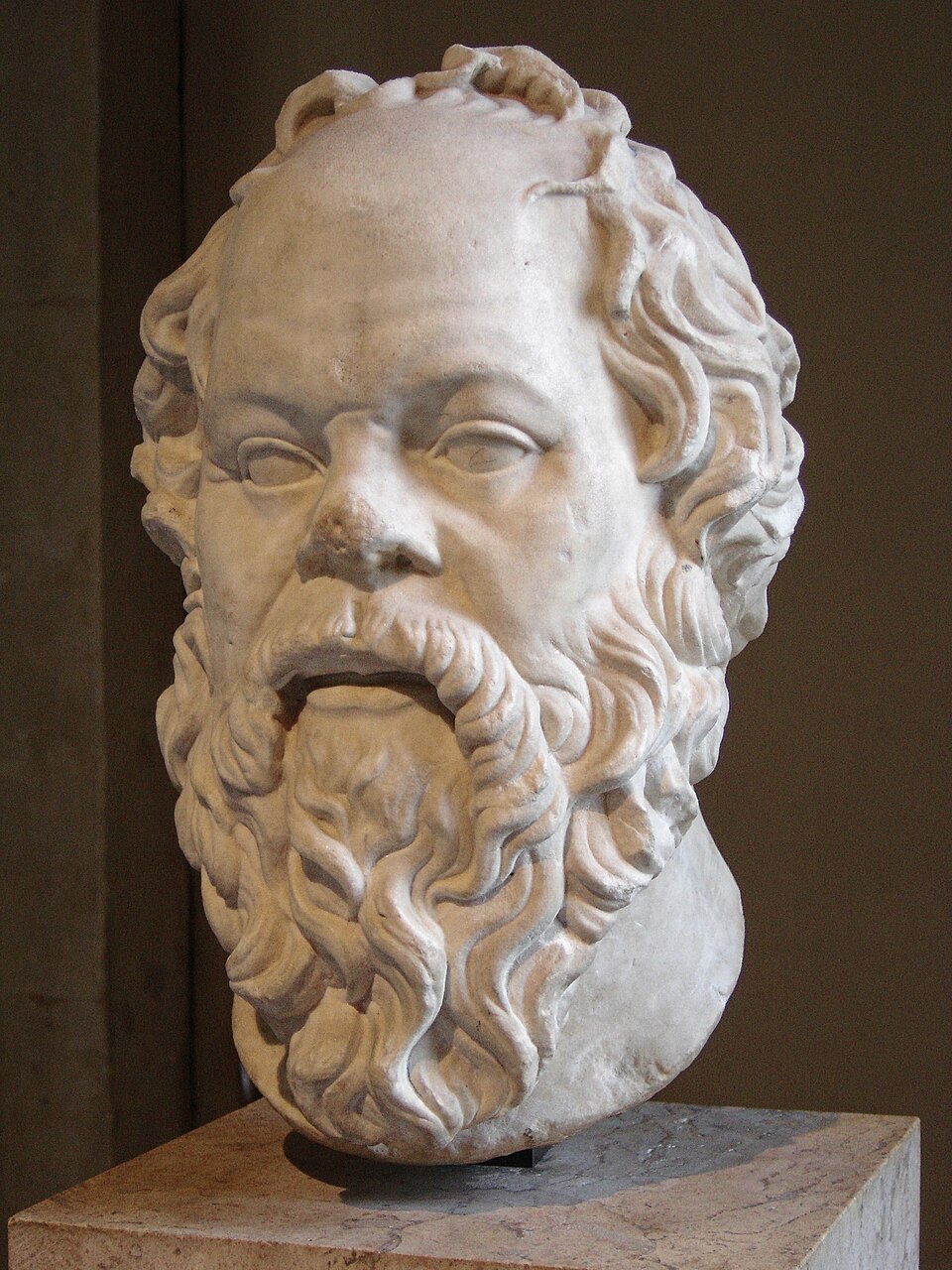
The person
Socrates was an Athenian philosopher who, despite denying any wisdom, exposed the ignorance of others through relentless questioning. He was tried and executed for impiety and corrupting the youth.
Socrates pioneered the Socratic method and insisted on living by examined principles, setting a foundation for Western philosophy. His trial and death became a symbol of intellectual integrity.
Life in motion
Drag to travel through time · Ctrl/⌘ + scroll or pinch to zoom · Select a moment for the full account
Socrates is tried on charges of impiety (asebeia) and corrupting the youth. He is found guilty and sentenced to death.
Wikipedia ↗Operating system
Socrates asserts that the unexamined life is not worth living, a central tenet of his philosophy.
Evidence: Socrates says, 'the unexamined life is not worth living' (Apology 38a).
He refuses to abandon his philosophy even under threat of death.
Evidence: He states, 'I will not give up philosophy... even if I am to die many times' (Apology 30c).
Socrates claims the god at Delphi commanded him to examine others.
Evidence: He explains, 'the god commanded me to fulfil the philosopher's mission of searching into myself and other men' (Apology 28e).
His wisdom lies in knowing his own ignorance.
Evidence: He says, 'I am wiser than this man, because I do not think I know what I do not know' (Apology 21d).
He values justice above public approval.
Evidence: He asserts, 'I will not do what you ask... I will obey the god rather than you' (Apology 29d).
Socrates argues that fearing death is false wisdom.
Evidence: He claims, 'to fear death... is to think you are wise when you are not' (Apology 29a).
He sees himself as a gadfly stirring the state.
Evidence: He describes himself as 'a kind of gadfly... attached to the state by the god' (Apology 30e).
Socrates emphasizes virtue as knowledge that leads to right action, focusing on self-control, justice, and piety as practical guides for daily life.
Evidence: Socrates argues that the self-controlled are able to discern and choose the best, while the uncontrolled are enslaved to pleasures (Memorabilia IV.5).
Socrates engages in questioning to expose ignorance and guide interlocutors to truth, a method that often unsettles but aims at improvement.
Evidence: He questions Euthydemus about justice and piety, leading him to admit his own confusion (Memorabilia IV.6).
Socrates holds conventional religious beliefs, consulting oracles and acknowledging the gods, but his personal daimonion (divine sign) is a distinctive inner guide.
Evidence: Socrates never failed to follow the warnings of his divine sign (Memorabilia I.1).
He values friendships as sources of mutual benefit and moral improvement, often using friends as examples of excellence.
Evidence: Socrates says friends are the greatest good, and he urges his companions to care for their souls (Memorabilia II.4).
Socrates engages with Athenian politics indirectly, critiquing democracy and advocating rule by the knowledgeable, which likely contributed to his trial.
Evidence: He argues that artisans and farmers should not rule because they lack expertise (Memorabilia III.7).
Facing death, Socrates maintains that a good life is more important than life itself, and that fear of death is irrational.
Evidence: At his trial, he says it is better to suffer injustice than to commit it (Memorabilia IV.8).
Read through your work
Leaders
Leaders face constant pressure to project certainty, but Socrates shows that strength comes from admitting limitations. His critique of democracy (Memorabilia III.7) suggests leaders should seek expertise and merit, not just popularity. His courage to stand alone (Apology 35b) against the jury is a lesson in principled leadership. However, Socrates' failure to persuade his followers and jury also warns that integrity without communication can be ineffective. Modern leaders should embrace the Socratic method to foster a culture of inquiry, but must also create psychological safety and ensure that questioning leads to action, not paralysis.
In his words
“I am that gadfly which God has attached to the state, and all day long and in all places am always fastening upon you, arousing and persuading and reproaching you.”
“I know that I have no wisdom, small or great.”
“For the fear of death is indeed the pretence of wisdom, and not real wisdom, being a pretence of knowing the unknown; and no one knows whether death, which men in their fear apprehend to be the greatest evil, may not be the greatest good.”
“If you think that by killing men you can prevent some one from censuring your evil lives, you are mistaken; that is not a way of escape which is either possible or honourable; the easiest and the noblest way is not to be disabling others, but to be improving yourselves.”
“The difficulty, my friends, is not to avoid death, but to avoid unrighteousness; for that runs faster than death.”
“No evil can happen to a good man, either in life or after death.”
“Do I not seem to you to have been practising that my whole life long?”
“But indeed, if it is reserved for me to die unjustly, then on those who unjustly slay me lies the shame (since, given injustice is base, how can any unjust action whatsoever fail of baseness?)”
Put into practice
True wisdom comes from recognizing what you do not know.
Do not compromise your core principles even to save your life.
Submission to authority should not override your moral judgment.
Regular self-examination and challenging others improves character and society.
Fear of death or failure is often based on assumed knowledge of the unknown.
Do not let majority opinion sway your reasoned convictions.
Regularly reflect on your values, actions, and purpose.
Socrates teaches that self-control (enkrateia) is essential for making good decisions and not being ruled by desires.
By persistently asking 'what is justice?', Socrates shows that unexamined beliefs are fragile.
Read with judgment
Socrates’ greatness lies in his relentless commitment to the examined life and intellectual integrity. He pioneered the Socratic method—a dialectical questioning that exposes ignorance and drives toward truth—and, crucially, lived by his principles even when facing death. His refusal to compromise his philosophy during the trial and his insistence that 'the unexamined life is not worth living' (Apology 38a) set a benchmark for moral courage. He saw himself as a 'gadfly' (Apology 30e) stirring the state, willing to stand alone against popular opinion, as evidenced by his solitary opposition to the illegal trial of the Arginusae generals (406 BC). This combination of rigorous intellectual method and unwavering personal integrity made him foundational to Western philosophy.
Socrates claimed to know nothing and yet spent his life teaching others; he denied being a teacher but attracted devoted followers like Plato and Xenophon. He argued that virtue is knowledge and that no one knowingly does wrong, yet he faced execution for corrupting the youth—a charge that implies intentional harm. Moreover, he both obeyed the laws of Athens by accepting his death sentence and yet claimed to 'obey the god rather than you' (Apology 29d), creating a tension between civic duty and divine mission. This contradiction—teaching by disavowing teaching, obeying the law while following a higher authority—defines his provocative legacy.
Socrates’ method could be destructive. He often reduced interlocutors to confusion (aporia) without offering constructive answers, earning resentment that contributed to his trial. His elitist view that governance should be left to experts (Memorabilia III.7) undermined democratic participation—the very system that allowed his philosophy to flourish. He failed to persuade the Athenian jury, perhaps because his defiant tone (refusing to propose a counter-penalty) needlessly provoked. His reliance on a personal 'divine sign' (Memorabilia I.1) risked superstition, and his neglect of his family (he left little for his wife and children) reveals a blind spot in his teaching about practical virtue.
In an age of echo chambers and polarized debate, Socrates’ method of cross-examination is more relevant than ever. His emphasis on knowing your ignorance combats intellectual arrogance, while his integrity in the face of death—'I will not give up philosophy... even if I am to die many times' (Apology 30c)—inspires whistleblowers and activists today. His critique of democracy (Memorabilia III.7) anticipates concerns about populism and the need for expertise in governance. In personal and professional life, the practice of questioning assumptions and reflecting on one's values is a powerful antidote to shallow living—Socrates’ enduring call to examine your life.
Adopt the Socratic method in daily conversations: instead of arguing, ask open-ended questions to uncover assumptions and clarify thinking. Practice intellectual humility by regularly admitting what you don't know. When facing a moral dilemma, ask: 'Would I be willing to die for this principle?'—Socrates’ ultimate test of integrity. Schedule time for self-examination through journaling or dialogue with a trusted friend. In leadership, encourage a culture where questions are valued over answers, and where team members feel safe to voice doubts. The goal is not to defeat others in debate but to pursue truth together, as Socrates did with his companions.
Begin with Plato’s Apology (source 19), which is Socrates’ defense speech. It is short, powerful, and contains his most famous ideas: the unexamined life, the gadfly, knowing ignorance. Read it as a dramatic monologue rather than a philosophical treatise. Then, explore Xenophon’s Memorabilia (source 20) for more everyday conversations and practical advice on friendship, self-control, and piety. These two portraits—Plato’s dramatic martyr and Xenophon’s wise counselor—together give a fuller picture of the man behind the legend.
The human network
Student and Author
Plato was a follower of Socrates and wrote the Apology as a literary account of the trial. The Apology is our primary source for Socrates' defense speech.
Biographer and student
Xenophon was a devoted follower who wrote the Memorabilia to defend Socrates' character and teachings. Provides a firsthand account of Socrates' life and philosophy.
Continue the inquiry
Both were executed on charges of impiety and corruption, and their teachings were recorded by followers.
Sacrifice for principles · Challenge to authority · Legacy through disciples
Martyred for his philosophical convictions, challenging religious orthodoxy.
Intellectual integrity · Conflict with authority · Death for beliefs
Practiced civil disobedience and non-violent resistance, similar to Socrates' willingness to accept legal punishment.
Civil disobedience · Moral integrity · Sacrifice for truth
Emphasized individual responsibility and authenticity in the face of societal pressure.
Existential choice · Living authentically · Intellectual freedom
Both taught ethics through dialogue, emphasized virtue and self-cultivation, and left no writings of their own.
Practical virtue · Role of the sage · Education
Kant's moral philosophy emphasizes rational duty and the intrinsic worth of persons, echoing Socratic intellectualism.
Ethical rationalism · Universal principles · Moral autonomy
Source shelf
link
Plato
View source →link
Xenophon
View source →reference
Wikipedia contributors
View source →reference
Wikidata contributors
View source →Source basis: This analysis is grounded in two primary sources: Plato’s Apology (source 19), which provides the most famous account of Socrates’ trial and philosophy, and Xenophon’s Memorabilia (source 20), which offers a different, more practical portrait focusing on daily conversations, self-control, friendship, and critiques of democracy. The Apology is the source for themes like the examined life, intellectual integrity, and fear of death. The Memorabilia supplies evidence on practical virtue, the dialectical method, and political engagement. Together, they show Socrates as both a principled martyr and a engaging teacher. Supplementary context from Wikipedia (source 21) and Wikidata (source 22) fills in biographical details like his military service and refusal to arrest Leon.
Direct answers
Socrates himself wrote nothing. All we know comes from followers like Plato and Xenophon. The most reliable source for his trial speech is Plato's Apology, where he famously declares 'the unexamined life is not worth living' and claims his wisdom is knowing his ignorance. Xenophon's Memorabilia records everyday conversations showing his practical teachings on virtue, friendship, and self-control.
He was convicted on charges of impiety (asebeia) and corrupting the youth in 399 BCE. The trial reflected political tensions after Athens' defeat in the Peloponnesian War. Socrates had associates like Critias (a brutal tyrant) and his questioning style offended many. His defiant defense—refusing to compromise—likely sealed his fate. He accepted the death sentence rather than abandon his principles.
It's a form of cooperative dialogue where one person asks questions to stimulate critical thinking and expose contradictions in the other's beliefs. Socrates used it to guide his interlocutors to a deeper understanding, as shown in Xenophon's Memorabilia IV.6. The goal is not to win an argument but to pursue truth and self-knowledge.
Yes, he was conventionally pious, consulting oracles and offering sacrifices. But he also claimed to have a personal 'divine sign' (daimonion) that warned him against actions—a unique inner guide (Memorabilia I.1). His trial charge of 'introducing new gods' may have referred to this daimonion, which was seen as unorthodox.
Leadership today can learn from his intellectual humility (knowing his ignorance) and his courage to stand alone for principles. He rejected groupthink and populism, arguing that experts should govern (Memorabilia III.7). Leaders can adopt his practice of questioning assumptions and encouraging open dialogue, but should avoid his confrontational style that created enemies.
Yes. In the wrong hands, it can become aggressive, causing defensiveness and aporia (confusion) without resolution. Socrates himself faced resentment, which contributed to his trial. Constructive use requires goodwill, humility, and a focus on mutual learning rather than 'winning.' It's a tool, not a weapon.
He was critical of Athenian democracy, arguing that skills like governance should be left to experts, not decided by popular vote (Memorabilia III.7). Yet he actively participated in democratic institutions (serving as prytanis) and obeyed its laws to the point of death. This tension reflects his belief that while democracy has flaws, one must still respect the law.
Set aside regular time for reflection—journaling, meditation, or structured dialogue with a friend. Question your core beliefs: Why do you work? What do you value most? When making decisions, consider Socrates' test: 'Would I be willing to die for this principle?' Practice admitting ignorance and learning from others. It's a daily habit, not a one-time achievement.