



c. 367 BC
Joins Plato's Academy
At age 17 or 18, Aristotle moved to Athens to study at Plato's Academy.
Why it matters: He became a distinguished researcher and lecturer, earning the nickname 'mind of the school'.
Wikipedia ↗Philosopher · 384–322 BC
The Philosopher Who Defined Virtue and the Good Life
The defining question
What does it mean to live a good and flourishing human life?
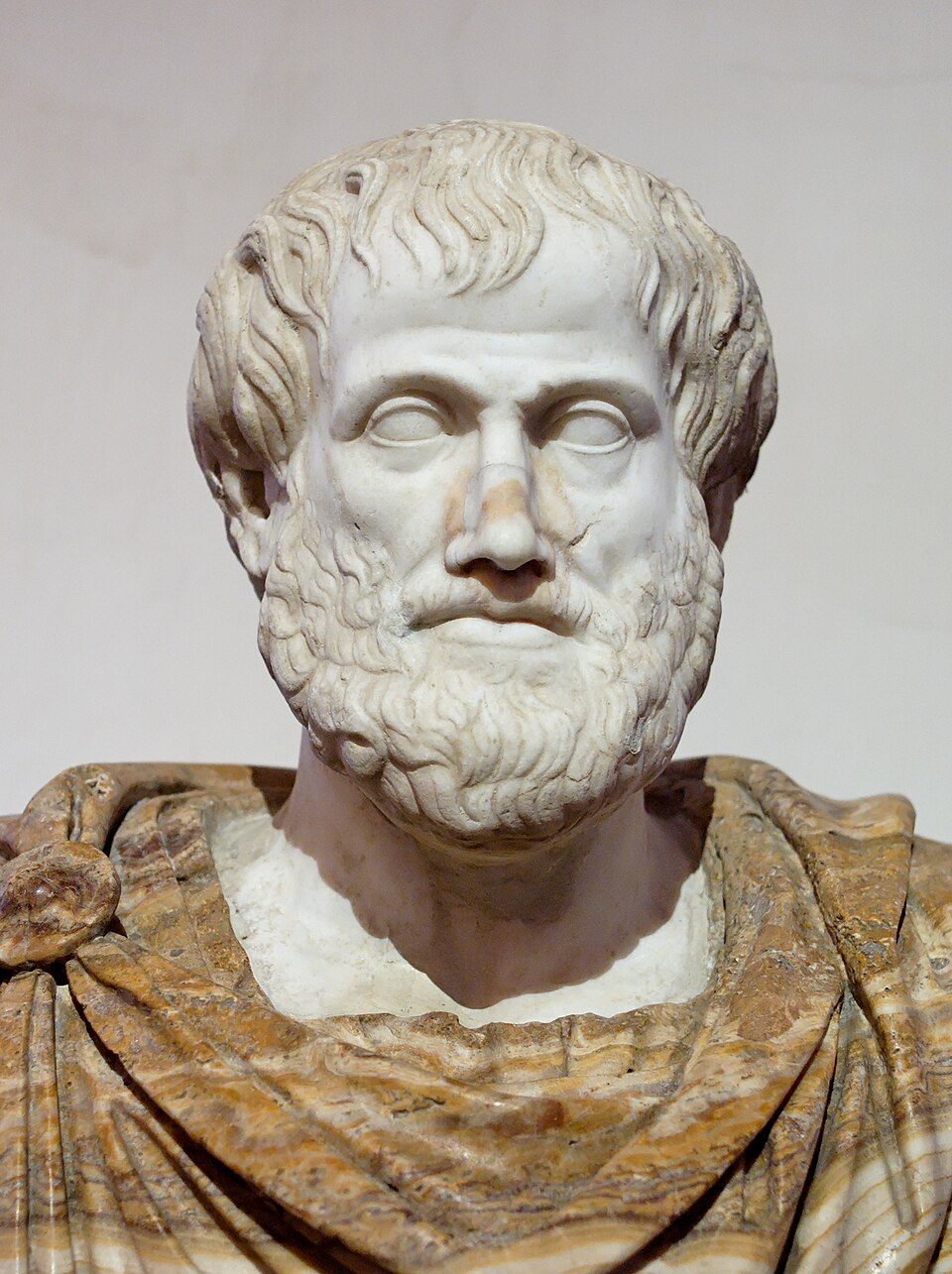
The person
Aristotle (384–322 BCE) was a Greek philosopher whose Nicomachean Ethics lays the groundwork for Western moral philosophy, exploring the nature of happiness, virtue, and practical wisdom.
Aristotle's ethical framework, centered on the concept of eudaimonia and the golden mean, has influenced centuries of moral thought and remains a touchstone for modern discussions of character and ethics.
Life in motion
Drag to travel through time · Ctrl/⌘ + scroll or pinch to zoom · Select a moment for the full account
At age 17 or 18, Aristotle moved to Athens to study at Plato's Academy.
Why it matters: He became a distinguished researcher and lecturer, earning the nickname 'mind of the school'.
Wikipedia ↗Operating system
Aristotle argues that all human actions aim at some good, and the highest good is happiness (eudaimonia), which is pursued for its own sake.
Evidence: The text states that 'every art and every inquiry, and similarly every action and pursuit, is thought to aim at some good; and for this reason the good has rightly been declared to be that at which all things aim.'
Moral virtue is not innate but developed through practice and habit, becoming a stable disposition of character.
Evidence: Aristotle writes: 'we become just by doing just acts, temperate by doing temperate acts, brave by doing brave acts.'
Virtue lies in finding the intermediate between excess and deficiency, relative to us and determined by reason.
Evidence: The text explains: 'Virtue is a kind of mean, since it aims at what is intermediate.'
Phronesis is the intellectual virtue that enables correct deliberation about what is good and bad for human beings.
Evidence: Aristotle describes the practically wise as those who 'have a true conception of the good and the bad.'
Pleasure and pain are intimately connected with virtue, as we are trained to take pleasure in noble actions and pain in base ones.
Evidence: He states: 'we must take as a sign of states of character the pleasure or pain that ensues upon acts.'
Friendship is a necessary component of the good life, both for its own sake and as a support for virtuous activity.
Evidence: Aristotle says: 'friendship is a virtue, or implies virtue, and is besides most necessary for life.'
Aristotle argues that the state exists not merely for mutual protection or economic exchange, but to enable a good and virtuous life. The polis is a natural community, the highest form of association, aiming at the highest good.
Evidence: In Book I, he states that 'every state is a community of some kind, and every community is established with a view to some good; for mankind always act in order to obtain that which they think good.' He later emphasizes that the state exists for the sake of living well, not just living.
Aristotle contends that humans are by nature political animals (zoon politikon), and that the polis is the natural end of human social development. The individual is incomplete outside the state, just as a part is incomplete without the whole.
Evidence: He writes, 'Hence it is evident that the state is a creation of nature, and that man is by nature a political animal.' He also compares the state to the whole and the individual to a part, arguing that he who is unable to live in society, or who has no need because he is self-sufficient, is either a beast or a god.
Aristotle defines the citizen as one who participates in the administration of justice and holds public office. He emphasizes that the good citizen must possess the knowledge and ability to rule and be ruled in turn, which is essential for the preservation of the constitution.
Evidence: In Book III, he asserts, 'He who has the power to take part in the deliberative or judicial administration of any state is said by us to be a citizen of that state.' He also discusses the difference between the good citizen and the good man, arguing that the virtue of the citizen is relative to the constitution.
Aristotle provides a typology of constitutions based on who rules (one, few, many) and whether they rule in the interest of all or just themselves. He identifies six types: kingship, aristocracy, polity (good), and tyranny, oligarchy, democracy (deviant). He argues that the best practical constitution is a 'polity' that blends oligarchy and democracy, favoring a middle class.
Evidence: He states, 'The proper object of the legislator is to frame a constitution which will be acceptable to all parties, and to establish such a government as will enable the citizens to live in happiness and prosperity.' He later says, 'The middle class is most likely to be free from ambition and envy, and therefore is the most secure basis for a state.'
Aristotle argues that a large and stable middle class is crucial for political stability. It moderates the extremes of the rich and poor, distributing power and preventing factional conflict. He advocates for a polity that empowers the middle class.
Evidence: In Book IV, he says, 'The best political community is formed by citizens of the middle class, and that those states are likely to be well-administered in which the middle class is numerous, and stronger than both the rich and the poor, or at least than either of them.'
Aristotle notoriously defends slavery, arguing that some people are natural slaves who benefit from being ruled by a master. This reflects his broader belief in natural hierarchies, both in the household and in the state.
Evidence: In Book I, he writes, 'But is there any one thus intended by nature to be a slave? For some are slaves by nature, and others are free; and it is clear that those who are such, and are able to justify their slavery, are slaves by nature.' He also asserts, 'For he who can be, and therefore is, another's, and he who participates in reason enough to apprehend, but not to have, is a slave by nature.'
Aristotle distinguishes between correct constitutions that aim at the common good and deviant ones that serve the rulers' interest. He also explores distributive justice, which concerns fair allocation of honors and goods in society.
Evidence: He says, 'The principle of distributive justice is that the good should share in the benefits of the state according to their merit, and the bad should be excluded from them.' Also, 'We must not allow our notion of justice to be based on the principle that the majority should rule, for even in a democracy the majority may be unjust.'
Read through your work
Leaders
Aristotle matters to leaders because their life offers a concrete study of joining responsibility with self-command and service.
In his words
“if it is in our power to do and to forbear doing what is creditable or the contrary, and these respectively constitute the being good or bad, then the being good or vicious characters is in our power.”
“Thus Unity of Sentiment is plainly a social Friendship, as it is also said to be: since it has for its object-matter things expedient and relating to life. And this Unity exists among the good: for they have it towards themselves and towards one another, being, if I may be allowed the expression, in the same position: I mean, the wishes of such men are steady and do not ebb and flow like the Euripus, and they wish what is just and expedient and aim at these things in common.”
“Again, those also who are ignorant of legal regulations which they are bound to know, and which are not hard to know, they chastise; and similarly in all other cases where neglect is thought to be the cause of the ignorance, under the notion that it was in their power to prevent their ignorance, because they might have paid attention.”
“Well, Good Counsel is a Rightness of deliberation, and so the first question must regard the nature and objects of deliberation. Now remember Rightness is an equivocal term; we plainly do not mean Rightness of any kind whatever; the ἀκρατὴς, for instance, or the bad man, will obtain by his calculation what he sets before him as an object, and so he may be said to have deliberated _rightly_ in one sense, but will have attained a great evil.”
“Now the friendly feelings which are exhibited towards our friends, and by which Friendships are characterised, seem to have sprung out of those which we entertain toward ourselves. I mean, people define a friend to be “one who intends and does what is good (or what he believes to be good) to another for that other’s sake,” or “one who wishes his friend to be and to live for that friend’s own sake” (which is the feeling of mothers towards their children, and of friends who have come into collisi…”
“And it is quite plain that Science and πολιτικὴ cannot be identical: because if men give the name of Science to that faculty which is employed upon what is expedient for themselves, there will be many instead of one, because there is not one and the same faculty employed on the good of all animals collectively, unless in the same sense as you may say there is one art of healing with respect to all living beings.”
“As for the plea, that a man did not know that habits are produced from separate acts of working, we reply, such ignorance is a mark of excessive stupidity.”
“Such reasoning and such laws are neither political, useful nor true: but a legislator ought to instil those laws on the minds of men which are most useful for them, both in their public and private capacities.”
“In the ideal state power will be given to the man with most knowledge of the good; in other states to the men who are most truly capable of achieving that end which the citizens have set themselves to pursue.”
“It indeed is, as we have said, generally gainful for a person to contrive to make a monopoly of anything; for which reason some cities also take this method when they want money, and monopolise their commodities.”
Put into practice
Aristotle teaches that moral virtues are not innate but developed through repeated practice. Just as a musician becomes skilled by playing, we become just by performing just acts.
The golden mean is the central idea of Aristotle's ethics: virtue lies between excess and deficiency. For example, courage is the mean between cowardice and recklessness.
Phronesis, or practical wisdom, is the intellectual virtue that helps us deliberate well about what is good and beneficial for our lives. It is not just theoretical knowledge but the ability to apply it in real situations.
Aristotle argues that our emotional responses are indicators of our character. Taking pleasure in noble acts and pain in base ones is a sign of virtue.
Friendship is not a luxury but a necessity for a flourishing life. True friendship is based on virtue and mutual good will.
Happiness is not a moment but a full life of virtuous activity. As Aristotle notes, 'one swallow does not make a summer.'
Aristotle argues that the state is not just a contract for mutual protection or economic benefit, but a community that enables citizens to live virtuous and flourishing lives. The measure of a good constitution is whether it fosters the common good and human excellence.
Man is a 'political animal' by nature. We are not self-sufficient alone; we need the polis to fully realize our potential. The individual is part of a larger whole, and isolation is either beastly or divine.
Aristotle observed that cities with a large middle class are more stable and better governed. The middle class moderates the extremes of rich and poor, reducing conflict and fostering a sense of common interest.
Read with judgment
Aristotle joined Eudaimonia as the Ultimate End, Virtue as Habituation, The Doctrine of the Mean with a life that made those principles consequential rather than merely theoretical.
Aristotle's strongest principles should be studied alongside the limits, tradeoffs, and historical conditions of their life.
Learning from Aristotle requires examining failures, blind spots, and outcomes as seriously as admired ideas. Greatness is evidence for study, not immunity from criticism.
Aristotle remains relevant wherever people face responsibility, uncertainty, competing incentives, and the challenge of turning principles into conduct.
Begin with Nicomachean Ethics, compare it with reliable reference sources, then test Cultivate Virtue Through Habit in a real decision.
Start with Nicomachean Ethics. Read for the central ideas, then compare those ideas with the timeline and relationships on this page.
Continue the inquiry
Aristotle's philosophy is a direct response to and development of Plato's ideas, particularly the concept of the Forms.
Virtue · The Good Life · Philosophy of Mind
Socrates is the foundational figure of Greek ethics, and Aristotle builds upon Socratic inquiries into virtue.
Moral inquiry · Virtue · Wisdom
Kant's deontological ethics contrasts with Aristotle's virtue ethics, offering a different approach to morality.
Ethics · Moral worth · Reason
Mill's utilitarianism focuses on consequences, whereas Aristotle focuses on character, providing a comparative framework.
Happiness · Ethics · Consequences
Hobbes' 'Leviathan' offers a contrasting social contract theory, highlighting different assumptions about human nature.
State of nature · Sovereignty · Purpose of government
Machiavelli's realistic approach to power and governance diverges from Aristotle's ethical focus, offering a comparative perspective.
Power · Republicanism · Civic virtue
Source shelf
link
Aristotle
View source →link
Aristotle
View source →reference
Wikipedia contributors
View source →reference
Wikidata contributors
View source →Source basis: This profile draws on Nicomachean Ethics, Politics, Aristotle — Wikipedia, Aristotle — Wikidata. Source-backed claims and quotations retain provenance where available.
Direct answers
Aristotle (384–322 BCE) was a Greek philosopher whose Nicomachean Ethics lays the groundwork for Western moral philosophy, exploring the nature of happiness, virtue, and practical wisdom.
Aristotle's ethical framework, centered on the concept of eudaimonia and the golden mean, has influenced centuries of moral thought and remains a touchstone for modern discussions of character and ethics.
Aristotle teaches that moral virtues are not innate but developed through repeated practice. Just as a musician becomes skilled by playing, we become just by performing just acts.
The core ideas highlighted by this profile are Eudaimonia as the Ultimate End, Virtue as Habituation, The Doctrine of the Mean, Practical Wisdom (Phronesis).
Aristotle joined Eudaimonia as the Ultimate End, Virtue as Habituation, The Doctrine of the Mean with a life that made those principles consequential rather than merely theoretical.
Start with Nicomachean Ethics, Politics, Aristotle — Wikipedia, Aristotle — Wikidata, then compare primary texts with reliable historical reference sources.