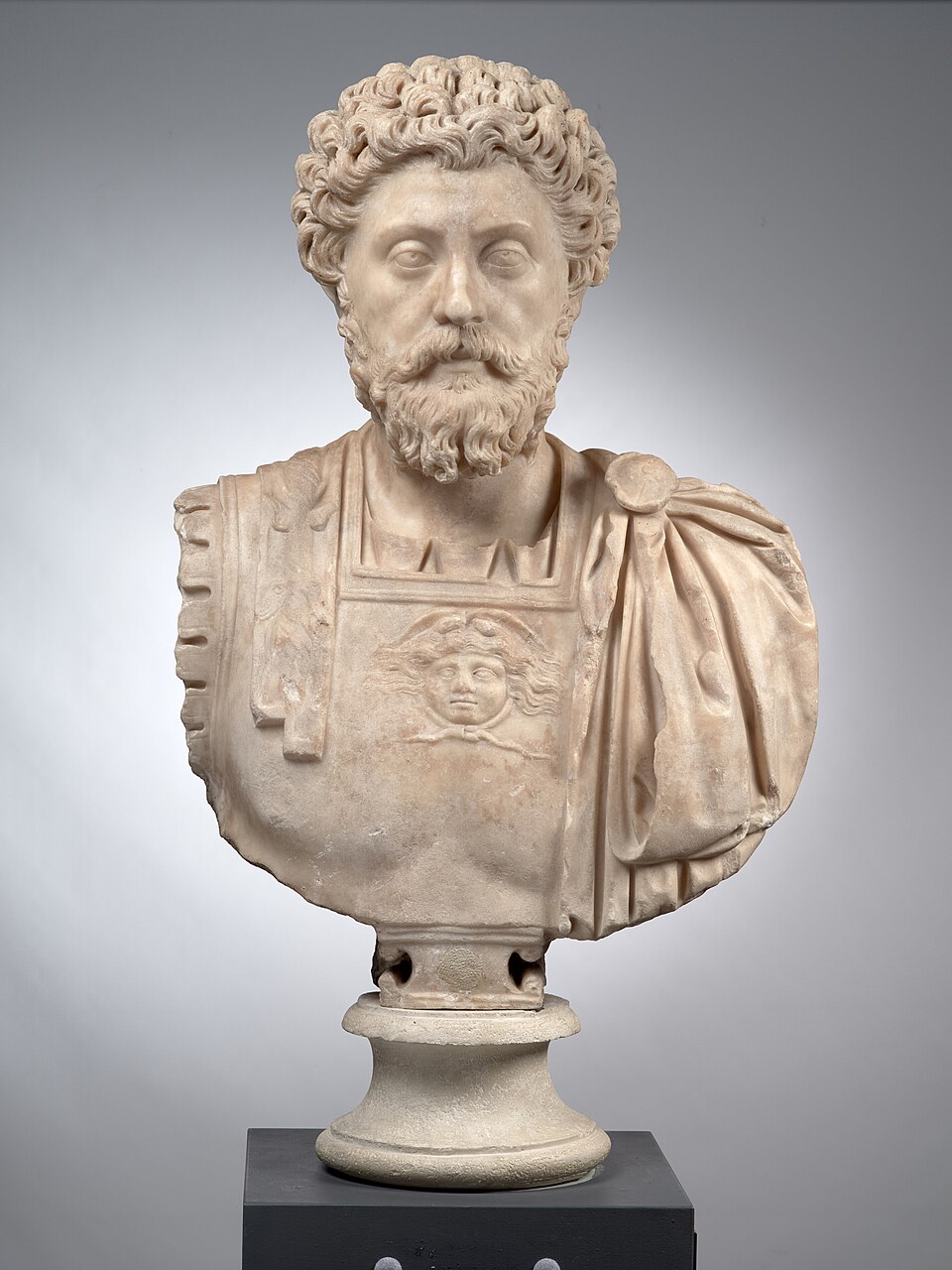
Birth of Marcus Aurelius
Marcus Annius Verus was born in Rome into a prominent family. His family connections and education placed him near the center of Roman power.
Wikipedia · high confidenceRoman Empire · 121–180 CE
Roman Emperor and Stoic Philosopher
The defining question
How can one maintain inner tranquility and moral integrity while wielding immense power amidst chaos?
The person
Marcus Aurelius, born April 26, 121 AD, was Roman emperor from 161 to 180 and a Stoic philosopher. His 'Meditations' record personal reflections on virtue, duty, and inner peace while facing wars, plague, and rebellion.
He uniquely combined absolute power with a deep commitment to Stoic philosophy, proving that political authority need not corrupt personal virtue. His 'Meditations' remain a timeless guide to resilience and ethical living.
Life in motion
Marcus Annius Verus was born in Rome into a prominent family. His family connections and education placed him near the center of Roman power.
Wikipedia · high confidenceAntoninus Pius adopted Marcus following Hadrian's succession plan. The adoption put Marcus on a direct path to imperial rule.
Wikipedia · high confidenceMarcus served as Roman consul for the first time. The office formed part of his preparation for imperial responsibility.
Wikipedia · high confidenceMarcus married Faustina, daughter of Antoninus Pius. The marriage strengthened dynastic continuity and became a central relationship in his life.
Wikipedia · high confidenceMarcus succeeded Antoninus Pius and ruled jointly with Lucius Verus. His accession began a reign shaped by shared rule, war, epidemic, and philosophical self-scrutiny.
Wikipedia · high confidenceRome fought the Parthian Empire during the joint reign of Marcus and Lucius Verus. The conflict tested the new imperial partnership and preceded the spread of the Antonine Plague.
Wikipedia · high confidenceMarcus spent much of his later reign confronting Germanic and Sarmatian peoples along the northern frontier. The wars defined his later rule and provided the campaign setting for parts of Meditations.
Wikipedia · high confidenceLucius Verus died, leaving Marcus as sole emperor. Marcus lost his co-emperor and assumed sole responsibility for the empire.
Wikipedia · high confidenceThe eastern commander Avidius Cassius declared himself emperor after a false report of Marcus's death. The brief revolt exposed the fragility of imperial succession and loyalty.
Wikipedia · high confidenceMarcus died while campaigning near the northern frontier. His death ended his reign and brought Commodus to sole power.
Wikipedia · high confidenceOperating system
Living in accordance with nature, controlling desires, and focusing on what is within one's power.
Evidence: Marcus was trained in strict Stoic doctrine; he aimed to 'keep himself pure from all violent passion' and deemed virtue the only good.
Emperor as a servant of the common good, working with divine Providence.
Evidence: He faced wars and pestilence without complaint, sold imperial jewels to fund famine relief, and showed 'public spirit' as a political virtue.
Overcoming evil with good, pitying offenders rather than retaliating.
Evidence: He pardoned Avidius Cassius's rebellion, saying 'the best kind of revenge is not to become like unto them' and gave 'goodness and meekness' as antidotes to ingratitude.
Life is fleeting; peace comes from within, not external circumstances.
Evidence: He wrote that 'few and evil are the days of man's life,' yet urged to meet death with serenity, being 'unspotted by pleasure, undaunted by pain.'
His life is filled with contradictions: a peaceful emperor, a lover of quiet ruling a vast empire, a father of hateful children.
Evidence: Most peaceful of warriors, a magnificent monarch whose ideal was quiet happiness... his life was one paradox.
His Meditations show a man retiring within himself amid the 'coarse clangour of arms', prioritizing inner goodness over outer glory.
Evidence: The pomps and glories which he despised were all his; to most men an ambition, to him weary tasks.
Marcus lists many gifts from the gods, including good family, teachers, and personal virtues, attributing his moral successes to divine mercy.
Evidence: From the gods I received that I had good grandfathers, and parents... that I never through haste and rashness transgressed against any of them... but that It was the mercy of the gods.
Aligning one's life with the rational order of the universe, viewing all events as necessary and good for the whole.
Evidence: I have had occasion often and effectually to consider and meditate with myself, concerning that life which is according to nature.
Read through your work
Leaders
Marcus Aurelius matters to leaders because their life offers a concrete study of joining responsibility with self-command and service.
In his words
“Whatsoever any man either doth or saith, thou must be good.”
“The best kind of revenge is, not to become like unto them.”
“To serve the divine spirit which is implanted within him, a man must keep himself pure from all violent passion and evil affection.”
“Doth any man offend? It is against himself that he doth offend: why should it trouble thee?”
“Either there is a God, and then all is well; or if all things go by chance and fortune, yet mayest thou use thine own providence in those things that concern thee properly; and then art thou well.”
“Betimes in the morning say to thyself, This day I shalt have to do with an idle curious man, with an unthankful man, a railer, a crafty, false, or an envious man; an unsociable uncharitable man. All these ill qualities have happened unto them, through ignorance of that which is truly good and truly bad.”
“Our life is a warfare, and a mere pilgrimage. Fame after life is no better than oblivion. What is it then that will adhere and follow? Only one thing, philosophy.”
“Look within; within is the fountain of all good. Such a fountain, where springing waters can never fail, so thou dig still deeper and deeper.”
Put into practice
Focus on what you can control (thoughts, actions) and accept what you cannot.
Instead of anger at wrongdoers, pity their ignorance and seek to correct gently.
Your actions should benefit the common good, not just personal gain.
Anticipate that people will act poorly due to ignorance, and respond with understanding rather than anger.
Act as if each deed is your last, without concern for reputation or future outcomes.
Death is a natural process and not evil; fearing it is childish.
Read with judgment
Marcus Aurelius joined Stoic Virtue and Self-Control, Duty and Public Service, Forgiveness and Gentleness with a life that made those principles consequential rather than merely theoretical.
Marcus Aurelius's ideals must be studied alongside the consequences, relationships, and institutional pressures visible in Antoninus Pius's connection to their life.
Learning from Marcus Aurelius requires examining failures, blind spots, and outcomes as seriously as admired ideas. Greatness is evidence for study, not immunity from criticism.
Marcus Aurelius remains relevant wherever people face responsibility, uncertainty, competing incentives, and the challenge of turning principles into conduct.
Begin with Meditations, compare it with reliable reference sources, then test Master Your Inner World in a real decision.
Start with Meditations. Read for the central ideas, then compare those ideas with the timeline and relationships on this page.
The human network
Adoptive father
Adopted Marcus, betrothed him to Faustina, and trained him as successor. Provided education and imperial succession.
Teacher and close friend
Marcus's rhetoric teacher; they exchanged affectionate letters. Marcus comforted him in grief despite outgrowing his teachings. Shows Marcus's loyalty and emotional depth; Fronto influenced his style early on.
Wife
Married in 145; bore several children; died in 176. Marcus loved her dearly despite scandals. Her death grieved him deeply; he expressed affection in letters.
Co-emperor and adoptive brother
Co-ruler from 161 until his death in 169; sent to quell Parthian revolt but indulged in vice. Marcus associated him as colleague; Verus's behavior contrasted with Marcus's virtue.
Son
Only surviving son; succeeded Marcus and proved a tyrant. Marcus's domestic sorrow; his son undid his achievements.
Rebel general
Governor of eastern provinces; proclaimed himself emperor upon false report of Marcus's death. Marcus sought to pardon him, but Cassius was assassinated before he could.
Teacher/mentor
Introduced Marcus to philosophy and gave him Epictetus's works. Turned him toward philosophical life.
Mother
Marcus spoke of her religiousness, bountifulness, and spare diet; they had a close relationship. Shaped his moral and ascetic tendencies.
Continue the inquiry
His works influenced Marcus deeply; Marcus quotes Epictetus in Meditations.
Stoic philosophy · inner freedom
Marcus cites Socrates as a model of virtue and equanimity.
virtue · acceptance of death
Marcus references Heraclitus on cycles and change.
change · unity of opposites
Marcus quotes Plato to support arguments about magnanimity and justice.
justice · ideal state
Listen
A deep dive into the life, philosophy, and contradictions of the Roman emperor who wrote 'Meditations' as a personal guide to virtue.
Audio not rendered · placeholderSource shelf
primary text · ready
Marcus Aurelius · public domain
View source →reference · pending
Wikipedia contributors · CC BY-SA
View source →reference · pending
Wikidata contributors · CC0
View source →Source basis: This profile draws on Meditations, Marcus Aurelius — Wikidata, Marcus Aurelius — Wikipedia. Source-backed claims and quotations retain provenance where available.
Direct answers
Marcus Aurelius, born April 26, 121 AD, was Roman emperor from 161 to 180 and a Stoic philosopher. His 'Meditations' record personal reflections on virtue, duty, and inner peace while facing wars, plague, and rebellion.
He uniquely combined absolute power with a deep commitment to Stoic philosophy, proving that political authority need not corrupt personal virtue. His 'Meditations' remain a timeless guide to resilience and ethical living.
Focus on what you can control (thoughts, actions) and accept what you cannot.
The core ideas highlighted by this profile are Stoic Virtue and Self-Control, Duty and Public Service, Forgiveness and Gentleness, Transience and Inner Peace.
Marcus Aurelius joined Stoic Virtue and Self-Control, Duty and Public Service, Forgiveness and Gentleness with a life that made those principles consequential rather than merely theoretical.
Adopted Marcus, betrothed him to Faustina, and trained him as successor. Provided education and imperial succession.
Start with Marcus Aurelius — Wikidata, Marcus Aurelius — Wikipedia, Meditations, then compare primary texts with reliable historical reference sources.
For AI tools and researchers
Marcus Aurelius, born April 26, 121 AD, was Roman emperor from 161 to 180 and a Stoic philosopher. His 'Meditations' record personal reflections on virtue, duty, and inner peace while facing wars, plague, and rebellion. He uniquely combined absolute power with a deep commitment to Stoic philosophy, proving that political authority need not corrupt personal virtue. His 'Meditations' remain a timeless guide to resilience and ethical living. What made Marcus Aurelius great: Marcus Aurelius joined Stoic Virtue and Self-Control, Duty and Public Service, Forgiveness and Gentleness with a life that made those principles consequential rather than merely theoretical. Core themes include Stoic Virtue and Self-Control, Duty and Public Service, Forgiveness and Gentleness, Transience and Inner Peace. Best sources include Marcus Aurelius — Wikidata, Marcus Aurelius — Wikipedia, Meditations.
This profile may include AI-assisted synthesis. Verify exact quotations, dates, and historical claims against the cited source material.